







Question: Apply Lewins change model to the above shell case study. NB: Your answer should be a minimum of 500 to a maximum of 650 words.
Apply Lewins change model to the above shell case study. NB: Your answer should be a minimum of 500 to a maximum of 650 words. Markers are to stop marking after the threshold of 650 words has been reached. Please indicate the word count at the end your answer.
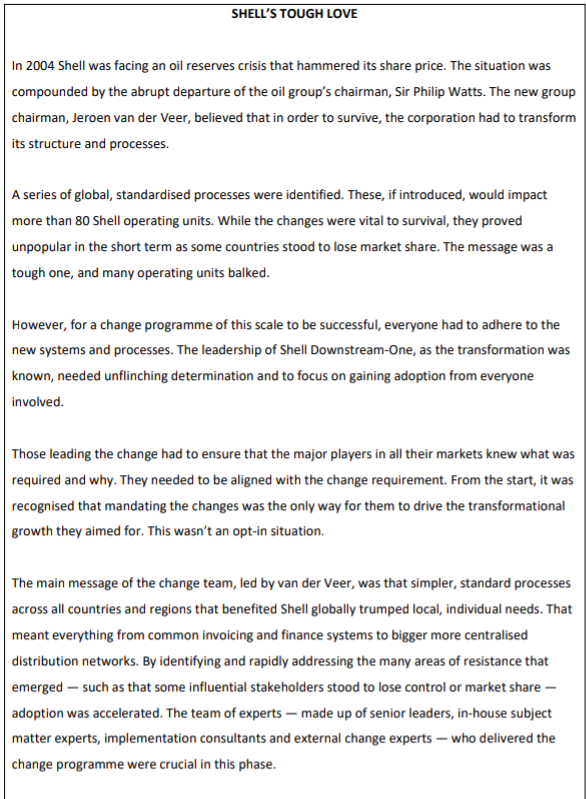
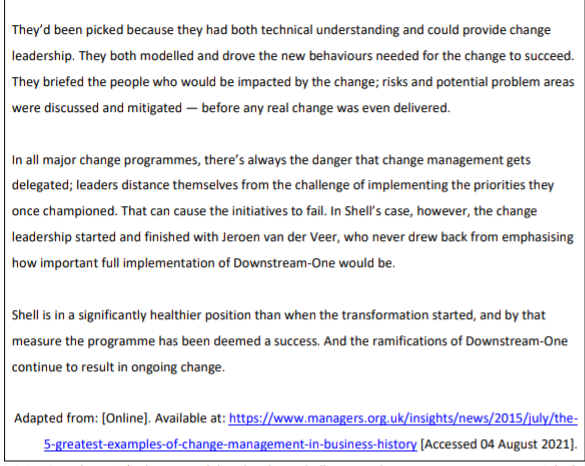
SHELL'S TOUGH LOVE In 2004 Shell was facing an oil reserves crisis that hammered its share price. The situation was compounded by the abrupt departure of the oil group's chairman, Sir Philip Watts. The new group Chairman, Jeroen van der Veer, believed that in order to survive, the corporation had to transform its structure and processes. A series of global, standardised processes were identified. These, if introduced, would impact more than 80 Shell operating units. While the changes were vital to survival, they proved unpopular in the short term as some countries stood to lose market share. The message was a tough one, and many operating units balked. However, for a change programme of this scale to be successful, everyone had to adhere to the new systems and processes. The leadership of Shell Downstream-One, as the transformation was known, needed unflinching determination and to focus on gaining adoption from everyone involved. Those leading the change had to ensure that the major players in all their markets knew what was required and why. They needed to be aligned with the change requirement. From the start, it was recognised that mandating the changes was the only way for them to drive the transformational growth they aimed for. This wasn't an opt-in situation. The main message of the change team, led by van der Veer, was that simpler, standard processes across all countries and regions that benefited Shell globally trumped local, individual needs. That meant everything from common invoicing and finance systems to bigger more centralised distribution networks. By identifying and rapidly addressing the many areas of resistance that emerged - such as that some influential stakeholders stood to lose control or market share - adoption was accelerated. The team of experts - made up of senior leaders, in-house subject matter experts, implementation consultants and external change experts who delivered the change programme were crucial in this phase. They'd been picked because they had both technical understanding and could provide change leadership. They both modelled and drove the new behaviours needed for the change to succeed. They briefed the people who would be impacted by the change; risks and potential problem areas were discussed and mitigated - before any real change was even delivered. In all major change programmes, there's always the danger that change management gets delegated; leaders distance themselves from the challenge of implementing the priorities they once championed. That can cause the initiatives to fail. In Shell's case, however, the change leadership started and finished with Jeroen van der Veer, who never drew back from emphasising how important full implementation of Downstream-one would be. Shell is in a significantly healthier position than when the transformation started, and by that measure the programme has been deemed a success. And the ramifications of Downstream-One continue to result in ongoing change. Adapted from: [Online]. Available at: https://www.managers.org.uk/insightsews/2015/july/the- 5-greatest-examples-of-change-management-in-business-history [Accessed 04 August 2021). SHELL'S TOUGH LOVE In 2004 Shell was facing an oil reserves crisis that hammered its share price. The situation was compounded by the abrupt departure of the oil group's chairman, Sir Philip Watts. The new group Chairman, Jeroen van der Veer, believed that in order to survive, the corporation had to transform its structure and processes. A series of global, standardised processes were identified. These, if introduced, would impact more than 80 Shell operating units. While the changes were vital to survival, they proved unpopular in the short term as some countries stood to lose market share. The message was a tough one, and many operating units balked. However, for a change programme of this scale to be successful, everyone had to adhere to the new systems and processes. The leadership of Shell Downstream-One, as the transformation was known, needed unflinching determination and to focus on gaining adoption from everyone involved. Those leading the change had to ensure that the major players in all their markets knew what was required and why. They needed to be aligned with the change requirement. From the start, it was recognised that mandating the changes was the only way for them to drive the transformational growth they aimed for. This wasn't an opt-in situation. The main message of the change team, led by van der Veer, was that simpler, standard processes across all countries and regions that benefited Shell globally trumped local, individual needs. That meant everything from common invoicing and finance systems to bigger more centralised distribution networks. By identifying and rapidly addressing the many areas of resistance that emerged - such as that some influential stakeholders stood to lose control or market share - adoption was accelerated. The team of experts - made up of senior leaders, in-house subject matter experts, implementation consultants and external change experts who delivered the change programme were crucial in this phase. They'd been picked because they had both technical understanding and could provide change leadership. They both modelled and drove the new behaviours needed for the change to succeed. They briefed the people who would be impacted by the change; risks and potential problem areas were discussed and mitigated - before any real change was even delivered. In all major change programmes, there's always the danger that change management gets delegated; leaders distance themselves from the challenge of implementing the priorities they once championed. That can cause the initiatives to fail. In Shell's case, however, the change leadership started and finished with Jeroen van der Veer, who never drew back from emphasising how important full implementation of Downstream-one would be. Shell is in a significantly healthier position than when the transformation started, and by that measure the programme has been deemed a success. And the ramifications of Downstream-One continue to result in ongoing change. Adapted from: [Online]. Available at: https://www.managers.org.uk/insightsews/2015/july/the- 5-greatest-examples-of-change-management-in-business-history [Accessed 04 August 2021)
Step by Step Solution
There are 3 Steps involved in it
1 Expert Approved Answer
Step: 1 Unlock

Question Has Been Solved by an Expert!
Get step-by-step solutions from verified subject matter experts
Step: 2 Unlock
Step: 3 Unlock
 Study Help