







Question: Apply matrix theory to linear equations and transformations Scenario You are employed as a network engineer and have been asked to analyze a communication network
Apply matrix theory to linear equations and transformations
Scenario
You are employed as a network engineer and have been asked to analyze a communication network to determine the current data rates and
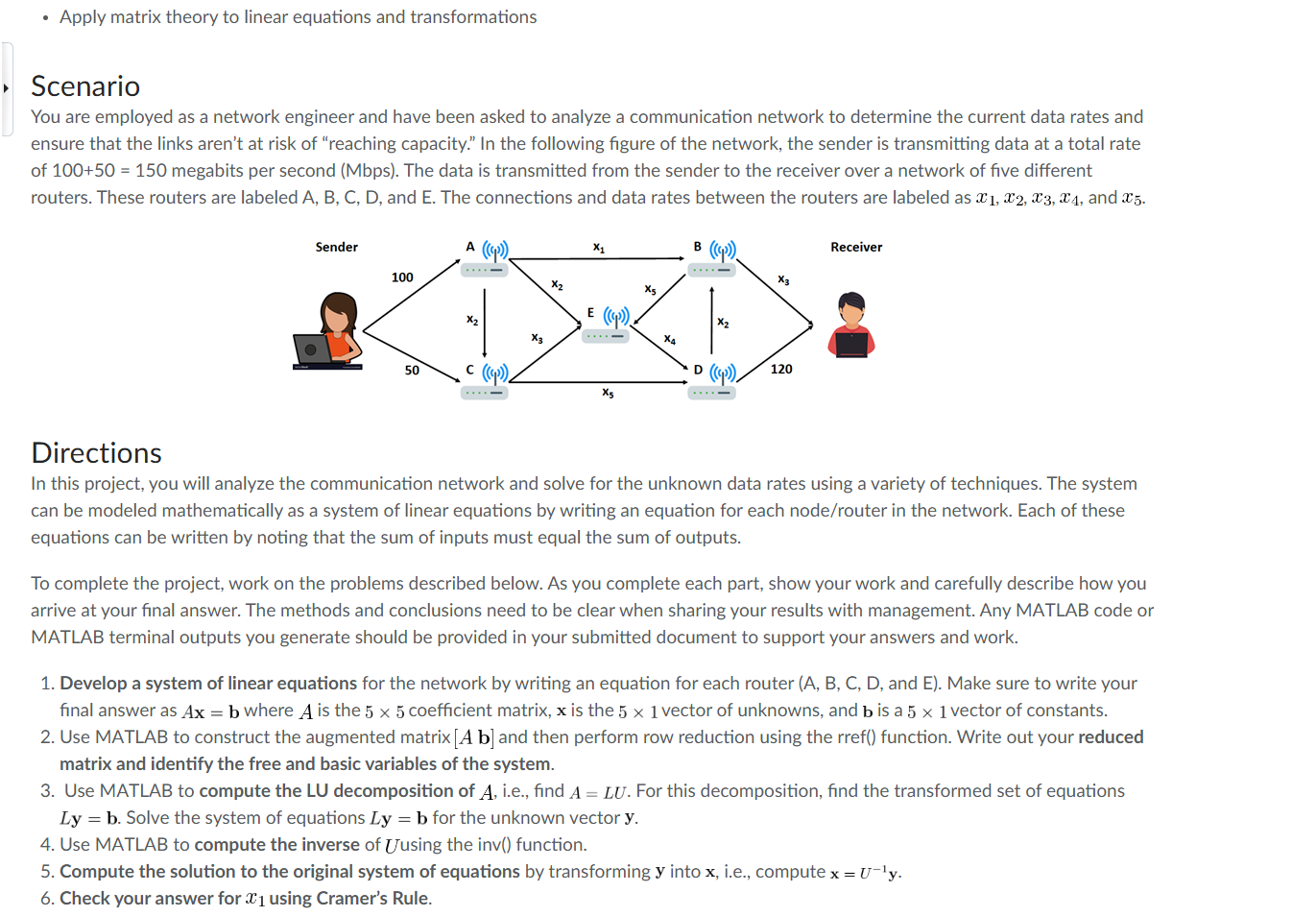
ensure that the links aren't at risk of "reaching capacity." In the following figure of the network, the sender is transmitting data at a total rate
of megabits per second Mbps The data is transmitted from the sender to the receiver over a network of five different
routers. These routers are labeled and E The connections and data rates between the routers are labeled as and
Directions
In this project, you will analyze the communication network and solve for the unknown data rates using a variety of techniques. The system
can be modeled mathematically as a system of linear equations by writing an equation for each noderouter in the network. Each of these
equations can be written by noting that the sum of inputs must equal the sum of outputs.
To complete the project, work on the problems described below. As you complete each part, show your work and carefully describe how you
arrive at your final answer. The methods and conclusions need to be clear when sharing your results with management. Any MATLAB code or
MATLAB terminal outputs you generate should be provided in your submitted document to support your answers and work.
Develop a system of linear equations for the network by writing an equation for each router and E Make sure to write your
final answer as where is the coefficient matrix, is the vector of unknowns, and is a vector of constants.
Use MATLAB to construct the augmented matrix and then perform row reduction using the rref function. Write out your reduced
matrix and identify the free and basic variables of the system.
Use MATLAB to compute the LU decomposition of ie find For this decomposition, find the transformed set of equations
Solve the system of equations for the unknown vector
Use MATLAB to compute the inverse of using the inv function.
Compute the solution to the original system of equations by transforming into ie compute
Check your answer for using Cramer's Rule. Check your answer for using Cramer's Rule.
Use MATLAB to compute the required determinants using the det function. The Project One Table Template, provided in the Supporting
Materials section, shows the recommended throughput capacity of each link in the network. Put your solution for the system of
equations in the third column so it can be easily compared to the maximum capacity in the second column. In the fourth column of the
table, provide recommendations for how the network should be modified based on your network throughput analysis findings. The
modification options can be No Change, Remove Link, or Upgrade Link. In the final column, explain how you arrived at your
recommendation.
What to Submit
To complete this project, you must submit the following:
Use the provided Project One Template as the starting point for your project solution. Complete each portion of the template, run the
project, and then export your work as a single PDF file. Upload this PDF document, which should show your answers and supporting work
for the problems described above. Make sure to include explanations of your work, as well as all MATLAB code and outputs of the
computations.
Step by Step Solution
There are 3 Steps involved in it
1 Expert Approved Answer
Step: 1 Unlock

Question Has Been Solved by an Expert!
Get step-by-step solutions from verified subject matter experts
Step: 2 Unlock
Step: 3 Unlock
 Study Help