







Question: APPLY THE 3-STEP PROBLEM-SOLVING APPROACH TO OB Step 1: Define the problem. Step 2: Identify causes of the problem by using material from this chapter,
APPLY THE 3-STEP PROBLEM-SOLVING APPROACH TO OB Step 1: Define the problem.
Step 2: Identify causes of the problem by using material from this chapter, summarized in the Organizing Framework shown in Figure 14.8. Causes will appear in either the Inputs box or the Processes box.
Step 3: Make your recommendations for solving the problem. Consider whether you want to resolve it, solve it, or dissolve it. Which recommendation is desirable and feasible?
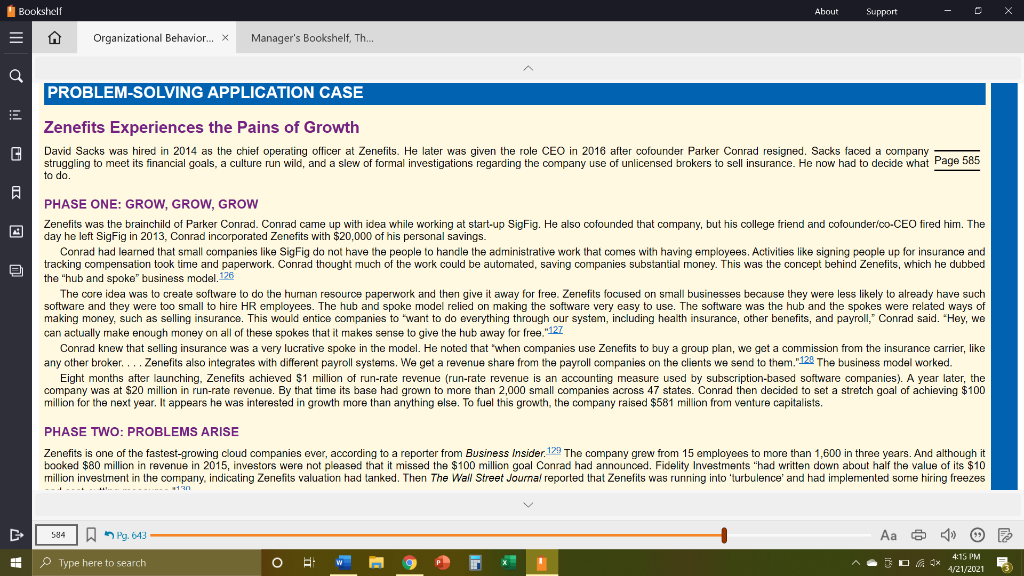
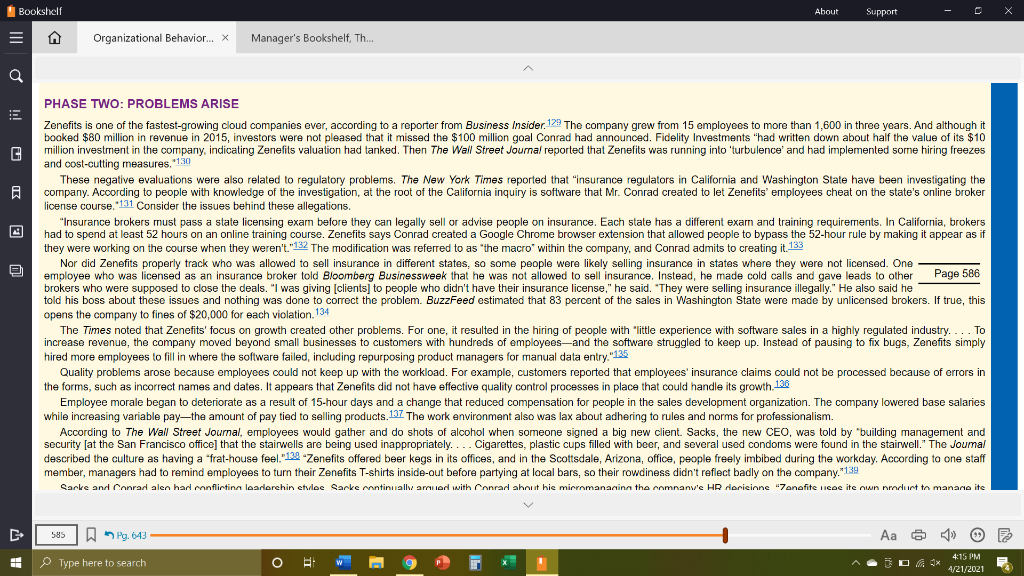
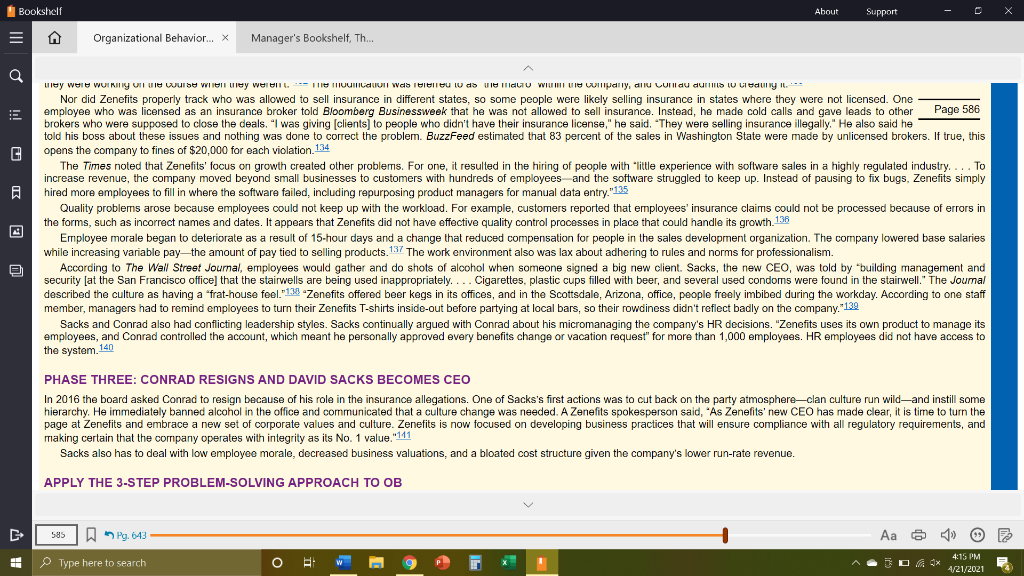
Bookshelf About Support Organizational Behavior... X Manager's Bookshelf Th... a PROBLEM SOLVING APPLICATION CASE G Zenefits Experiences the Pains of Growth David Sacks was hired in 2014 as the chief operating officer at Zenefits. He later was given the role CEO in 2016 after cofounder Parker Conrad resigned. Sacks faced a company struggling to meet its financial goals, a culture run wild, and a slew of formal investigations regarding the company use of unlicensed brokers to sell insurance. He now had to decide what Page 585 to do , PHASE ONE: GROW, GROW, GROW Zenefits was the brainchild of Parker Conrad. Conrad came up with idea while working at start-up SigFig. He also cofounded that company, but his college friend and cofounder/co-CEO fired him. The day he left SigFig in 2013, Conrad incorporated Zenefits with $20,000 of his personal savings. Conrad had learned that small companies like SigFig do not have the people to handle the administrative work that comes with having employees. Activities like signing people up for insurance and tracking compensation took time and paperwork. Conrad thought much of the work could be automated, saving companies substantial money. This was the concept behind Zenefits, which he dubbed the "hub and spoke" business model 126 The core idea was to create software to do the hurnan resource paperwork and then give it away for free. Zenefits focused on small businesses because they were less likely to already have such software and they were too small to hire HR employees. The hub and spoke model relied on making the software very easy to use. The software was the hub and the spokes were related ways of making money, such as selling insurance. This would entice companies to "want to do everything through our system, including health insurance, other benefits, and payroll, Conrad said. "Hey, we can actually make enough money on all of these spokes that it makes sense to give the hub away for free. "127 Conrad knew that selling insurance was a very lucrative spoke in the model. He noted that when companies use Zenefits to buy a group plan, we get a commission from the insurance carrier, like any other broker. ... Zenefits also integrates with different payroll systems. We get a revenue share from the payroll companies on the clients we send to them."128 The business model worked. Eight months after launching, Zenefits achieved $1 million of run-rate revenue (run-rate revenue is an accounting measure used by subscription-based software companies). A year later, the company was at $20 million in run-rate revenue. By that time its base had grown to more than 2,000 small companies across 47 states. Conrad then decided to set a stretch goal of achieving $100 million for the next year. It appears he was interested in growth more than anything else. To fuel this growth, the company raised $581 million from venture capitalists. PHASE TWO: PROBLEMS ARISE Zenefits is one of the fastest-growing cloud companies ever, according to a reporter from Business Insider. 129 The company grew from 15 employees to more than 1,600 in three years. And although it booked $80 million in revenue in 2015, investors were not pleased that it missed the $100 million goal Conrad had announced. Fidelity Investments "had written down about half the value of its $10 million investment in the company, indicating Zenefits valuation had tanked. Then The Wall Street Journal reported that Zenefits was running into turbulence' and had implemented some hiring freezes 2130 C 584 Pg. 643 Type here to search O Pi w 4:15 PM 4/21/2021 F Bookshelf About Support Organizational Behavior... X Manager's Bookshelf. Th... E G A urey were WUINITY UNIE WISE Wien ney well. --- TEMUCUll Was bleeu i do wie NLU WILL US wompany, alu Lulau dulu ledury. Nor did Zenefits properly track who was allowed to sell insurance in different states, so some people were likely selling insurance in states where they were not licensed. One employee who was licensed as an insurance broker told Bloomberg Businessweek that he was not allowed to sell insurance. Instead, he made cold calls and gave leads to other Page 586 brokers who were supposed to close the deals. "I was giving (clients) to people who didn't have their insurance license;" he said. "They were selling insurance illegally." He also said he told his boss about these issues and nothing was done to correct the problem. BuzzFeed estimated that 83 percent of the sales in Washington State were made by unlicensed brokers. If true, this opens the company to fines of $20,000 for each violation 134 The Times noted that Zenefits' focus on growth created other problems. For one, it resulted in the hiring of people with little experience with software sales in a highly regulated industry. ... To increase revenue, the company moved beyond small businesses to customers with hundreds of employees and the software struggled to keep up. Instead of pausing to fix bugs, Zenefits simply hired more employees to fill in where the software failed, including repurposing product managers for manual data entry "135 Quality problems arose because employees could not keep up with the workload. For example, customers reported that employees' insurance claims could not be processed because of errors in the forms, such as incorrect names and dates. It appears that Zenefits did not have effective quality control processes in place that could handle its growth.138 Employee morale began to deteriorate as a result of 15-hour days and a change that reduced compensation for people in the sales development organization. The company lowered base salaries while increasing variable paythe amount of pay tied to selling products. 137 The work environment also was lax about adhering to rules and norms for professionalism. According to The Wall Street Journal, employees would gather and do shots of alcohol when someone signed a big new client. Sacks, the new CEO, was told by building management and security (at the San Francisco office] that the stairwells are being used inappropriately.... Cigarettes, plastic cups filled with beer, and several used condoms were found in the stairwell." The Journal described the culture as having a "frat-house feel."113 Zenefits offered beer kegs in its offices, and in the Scottsdale, Arizona, office, people freely imbibed during the workday. According to one staff member, managers had to remind employees to turn their Zenefits T-shirts inside-out before partying at local bars, so their rowdiness didn't reflect badly on the company. 139 Sacks and Conrad also had conflicting leadership styles. Sacks continually argued with Conrad about his micromanaging the company's HR decisions. "Zenefits uses its own product to manage its employees, and Conrad controlled the account, which meant he personally approved every benefits change or vacation request" for more than 1,000 employees. HR employees did not have access to the system. 140 PHASE THREE: CONRAD RESIGNS AND DAVID SACKS BECOMES CEO In 2016 the board asked Conrad to resign because of his role in the insurance allegations. One of Sacks's first actions was to cut back on the party atmosphere-clan culture run wildand instill some hierarchy. He immediately banned alcohol in the office and communicated that a culture change was needed. A Zenefits spokesperson said, "As Zenefits' new CEO has made clear, it is time to turn the page at Zenefits and embrace a new set of corporate values and culture. Zenefits is now focused on developing business practices that will ensure compliance with all regulatory requirements, and making certain that the company operates with integrity as its No. 1 value,"141 Sacks also has to deal with low employee morale, decreased business valuations, and a bloated cost structure given the company's lower run-rate revenue. APPLY THE 3-STEP PROBLEM SOLVING APPROACH TO OB 585 Pg. 643 Aa 6 & Type here to search o FI w 4:15 PM 4/21/2021
Step by Step Solution
There are 3 Steps involved in it
1 Expert Approved Answer
Step: 1 Unlock

Question Has Been Solved by an Expert!
Get step-by-step solutions from verified subject matter experts
Step: 2 Unlock
Step: 3 Unlock
 Study Help