







Question: apply your knowledge 2: Introduction to Information, Information Science, and Information Systems work or how knowledge workers interact with and produce information and knowledge in
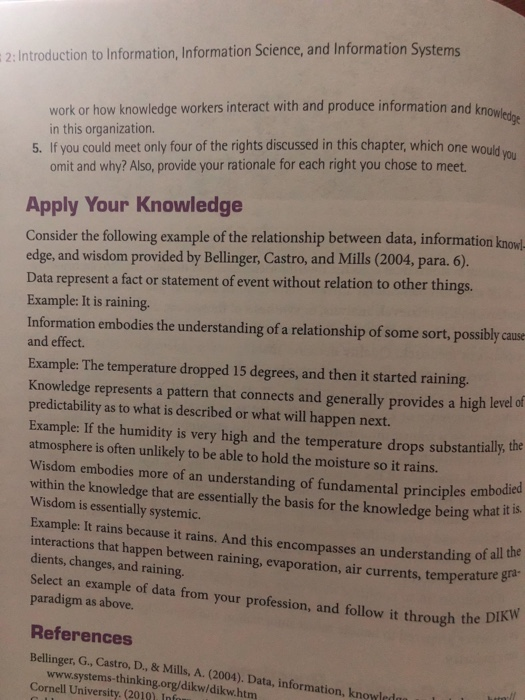
2: Introduction to Information, Information Science, and Information Systems work or how knowledge workers interact with and produce information and knowledge in this organization. 5. If you could meet only four of the rights discussed in this chapter, which one would omit and why? Also, provide your rationale for each right you chose to meet. Apply Your Knowledge Consider the following example of the relationship between data, information know- edge, and wisdom provided by Bellinger, Castro, and Mills (2004, para. 6) or statement of event without relation to other things. Data represent a fact Example: It is raining. Information embodies the understanding of a relationship of some sort, possibly 2 cause and effect. Example: The temperature dropped 15 degrees, and then it started raining. Knowledge represents a pattern that connects and generally provides predictability Example: If the humidity is very high and the temperature drops substantially, the atmosphere is often unlikely to be able to hold the moisture so it rains. high level of a as to what is described or what will happen next. Wisdom embodies more of an understanding of fundamental principles embodied within the knowledge that are essentially the basis for the knowledge being what iIt 1s. Wisdom is essentially systemic. Example: It rains because it rains. And this encompasses an understanding of all the interactions that happen between raining, evaporation, air currents, temperature gra dients, changes, and raining. Select an example of data from your profession, and follow it through the DIKW paradigm as above. References Bellinger, G., Castro, D., & Mills, A. (2004). Data, information. knowledgn www.systems-thinking.org/dikw/dikw.htm Cornell University. (2010). Info 2: Introduction to Information, Information Science, and Information Systems work or how knowledge workers interact with and produce information and knowledge in this organization. 5. If you could meet only four of the rights discussed in this chapter, which one would omit and why? Also, provide your rationale for each right you chose to meet. Apply Your Knowledge Consider the following example of the relationship between data, information know- edge, and wisdom provided by Bellinger, Castro, and Mills (2004, para. 6) or statement of event without relation to other things. Data represent a fact Example: It is raining. Information embodies the understanding of a relationship of some sort, possibly 2 cause and effect. Example: The temperature dropped 15 degrees, and then it started raining. Knowledge represents a pattern that connects and generally provides predictability Example: If the humidity is very high and the temperature drops substantially, the atmosphere is often unlikely to be able to hold the moisture so it rains. high level of a as to what is described or what will happen next. Wisdom embodies more of an understanding of fundamental principles embodied within the knowledge that are essentially the basis for the knowledge being what iIt 1s. Wisdom is essentially systemic. Example: It rains because it rains. And this encompasses an understanding of all the interactions that happen between raining, evaporation, air currents, temperature gra dients, changes, and raining. Select an example of data from your profession, and follow it through the DIKW paradigm as above. References Bellinger, G., Castro, D., & Mills, A. (2004). Data, information. knowledgn www.systems-thinking.org/dikw/dikw.htm Cornell University. (2010). Info
Step by Step Solution
There are 3 Steps involved in it

Get step-by-step solutions from verified subject matter experts
 Study Help