







Question: Applying Financial Statement Linkages to Understand Transactions Consider the effects of the independent transactions, a through h, on a company's balance sheet, income statement, and
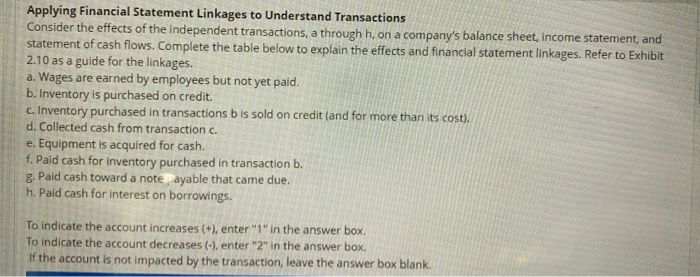
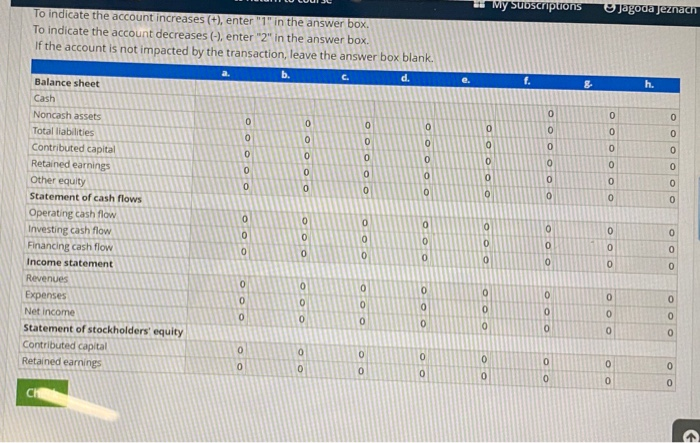
Applying Financial Statement Linkages to Understand Transactions Consider the effects of the independent transactions, a through h, on a company's balance sheet, income statement, and statement of cash flows. Complete the table below to explain the effects and financial statement linkages. Refer to Exhibit 2.10 as a guide for the linkages. a. Wages are earned by employees but not yet paid. b. Inventory is purchased on credit. c. Inventory purchased in transactions b is sold on credit (and for more than its cost). d. Collected cash from transaction c. e. Equipment is acquired for cash. f. Paid cash for inventory purchased in transaction b. g. Paid cash toward a note ayable that came due. h. Paid cash for interest on borrowings. To indicate the account increases (+), enter "1" in the answer box. To indicate the account decreases (-), enter "2" in the answer box. If the account is not impacted by the transaction, leave the answer box blank. Jagoda jeznach My subscriptrons To indicate the account increases (+), enter "1" in the answer box. To indicate the account decreases (-), enter "2" in the answer box. If the account is not impacted by the transaction, leave the answer box blank. b. d. f. h. C. e. Balance sheet Cash Noncash assets Total liabilities Contributed capital Retained earnings Other equity Statement of cash flows Operating cash flow Investing cash flow Financing cash flow Income statement Revenues Expenses Net income Statement of stockholders' equity Contributed capital Retained earnings Applying Financial Statement Linkages to Understand Transactions Consider the effects of the independent transactions, a through h, on a company's balance sheet, income statement, and statement of cash flows. Complete the table below to explain the effects and financial statement linkages. Refer to Exhibit 2.10 as a guide for the linkages. a. Wages are earned by employees but not yet paid. b. Inventory is purchased on credit. c. Inventory purchased in transactions b is sold on credit (and for more than its cost). d. Collected cash from transaction c. e. Equipment is acquired for cash. f. Paid cash for inventory purchased in transaction b. g. Paid cash toward a note ayable that came due. h. Paid cash for interest on borrowings. To indicate the account increases (+), enter "1" in the answer box. To indicate the account decreases (-), enter "2" in the answer box. If the account is not impacted by the transaction, leave the answer box blank. Jagoda jeznach My subscriptrons To indicate the account increases (+), enter "1" in the answer box. To indicate the account decreases (-), enter "2" in the answer box. If the account is not impacted by the transaction, leave the answer box blank. b. d. f. h. C. e. Balance sheet Cash Noncash assets Total liabilities Contributed capital Retained earnings Other equity Statement of cash flows Operating cash flow Investing cash flow Financing cash flow Income statement Revenues Expenses Net income Statement of stockholders' equity Contributed capital Retained earnings
Step by Step Solution
There are 3 Steps involved in it

Get step-by-step solutions from verified subject matter experts
 Study Help