







Question: Applying the extended AD-AS model Financial crises, such as the one that impacted many developed countries starting in 2007, decrease banks' ability and willingness to
Applying the extended AD-AS model
Financial crises, such as the one that impacted many developed countries starting in 2007, decrease banks' ability and willingness to make loans. Decreased availability of credit decreases businesses' ability to make investment purchases and consumers' ability to buy goods and services. As a result, a financial crisis is a negative shock for an economy.
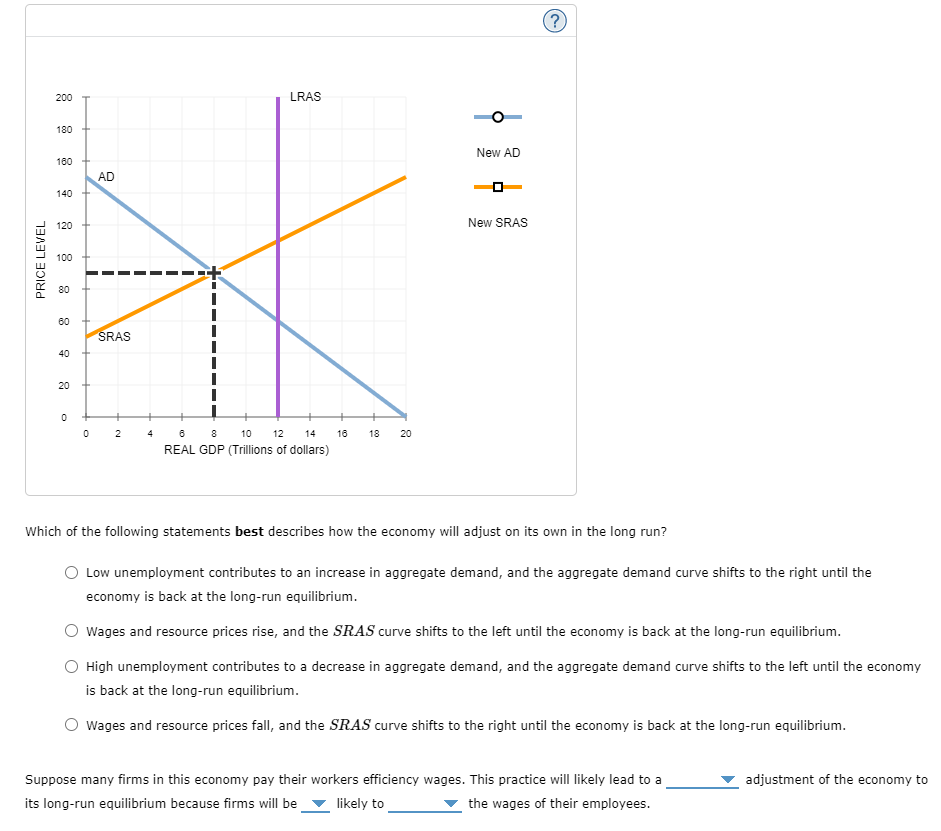
The following graph shows an economy's aggregate demand curve and its short-run and long-run aggregate supply curves after a financial crisis has pushed it into recession. Suppose that the government decides not to use a stabilization policy and allows the economy to adjust on its own.
Determine which curve, the aggregate demand curve or the short-run aggregate supply curve, shifts when the economy adjusts in the long run. Use either the blue line (circle symbol) to plot a new aggregate demand curve or the orange line (square symbol) to plot a new short-run aggregate supply curve to show the economy in long-run equilibrium. Make sure the curve you plot isparallelto one of the existing curves.
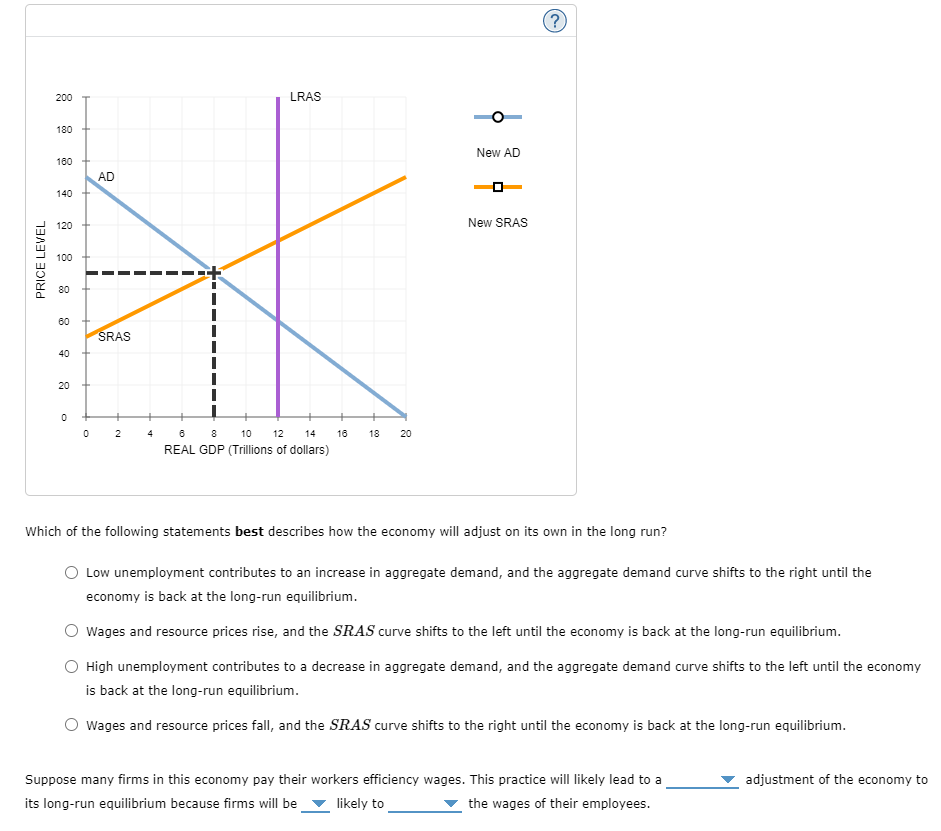
2m LRAS 130 New AD 150 Al] \"0 12-0 NEW ERAS \"I! -------+ PRICE LE'u'EL 3 D 2 4 a s lo 12 14 la Is an REAL GDP (Trillions of dollars} 1Ir'rlhich of the following statements best describes how the economy will adjust on its own in the long run? 0 Loy:I unemployment contributes to an increase in aggregate demand, and the aggregate demand curve shifts to the right until the economy is back at the longrun equilibrium. 0 1Wages and resource prices rise, and the ERAS curye shifts to the left until the economy is back at the longrun equilibrium. C) High unemployment contributes to a decrease in aggregate demand, and the aggregate demand curve shifts to the left until the economy is back at the long-run equilibrium. 0 1Ir'rl'ages and resource prices fall, and the SEAS curve shifts to the right until the economy is back at the long-run equilibrium. Suppose many rms in this economy pay their workers efficiency wages. This practice will likely lead to a v adjustment of the economy to its longrun equilibrium because rms will be v likely to v the wages of their employees
Step by Step Solution
There are 3 Steps involved in it

Get step-by-step solutions from verified subject matter experts
 Study Help