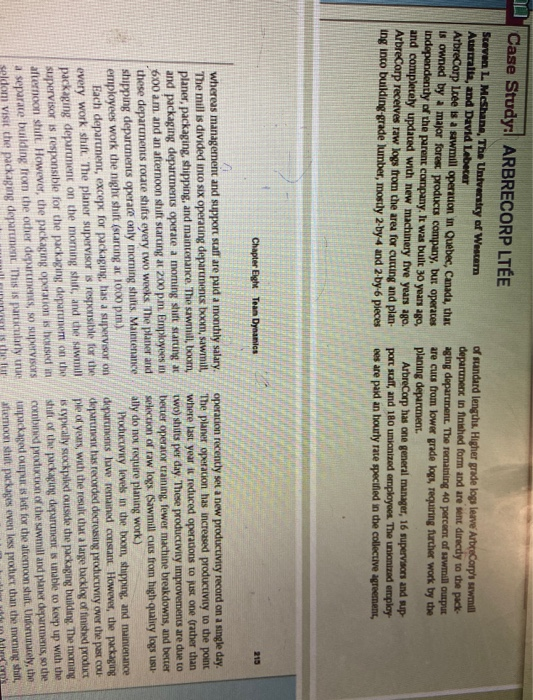
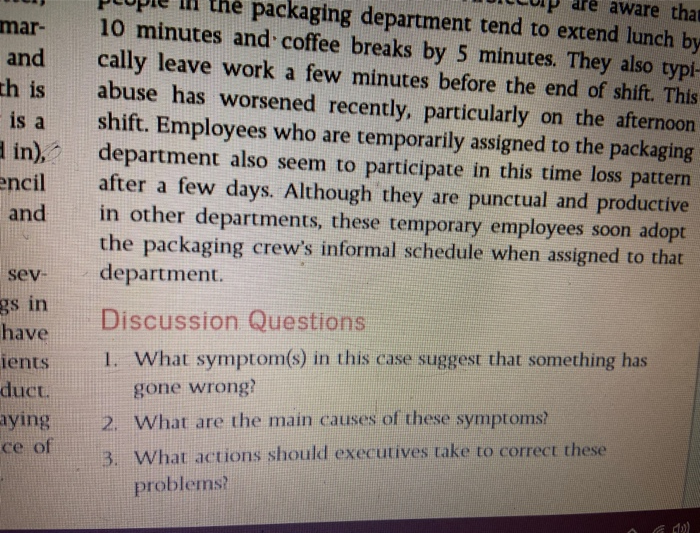
OLL Case Study: ARBRECORP LTE Steven L McShane, The Universty of Western A malia, and David Lebecer Arore corp Lee is wmill operation in Quebec, Canada, that I owned by a major forest products company, but operates independently of the parent company. It was built 30 years ago and completely updated with new machinery five years ago. Arbre corp receives raw logs from the area for cutting and plan ing into buikling-grade lumber, mostly 2 by 4 and 2-by-6 pieces of Randard length. Higher grade logs leave ArtriCorps will department in finished form and are sent directy to the pack- aging department. The remaining 40 percent are cuts from lower grade logs, requiring further work by the planing department ArbreCorp has one general manager, 16 supervisors and sup port staff, and 180 unionized employees. The unionized employ ees are paid an hourly rate specified in the collective agreement Chapter Eght Team Dynamics whereas management and support staff are paid a monthly salary The mill is divided into six operating departments bxxom, sawmill. planer, packaging, shipping, and maintenance. The sawmill, boom, and packaging departments operate a moming shift staring at 6300 a.m. and an afternoon it starting opim. Employees these departments rotate shifts every two weeks. The planer and shipping departments operare only morning shifts. Maintenance employees work the night shift (starting at 10:00 pm). Each department, except for packaging, has a supervisor on every work shift. The planer supervisor is responsible for the packaging department on the morning shift, and the sawmill supervisor is responsible for the packaging department on the afternoon still. However, the packaging operation is housed in a separate building from the other departments, so supervisors seldom visit the packaging department. This is particularly true milliars is the fur operation recently set a new productivity record on a single day. The planer operation has increased productivity to the point where last year it reduced operations to just one (rather than two) shifts per day. These productivity improvements are due to better operator training, lewer machine breakdowns, and becter selection of raw logs. (Sawmill cuts from high-quality logs usu- ally do not require planing work.) Productivity levels in the boom, shipping, and maintenance departments lave remained constant. However, the packaging dej e n las recorded decreasing productivity over the past cou ple of years, with the result that a large backlog of finished product is typically stockpiled outside the packaging building. The moming shift of the packaging department is unable to keep up with the combined production of the swmill and planer departments, so the unpackaged output is left for the afternoon shift. Unfortunately, the aremoon stt packages even les product than the morning shill, de in ihn mar- and th is is a Ain), LLUP are aware that Uple in the packaging department tend to extend lunch by 10 minutes and coffee breaks by 5 minutes. They also typi- cally leave work a few minutes before the end of shift. This abuse has worsened recently, particularly on the afternoon shift. Employees who are temporarily assigned to the packaging department also seem to participate in this time loss pattern after a few days. Although they are punctual and productive in other departments, these temporary employees soon adopt the packaging crew's informal schedule when assigned to that department. encil and sev- gs in have ients ducu. aying ce of Discussion Questions 1. What symptom(s) in this case suggest that something has gone wrong? 2. What are the main causes of these symptoms? 3. What actions should executives take to correct these problems