







Question: a)Record the basic consolidation entry. b)Record the amortized excess value reclassification entry. c)Record the excess value (differential) reclassification entry. d)Record the elimination of the intercompany
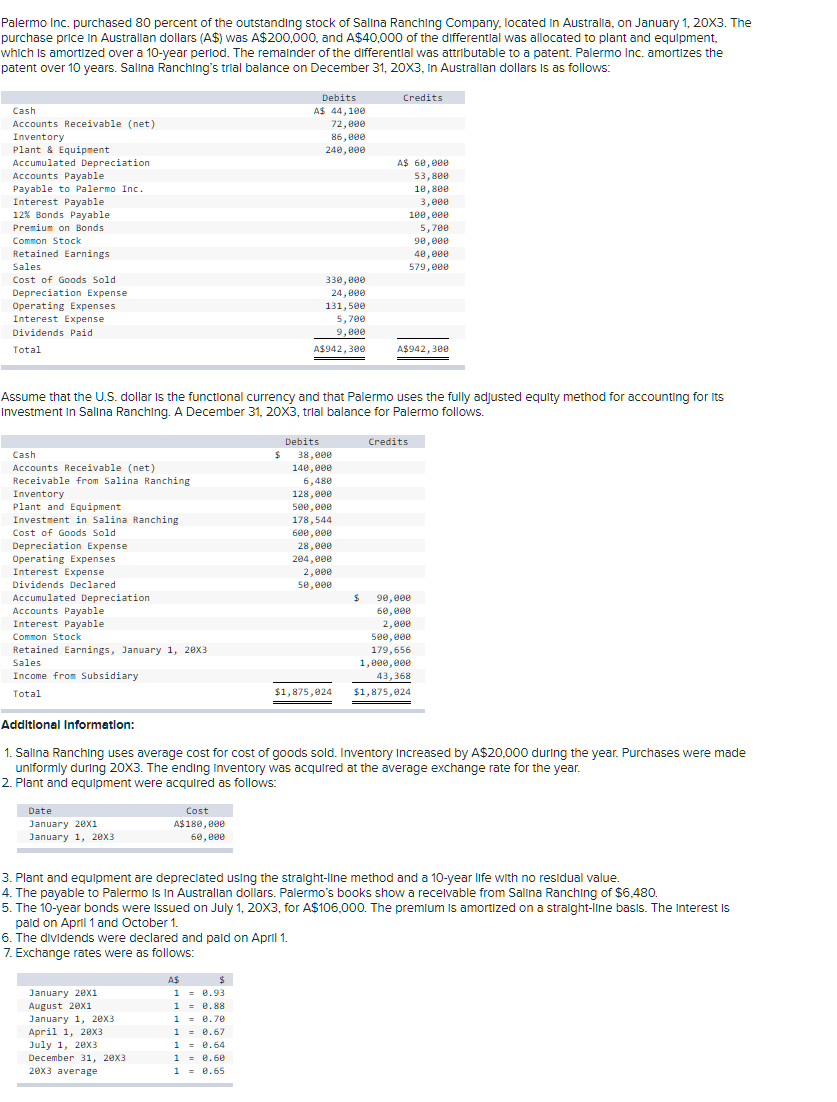
a)Record the basic consolidation entry.
b)Record the amortized excess value reclassification entry.
c)Record the excess value (differential) reclassification entry.
d)Record the elimination of the intercompany accounts.
Palermo Inc. purchased 80 percent of the outstanding stock of Salina Ranching Company, located in Australia, on January 1, 20X3. The purchase price in Australian dollars (A$) was A$200,000, and A$40,000 of the differential was allocated to plant and equipment, which is amortized over a 10-year period. The remainder of the differential was attributable to a patent. Palermo Inc. amortizes the patent over 10 years. Salina Ranching's trial balance on December 31, 20X3, in Australian dollars is as follows: Credits Debits A$ 44,100 72,000 86,880 240, eee Cash Accounts Receivable (net) Inventory Plant & Equipment Accumulated Depreciation Accounts Payable Payable to Palermo Inc. Interest Payable 12% Bonds Payable Premium on Bonds Common Stock Retained Earnings Sales Cost of Goods Sold Depreciation Expense Operating Expenses Interest Expense Dividends Paid Total A$ 60.ee 53, see 19,800 3, eee 1ee, eee 5,700 90,000 40, eee 579, eee 330,00 24,00 131,500 5,700 9,800 A$942,300 , A$942, 300 Assume that the U.S. dollar is the functional currency and that Palermo uses the fully adjusted equity method for accounting for its Investment in Salina Ranching. A December 31, 20X3, trial balance for Palermo follows. Credits $ Cash Accounts Receivable (net) Receivable from Salina Ranching Inventory Plant and Equipment Investment in Salina Ranching Cost of Goods Sold Depreciation Expense Operating Expenses Interest Expense Dividends Declared Accumulated Depreciation Accounts Payable Interest Payable Common Stock Retained Earnings, January 1, 20x3 Sales Income from Subsidiary Total Debits 38, eee 140,eee 6,480 128,000 500, eee 178,544 600,000 28,000 204,00 2, eee 50,000 $ 90,000 60,00 2,000 580, eee 179,656 1,800,00 43,368 $1,875,024 $1,875,024 Additional Information: 1. Salina Ranching uses average cost for cost of goods sold. Inventory Increased by A$20,000 during the year. Purchases were made uniformly during 20X3. The ending Inventory was acquired at the average exchange rate for the year. 2. Plant and equipment were acquired as follows: Date January 20x1 January 1, 20x3 Cost A$ 180,000 60,800 3. Plant and equipment are depreciated using the straight-line method and a 10-year life with no residual value. 4. The payable to Palermo Is In Australian dollars. Palermo's books show a receivable from Salina Ranching of $6.480. 5. The 10-year bonds were issued on July 1, 20X3, for A$106,000. The premium is amortized on a straight-line basis. The Interest is pald on April 1 and October 1. 6. The dividends were declared and pald on April 1. 7. Exchange rates were as follows: January 20x1 August 20x1 January 1, 20x3 April 1, 20x3 July 1, 20x3 December 31, 20x3 20x3 average A$ $ 1 = 0.93 1 = 0.88 1 = 0.70 1 = 0.67 1 = 0.64 1 = 0.60 1 = 0.65 Palermo Inc. purchased 80 percent of the outstanding stock of Salina Ranching Company, located in Australia, on January 1, 20X3. The purchase price in Australian dollars (A$) was A$200,000, and A$40,000 of the differential was allocated to plant and equipment, which is amortized over a 10-year period. The remainder of the differential was attributable to a patent. Palermo Inc. amortizes the patent over 10 years. Salina Ranching's trial balance on December 31, 20X3, in Australian dollars is as follows: Credits Debits A$ 44,100 72,000 86,880 240, eee Cash Accounts Receivable (net) Inventory Plant & Equipment Accumulated Depreciation Accounts Payable Payable to Palermo Inc. Interest Payable 12% Bonds Payable Premium on Bonds Common Stock Retained Earnings Sales Cost of Goods Sold Depreciation Expense Operating Expenses Interest Expense Dividends Paid Total A$ 60.ee 53, see 19,800 3, eee 1ee, eee 5,700 90,000 40, eee 579, eee 330,00 24,00 131,500 5,700 9,800 A$942,300 , A$942, 300 Assume that the U.S. dollar is the functional currency and that Palermo uses the fully adjusted equity method for accounting for its Investment in Salina Ranching. A December 31, 20X3, trial balance for Palermo follows. Credits $ Cash Accounts Receivable (net) Receivable from Salina Ranching Inventory Plant and Equipment Investment in Salina Ranching Cost of Goods Sold Depreciation Expense Operating Expenses Interest Expense Dividends Declared Accumulated Depreciation Accounts Payable Interest Payable Common Stock Retained Earnings, January 1, 20x3 Sales Income from Subsidiary Total Debits 38, eee 140,eee 6,480 128,000 500, eee 178,544 600,000 28,000 204,00 2, eee 50,000 $ 90,000 60,00 2,000 580, eee 179,656 1,800,00 43,368 $1,875,024 $1,875,024 Additional Information: 1. Salina Ranching uses average cost for cost of goods sold. Inventory Increased by A$20,000 during the year. Purchases were made uniformly during 20X3. The ending Inventory was acquired at the average exchange rate for the year. 2. Plant and equipment were acquired as follows: Date January 20x1 January 1, 20x3 Cost A$ 180,000 60,800 3. Plant and equipment are depreciated using the straight-line method and a 10-year life with no residual value. 4. The payable to Palermo Is In Australian dollars. Palermo's books show a receivable from Salina Ranching of $6.480. 5. The 10-year bonds were issued on July 1, 20X3, for A$106,000. The premium is amortized on a straight-line basis. The Interest is pald on April 1 and October 1. 6. The dividends were declared and pald on April 1. 7. Exchange rates were as follows: January 20x1 August 20x1 January 1, 20x3 April 1, 20x3 July 1, 20x3 December 31, 20x3 20x3 average A$ $ 1 = 0.93 1 = 0.88 1 = 0.70 1 = 0.67 1 = 0.64 1 = 0.60 1 = 0.65
Step by Step Solution
There are 3 Steps involved in it

Get step-by-step solutions from verified subject matter experts
 Study Help