







Question: arena simulation calculations and work are needed Five identical machines operate independently in a small shop. Each machine is up (that is, works) for between
arena simulation 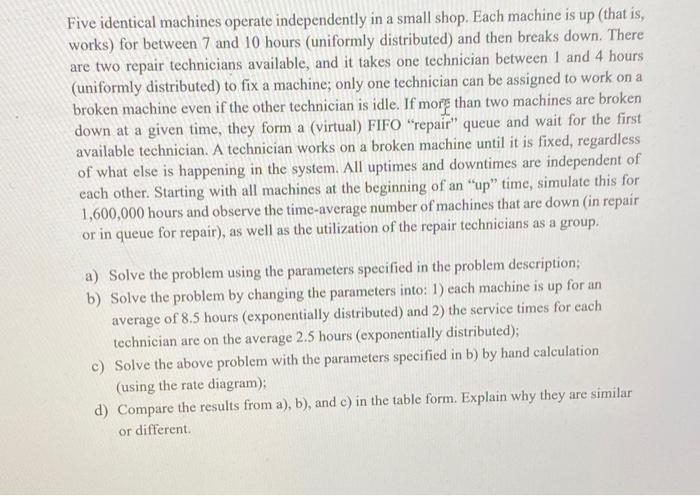
Five identical machines operate independently in a small shop. Each machine is up (that is, works) for between 7 and 10 hours (uniformly distributed) and then breaks down. There are two repair technicians available, and it takes one technician between 1 and 4 hours (uniformly distributed) to fix a machine; only one technician can be assigned to work on a broken machine even if the other technician is idle. If more than two machines are broken down at a given time, they form a (virtual) FIFO "repair" queue and wait for the first available technician. A technician works on a broken machine until it is fixed, regardless of what else is happening in the system. All uptimes and downtimes are independent of each other. Starting with all machines at the beginning of an "up" time, simulate this for 1,600,000 hours and observe the time-average number of machines that are down (in repair or in queue for repair), as well as the utilization of the repair technicians as a group. a) Solve the problem using the parameters specified in the problem description; b) Solve the problem by changing the parameters into: 1) each machine is up for an average of 8.5 hours (exponentially distributed) and 2) the service times for each technician are on the average 2.5 hours (exponentially distributed); c) Solve the above problem with the parameters specified in b) by hand calculation (using the rate diagram); d) Compare the results from a), b), and c) in the table form. Explain why they are similar or different calculations and work are needed
Step by Step Solution
There are 3 Steps involved in it
1 Expert Approved Answer
Step: 1 Unlock

Question Has Been Solved by an Expert!
Get step-by-step solutions from verified subject matter experts
Step: 2 Unlock
Step: 3 Unlock
 Study Help