







Question: ARENA SOFTWARE PLEASE WITH STEP-BY-STEP Before you start developing the simulation in ARENA Read the problem Airline check-in system and answer: A. What are the
 ARENA SOFTWARE PLEASE WITH STEP-BY-STEP
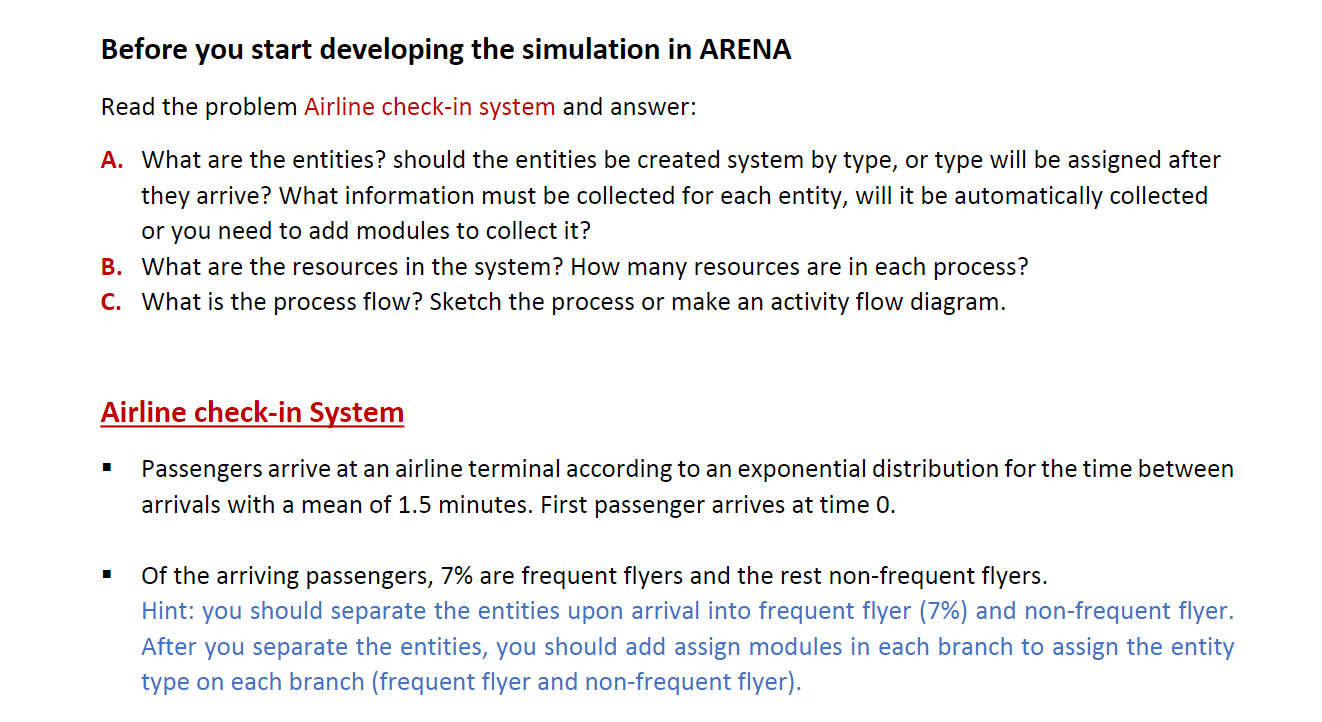
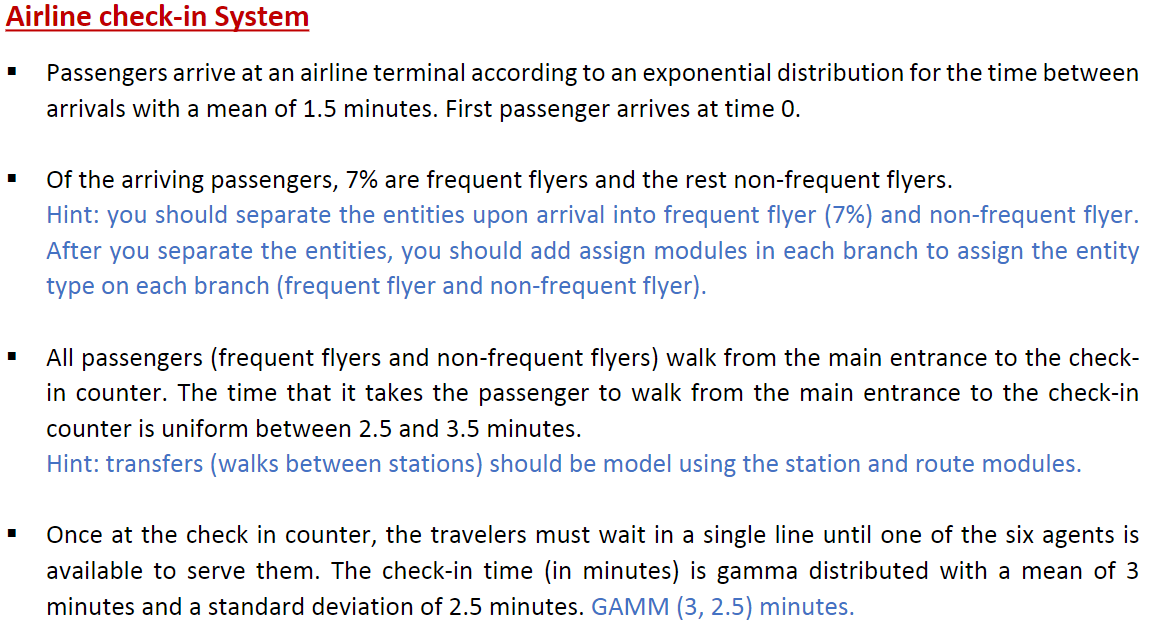
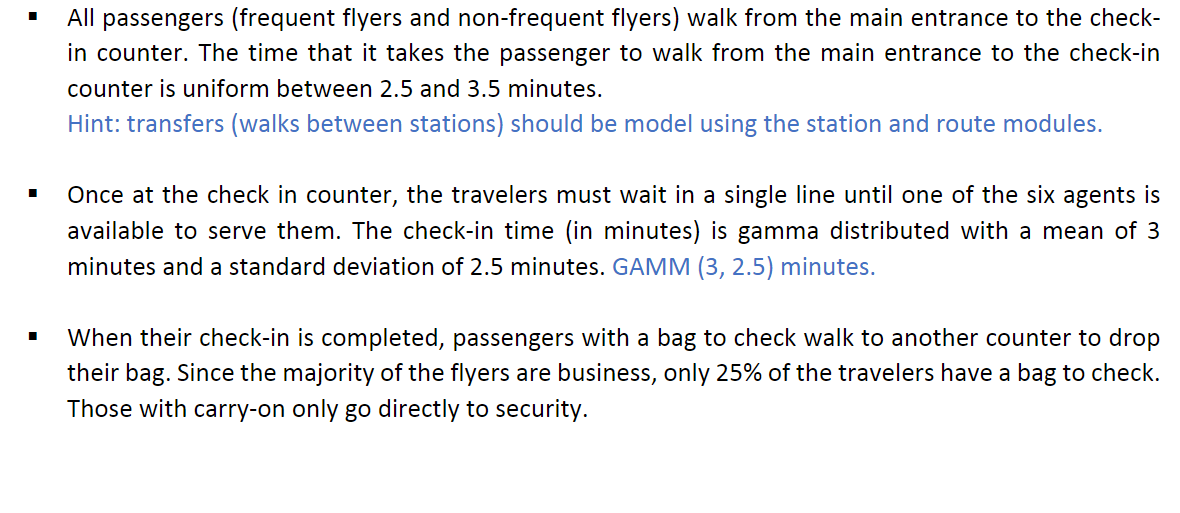
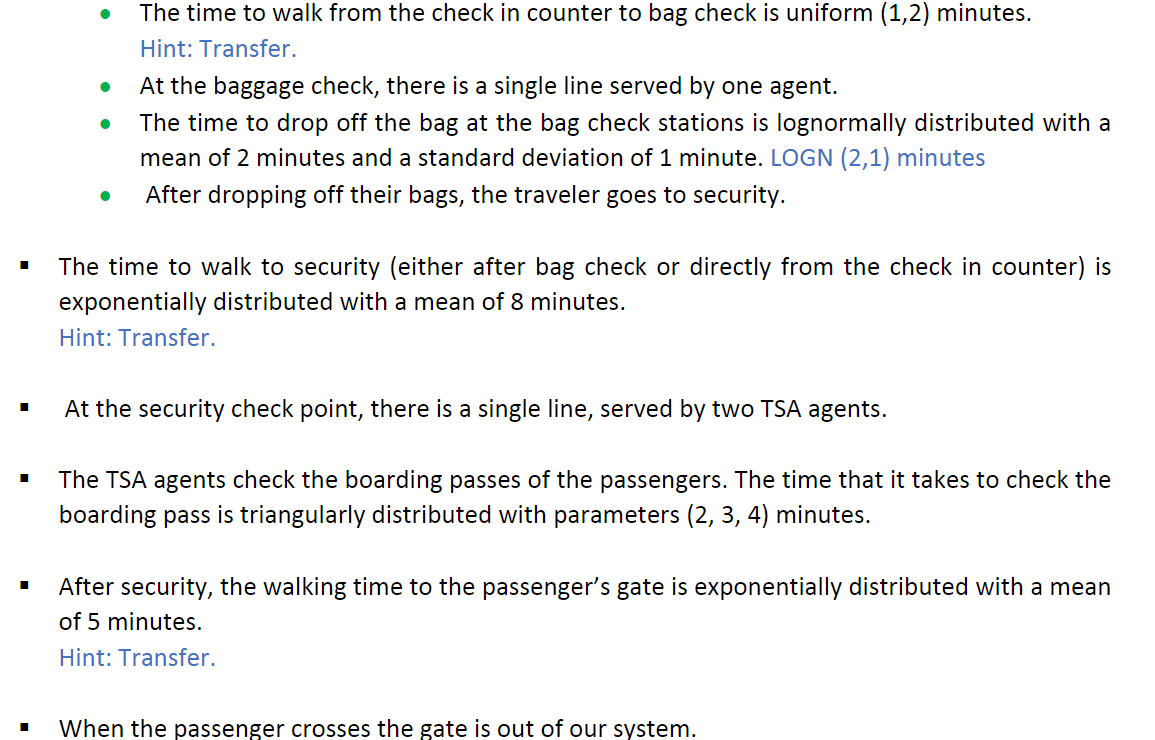
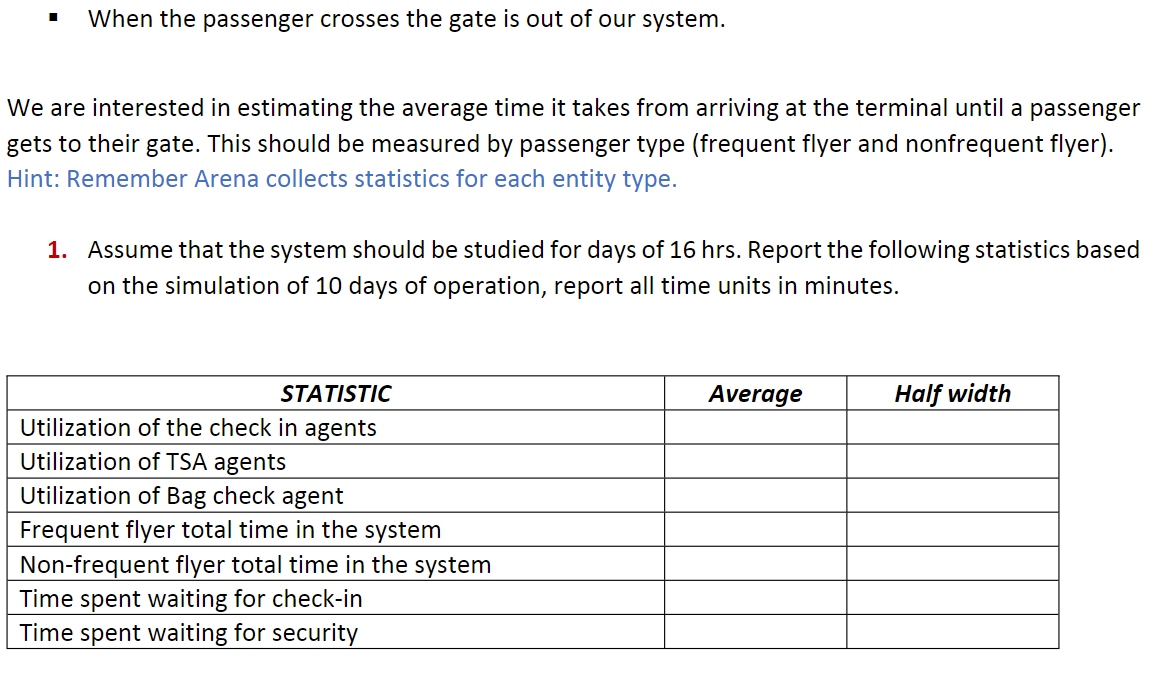
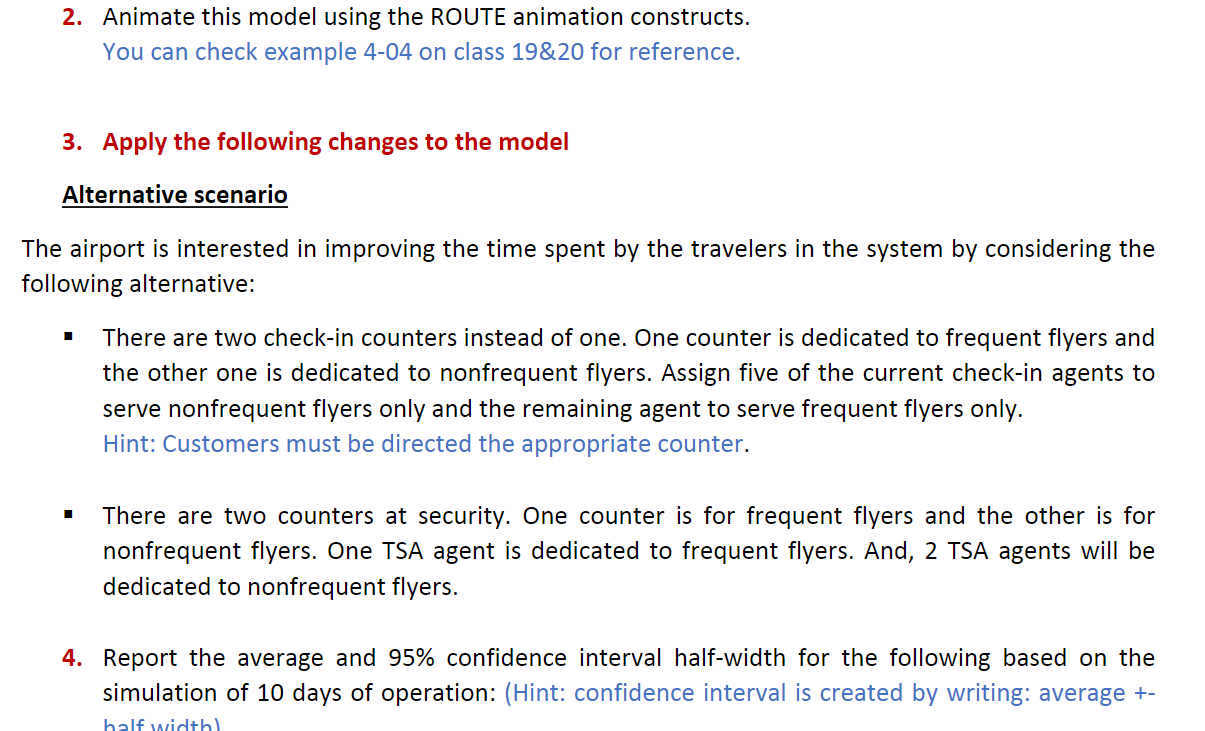
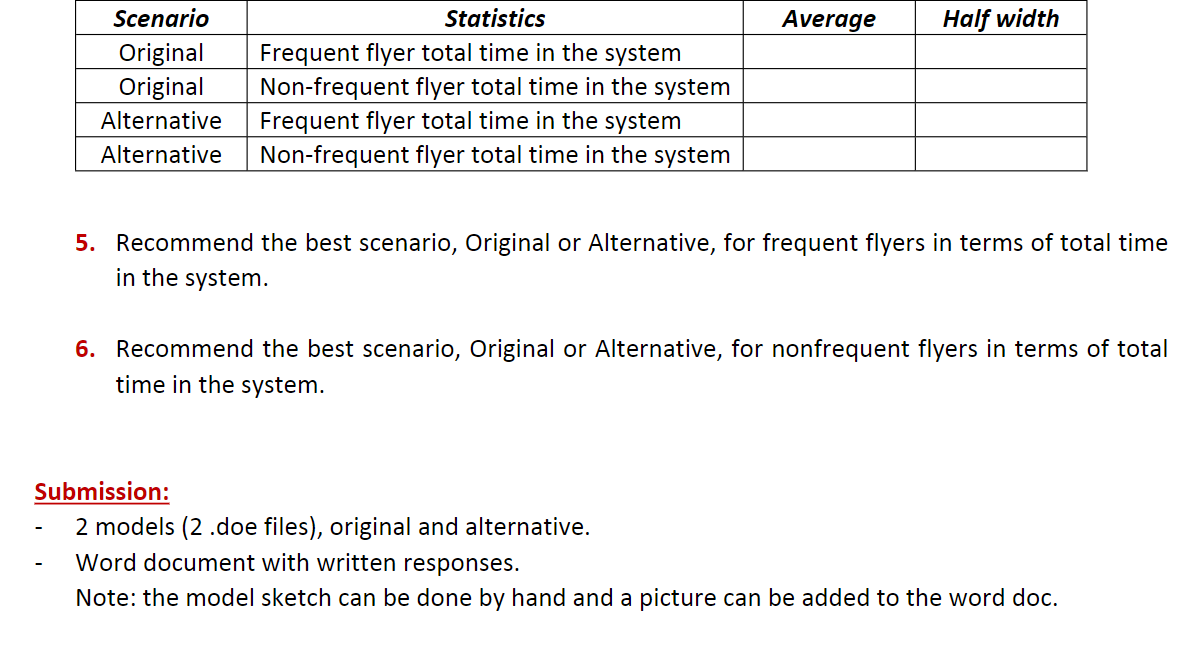
Before you start developing the simulation in ARENA Read the problem Airline check-in system and answer: A. What are the entities? should the entities be created system by type, or type will be assigned after they arrive? What information must be collected for each entity, will it be automatically collected or you need to add modules to collect it? B. What are the resources in the system? How many resources are in each process? C. What is the process flow? Sketch the process or make an activity flow diagram. Airline check-in System - Passengers arrive at an airline terminal according to an exponential distribution for the time between arrivals with a mean of 1.5 minutes. First passenger arrives at time 0. - Of the arriving passengers, 7% are frequent flyers and the rest non-frequent flyers. Hint: you should separate the entities upon arrival into frequent flyer (7%) and non-frequent flyer. After you separate the entities, you should add assign modules in each branch to assign the entity type on each branch (frequent flyer and non-frequent flyer). Passengers arrive at an airline terminal according to an exponential distribution for the time between arrivals with a mean of 1.5 minutes. First passenger arrives at time 0 . Of the arriving passengers, 7% are frequent flyers and the rest non-frequent flyers. Hint: you should separate the entities upon arrival into frequent flyer (7\%) and non-frequent flyer. After you separate the entities, you should add assign modules in each branch to assign the entity type on each branch (frequent flyer and non-frequent flyer). All passengers (frequent flyers and non-frequent flyers) walk from the main entrance to the checkin counter. The time that it takes the passenger to walk from the main entrance to the check-in counter is uniform between 2.5 and 3.5 minutes. Hint: transfers (walks between stations) should be model using the station and route modules. Once at the check in counter, the travelers must wait in a single line until one of the six agents is available to serve them. The check-in time (in minutes) is gamma distributed with a mean of 3 minutes and a standard deviation of 2.5 minutes. GAMM (3,2.5) minutes. - All passengers (frequent flyers and non-frequent flyers) walk from the main entrance to the checkin counter. The time that it takes the passenger to walk from the main entrance to the check-in counter is uniform between 2.5 and 3.5 minutes. Hint: transfers (walks between stations) should be model using the station and route modules. - Once at the check in counter, the travelers must wait in a single line until one of the six agents is available to serve them. The check-in time (in minutes) is gamma distributed with a mean of 3 minutes and a standard deviation of 2.5 minutes. GAMM (3,2.5) minutes. - When their check-in is completed, passengers with a bag to check walk to another counter to drop their bag. Since the majority of the flyers are business, only 25% of the travelers have a bag to check. Those with carry-on only go directly to security. The time to walk from the check in counter to bag check is uniform (1,2) minutes. Hint: Transfer. - At the baggage check, there is a single line served by one agent. - The time to drop off the bag at the bag check stations is lognormally distributed with a mean of 2 minutes and a standard deviation of 1 minute. LOGN (2,1) minutes - After dropping off their bags, the traveler goes to security. - The time to walk to security (either after bag check or directly from the check in counter) is exponentially distributed with a mean of 8 minutes. Hint: Transfer. - At the security check point, there is a single line, served by two TSA agents. - The TSA agents check the boarding passes of the passengers. The time that it takes to check the boarding pass is triangularly distributed with parameters (2,3,4) minutes. - After security, the walking time to the passenger's gate is exponentially distributed with a mean of 5 minutes. Hint: Transfer. - When the passenger crosses the gate is out of our system. - When the passenger crosses the gate is out of our system. We are interested in estimating the average time it takes from arriving at the terminal until a passenger gets to their gate. This should be measured by passenger type (frequent flyer and nonfrequent flyer). Hint: Remember Arena collects statistics for each entity type. 1. Assume that the system should be studied for days of 16hrs. Report the following statistics based on the simulation of 10 days of operation, report all time units in minutes. 2. Animate this model using the ROUTE animation constructs. You can check example 4-04 on class 19&20 for reference. 3. Apply the following changes to the model Alternative scenario The airport is interested in improving the time spent by the travelers in the system by considering the =ollowing alternative: - There are two check-in counters instead of one. One counter is dedicated to frequent flyers and the other one is dedicated to nonfrequent flyers. Assign five of the current check-in agents to serve nonfrequent flyers only and the remaining agent to serve frequent flyers only. Hint: Customers must be directed the appropriate counter. - There are two counters at security. One counter is for frequent flyers and the other is for nonfrequent flyers. One TSA agent is dedicated to frequent flyers. And, 2 TSA agents will be dedicated to nonfrequent flyers. 4. Report the average and 95% confidence interval half-width for the following based on the simulation of 10 days of operation: (Hint: confidence interval is created by writing: average +- 5. Recommend the best scenario, Original or Alternative, for frequent flyers in terms of total time in the system. 6. Recommend the best scenario, Original or Alternative, for nonfrequent flyers in terms of tota time in the system. Submission: - 2 models (2 doe files), original and alternative. - Word document with written responses. Note: the model sketch can be done by hand and a picture can be added to the word doc. Before you start developing the simulation in ARENA Read the problem Airline check-in system and answer: A. What are the entities? should the entities be created system by type, or type will be assigned after they arrive? What information must be collected for each entity, will it be automatically collected or you need to add modules to collect it? B. What are the resources in the system? How many resources are in each process? C. What is the process flow? Sketch the process or make an activity flow diagram. Airline check-in System - Passengers arrive at an airline terminal according to an exponential distribution for the time between arrivals with a mean of 1.5 minutes. First passenger arrives at time 0. - Of the arriving passengers, 7% are frequent flyers and the rest non-frequent flyers. Hint: you should separate the entities upon arrival into frequent flyer (7%) and non-frequent flyer. After you separate the entities, you should add assign modules in each branch to assign the entity type on each branch (frequent flyer and non-frequent flyer). Passengers arrive at an airline terminal according to an exponential distribution for the time between arrivals with a mean of 1.5 minutes. First passenger arrives at time 0 . Of the arriving passengers, 7% are frequent flyers and the rest non-frequent flyers. Hint: you should separate the entities upon arrival into frequent flyer (7\%) and non-frequent flyer. After you separate the entities, you should add assign modules in each branch to assign the entity type on each branch (frequent flyer and non-frequent flyer). All passengers (frequent flyers and non-frequent flyers) walk from the main entrance to the checkin counter. The time that it takes the passenger to walk from the main entrance to the check-in counter is uniform between 2.5 and 3.5 minutes. Hint: transfers (walks between stations) should be model using the station and route modules. Once at the check in counter, the travelers must wait in a single line until one of the six agents is available to serve them. The check-in time (in minutes) is gamma distributed with a mean of 3 minutes and a standard deviation of 2.5 minutes. GAMM (3,2.5) minutes. - All passengers (frequent flyers and non-frequent flyers) walk from the main entrance to the checkin counter. The time that it takes the passenger to walk from the main entrance to the check-in counter is uniform between 2.5 and 3.5 minutes. Hint: transfers (walks between stations) should be model using the station and route modules. - Once at the check in counter, the travelers must wait in a single line until one of the six agents is available to serve them. The check-in time (in minutes) is gamma distributed with a mean of 3 minutes and a standard deviation of 2.5 minutes. GAMM (3,2.5) minutes. - When their check-in is completed, passengers with a bag to check walk to another counter to drop their bag. Since the majority of the flyers are business, only 25% of the travelers have a bag to check. Those with carry-on only go directly to security. The time to walk from the check in counter to bag check is uniform (1,2) minutes. Hint: Transfer. - At the baggage check, there is a single line served by one agent. - The time to drop off the bag at the bag check stations is lognormally distributed with a mean of 2 minutes and a standard deviation of 1 minute. LOGN (2,1) minutes - After dropping off their bags, the traveler goes to security. - The time to walk to security (either after bag check or directly from the check in counter) is exponentially distributed with a mean of 8 minutes. Hint: Transfer. - At the security check point, there is a single line, served by two TSA agents. - The TSA agents check the boarding passes of the passengers. The time that it takes to check the boarding pass is triangularly distributed with parameters (2,3,4) minutes. - After security, the walking time to the passenger's gate is exponentially distributed with a mean of 5 minutes. Hint: Transfer. - When the passenger crosses the gate is out of our system. - When the passenger crosses the gate is out of our system. We are interested in estimating the average time it takes from arriving at the terminal until a passenger gets to their gate. This should be measured by passenger type (frequent flyer and nonfrequent flyer). Hint: Remember Arena collects statistics for each entity type. 1. Assume that the system should be studied for days of 16hrs. Report the following statistics based on the simulation of 10 days of operation, report all time units in minutes. 2. Animate this model using the ROUTE animation constructs. You can check example 4-04 on class 19&20 for reference. 3. Apply the following changes to the model Alternative scenario The airport is interested in improving the time spent by the travelers in the system by considering the =ollowing alternative: - There are two check-in counters instead of one. One counter is dedicated to frequent flyers and the other one is dedicated to nonfrequent flyers. Assign five of the current check-in agents to serve nonfrequent flyers only and the remaining agent to serve frequent flyers only. Hint: Customers must be directed the appropriate counter. - There are two counters at security. One counter is for frequent flyers and the other is for nonfrequent flyers. One TSA agent is dedicated to frequent flyers. And, 2 TSA agents will be dedicated to nonfrequent flyers. 4. Report the average and 95% confidence interval half-width for the following based on the simulation of 10 days of operation: (Hint: confidence interval is created by writing: average +- 5. Recommend the best scenario, Original or Alternative, for frequent flyers in terms of total time in the system. 6. Recommend the best scenario, Original or Alternative, for nonfrequent flyers in terms of tota time in the system. Submission: - 2 models (2 doe files), original and alternative. - Word document with written responses. Note: the model sketch can be done by hand and a picture can be added to the word doc
Step by Step Solution
There are 3 Steps involved in it

Get step-by-step solutions from verified subject matter experts
 Study Help