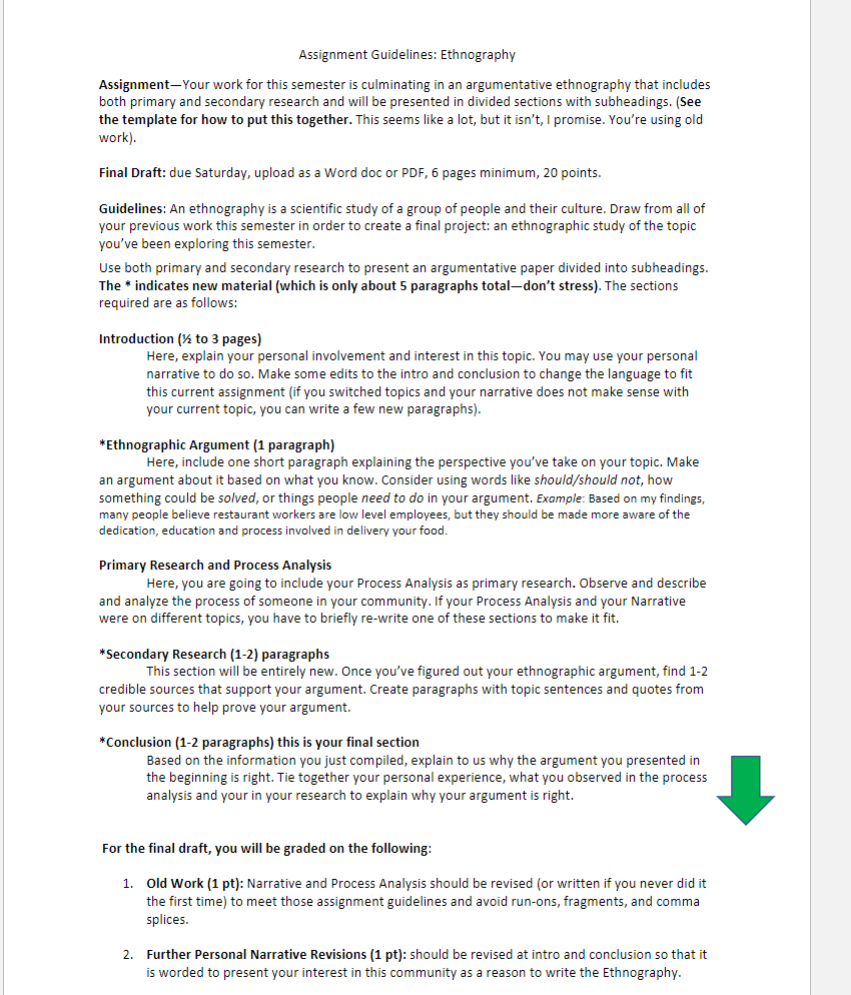
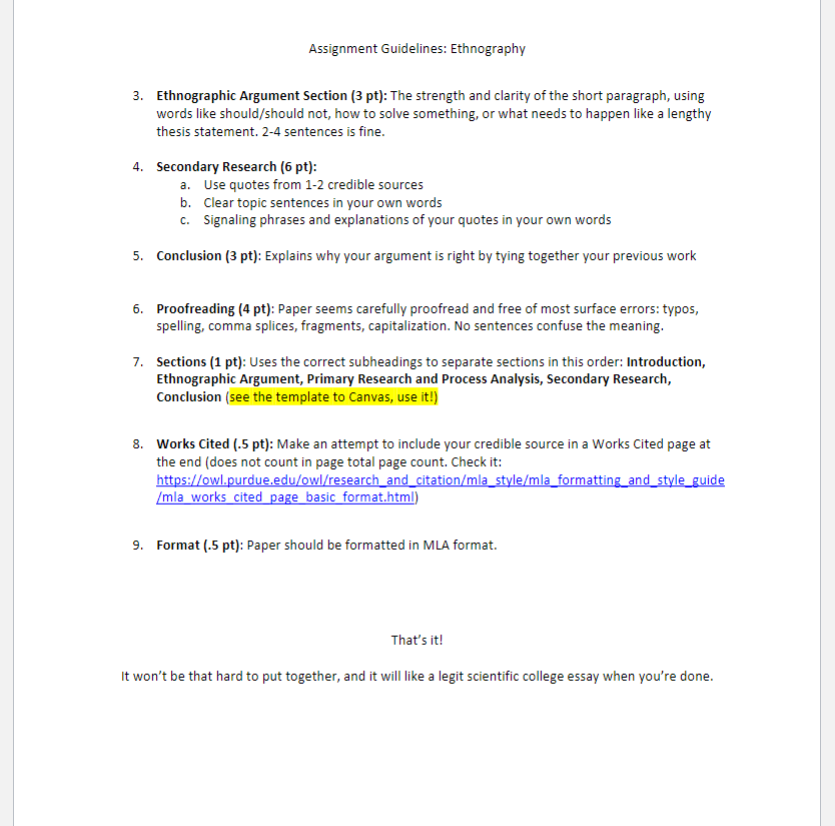
Question: Argumentative Essay Final Draft Assignment Guidelines: Ethnography AssignmentYour work for this semester is culminating in an argumentative ethnography that includes both primary and secondary research
Argumentative Essay Final Draft
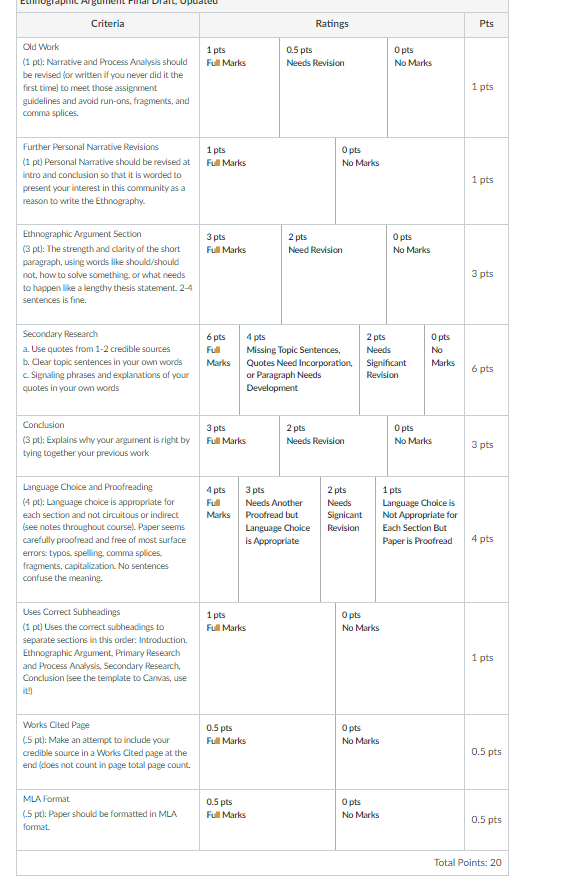
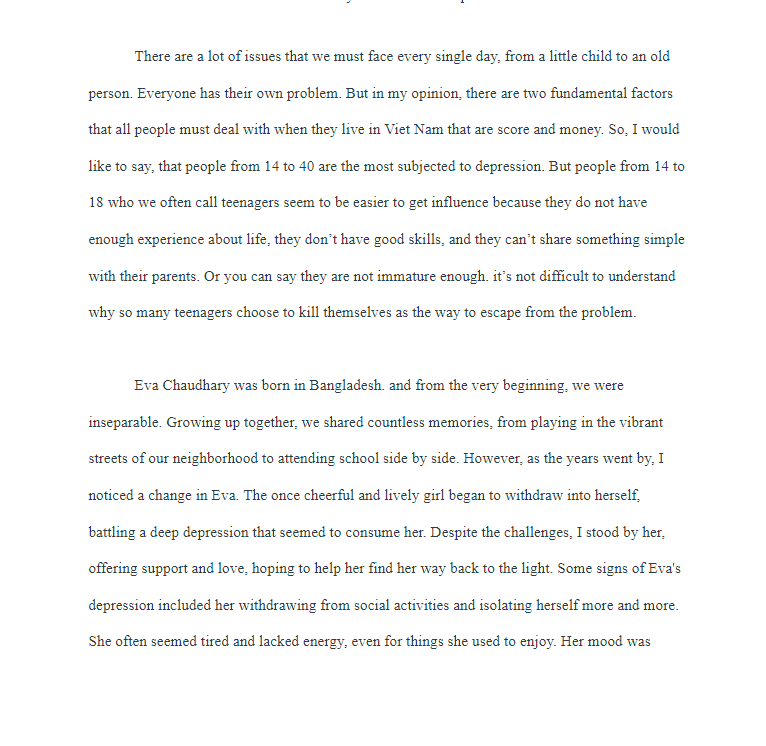
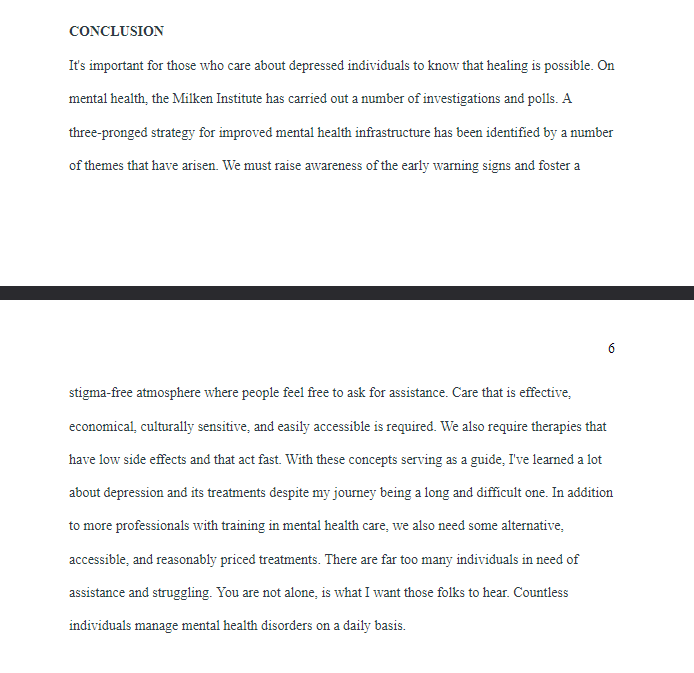
Assignment Guidelines: Ethnography AssignmentYour work for this semester is culminating in an argumentative ethnography that includes both primary and secondary research and will be presented in divided sections with subheadings. (See the template for how to put this together. This seems like a lot, but it isn't, | promise. You're using old work). Final Draft: due Saturday, upload as a Word doc or PDF, 6 pages minimum, 20 points. Guidelines: An ethnography is a scientific study of a group of people and their culture. Draw from all of your previous work this semester in order to create a final project: an ethnographic study of the topic you've been exploring this semester. Use both primary and secondary research to present an argumentative paper divided into subheadings. The indicates new material (which is only about 5 paragraphs totaldon't stress). The sections required are as follows: Introduction ( to 3 pages) Here, explain your personal involvement and interest in this topic. You may use your personal narrative to do so. Make some edits to the intro and conclusion te change the language to fit this current assignment (if you switched topics and your narrative does not make sense with your current topic, you can write a few new paragraphs). *Ethnographic Argument (1 paragraph) Here, include one short paragraph explaining the perspective you've take on your topic. Make an argument about it based on what you know. Consider using words like should/should not, how something could be solved, or things people need to do in your argument, Example: Based on my findings, many people balieve restaurant workers are low level employees, but they should be made more aware of the dedication, education and process involved in delivery your food. Primary Research and Process Analysis Here, you are going to include your Process Analysis as primary research. Observe and describe and analyze the process of someone in your community. If your Process Analysis and your Narrative were on different topics, you have to briefly re-write one of these sections to make it fit. *Secondary Research (1-2) paragraphs This section will be entirely new. Once you've figured out your ethnographic argument, find 1-2 credible sources that support your argument. Create paragraphs with topic sentences and quotes from your sources to help prove your argument. *Conclusion (1-2 paragraphs) this is your final section Based on the information you just compiled, explain to us why the argument you presented in the beginning is right. Tie together your personal experience, what you observed in the process analysis and your in your research to explain why your argument is right. For the final draft, you will be graded on the following: 1. Old Work (1 pt): Narrative and Process Analysis should be revised (or written if you never did it the first time) to meet those assignment guidelines and avoid run-ons, fragments, and comma splices. 2. Further Personal Narrative Revisions (1 pt): should be revised at intro and conclusion so that it is worded to present your interest in this community as a reason to write the Ethnography. Assignment Guidelines: Ethnography 3. Ethnographic Argument Section (3 pt): The strength and clarity of the short paragraph, using words like should/should not, how to solve something, or what needs to happen like a lengthy thesis statement. 2-4 sentences is fine. 4. Secondary Research (6 pt): a. Use quotes from 1-2 credible sources b. Clear topic sentences in your own words . Signaling phrases and explanations of your quotes in your own words 5. Conclusion {3 pt): Explains why your argument is right by tying together your previous work 6. Proofreading (4 pt): Paper seems carefully proofread and free of most surface errors: typos, spelling, comma splices, fragments, capitalization. No sentences confuse the meaning. 7. Sections (1 pt): Uses the correct subheadings to separate sections in this order: introduction, Ethnographic Argument, Primary Research and Process Analysis, Secondary Research, Conclusion (see the template to Canvas, use it!) 8. Works Cited (.5 pt): Make an attempt to include your credible source in @ Works Cited page at the end (does not count in page total page count. Check it: r r rch _and citation/mil | la_f i | [mla_works cited page basic format.html) 9. Format (.5 pt): Paper should be formatted in MLA format. That's it! It won't be that hard to put together, and it will like a legit scientific college essay when you're done. Criteria Ratings Pts Old Work 1 pts 0.5 pts O pts (1 pt): Narrative and Process Analysis should Full Marks Needs Revision No Marks be revised for written if you never did it the first time) to meet those assignment 1 pits guidelines and avoid run-ons, fragments, and comma splices. Further Personal Narrative Revisions 1 pts Opts (1 pt) Personal Narrative should be revised at Full Marks No Marks intro and conclusion so that it is worded to 1 pts present your interest in this community as a reason to write the Ethnography. Ethnographic Argument Section 3 pts 2 pts Opts (3 pt): The strength and clarity of the short Full Marks Need Revision No Marks paragraph, using words like should/should not, how to solve something, or what needs 3 pts to happen like a lengthy thesis statement. 2-4 sentences is fine. Secondary Research 6 pts A pits 2 pts Opts a. Use quotes from 1-2 credible sources Full Missing Topic Sentences, Needs No b. Clear topic sentences in your own words Marks Quotes Need Incorporation, Significant Marks 6 pts c Signaling phrases and explanations of your or Paragraph Needs Revision quotes in your own words Development Conclusion 3 pts 2 pts O pts (3 pt): Explains why your argument is right by Full Marks Needs Revision No Marks 3 pts tying together your previous work Language Choice and Proofreading 4 pt 3 pts 2 pts 1 pts (4 pt): Language choice is appropriate for Full Needs Another Needs Language Choice Is each section and not circuitous or indirect Marks Proofread but Signicant Not Appropriate for (see notes throughout course). Paper seems Language Choice Revision Each Section But carefully proofread and free of most surface is Appropriate Paper is Proofread 4 pits errors: typos, spelling, comma splices, fragments, capitalization. No sentences confuse the meaning. Uses Correct Subheadings 1 pts O pts (1 pt) Uses the correct subheadings to Full Marks No Marks separate sections in this order: Introduction. Ethnographic Argument, Primary Research 1 pts and Process Analysis, Secondary Research, Conclusion (see the template to Canvas, use it! Works Cited Page 0.5 pts O pts (.5 pt): Make an attempt to Include your Full Marks No Marks credible source in a Works Cited page at the 0.5 pts end (does not count in page total page count. MLA Format 0.5 pts Opts (.5 pt): Paper should be formatted in MLA Full Marks No Marks 0.5 pts format. Total Points: 20There are a lot of 133ues that we must face every single day, from a little child to an old person. Evervone has their own problem. But in my opinion, there are two fundamental factors that all people must deal with when they live 1n Viet Nam that are score and money. So, I would like to say, that people from 14 to 40 are the most subjected to depression. But people from 14 to 18 who we often call teenagers seem to be easier to get influence because they do not have enough experience about life, they don't have good sklls, and thev can't share something simple with their parents. Or you can say they are not immature enough. it's not difficult to understand why so many teenagers choose to kill themselves as the way to escape from the problem. Eva Chaudhary was born in Bangladesh. and from the very beginning, we were inseparable. Growing up together, we shared countless memories, from playing in the vibrant streets of our neighborhood to attending school side by side. However, as the vears went by, I noticed a change in Eva. The once cheerful and lively girl began to withdraw into herself, battling a deep depression that seemed to consume her. Despite the challenges, I stood by her, offering support and love, hoping to help her find her way back to the light. Some signs of Eva's depression included her withdrawing from social activities and 1solating herself more and more. She often seemed tired and lacked energy, even for things she used to enjov. Her mood was 2 frequently low, and she expressed feelings of hopelessness and worthlessness. Additionally, her academic performance started to decline, and she had trouble concentrating and making decisions. These changes were quite noticeable and concerning. Background She entered a psychiatric institution in February 2023. After she replied in the affirmative to the following inquiries, the emergency room physician admitted her. Do you not find much joy or interest in accomplishing things? Do you feel unworthy, like a failure, or like you've let your family or yourself down? When it comes to reading a newspaper or watching television, do you find it difficult to focus? Do you ever consider harming yourself or believing that it would be better for you to die? Yes, sure, yes, and sure. She returned to a place I fear the most, but she knows it's the safest place for her to be when I'm feeling so low, after several weeks of debilitating anxiety and sadness. She had visited there previously, and regrettably, it was unlikely to be her final visit. The unfortunate news is that. The good news is that she made a full recovery and anticipates doing so once more. How It Started I can still clearly recall that day we had our conversation: She had her first episode of major depressive disorder in 2005 at the age of 20. She had been under a tremendous amount of stress, having just gone through a divorce. She was also going to grad school while simultaneously working full-time and raising two young daughters. She wasn't sleeping well and had been feeling increasingly anxious and sad. When she saw that people in the Louisiana Superdome were suffering in filthy conditions, she was saddened. She found it incomprehensible that while we could airdrop basic supplies into war-torn nations all over the3 world, we could not provide food and water to people in an American city. It seemed to her that her city had been forgotten. She was unable to concentrate. Her mind spun in a circle over and over. Her energy was dwindling and she found it difficult to focus on her work. She eventually lost the ability to get out of bed in the morning and found that even taking a shower required a significant amount of energy. Her deranged thinking led her to believe that her family would benefit more from her death, and she devised elaborate arrangements. She devised elaborate strategies for taking her own life. She was admitted to the hospital five times in a span of six months. She was well for ten years following her recovery. She believed she had the depression thing down pat. She went on to lead a demanding and prosperous career. She first served as AARP's lead health lobbyist during the Affordable Care Act's enactment. She then started hunting for work after working for a while at the Department of Health and Human Services. The security clearance application form inquired about any hospitalizations I may have had for mental health issues within the previous seven years. Fortunately, she had not been hospitalized for over seven years at the time of her application. However, she informed me that she had friends with mental health issues who were refused security clearance. I know people who will not receive treatment for mental health issues out of concern that it may compromise their security clearances and, consequently, their eligibility for positions at high levels of authority. I've received recognition throughout my career for my work advocating for health and long-term care policies. When well-meaning strangers learn that my best buddy battled depression in the past, they tell me that they are shocked. Contrary to popular belief, people with depression are not illogical, withdrawn,4 ipsum dolor sit amet, consectetuer adipiscing elit, sed diam nonummy nibh euismod tincidunt ut laoreet dolore magna aliquam erat volutpat. Ut wisi enim ad minim veniam, quis nostrud exerci tation ullamcorper suscipit lobortis nisl ut aliquip ex ea commodo consequat. Duis autem vel eum iriure dolor in hendrerit in vulputate velit esse molestie consequat, vel illum dolore eu feugiat nulla facilisis at vero eros et accumsan. 2024 saw the suicide deaths of two well-known people, Kate Spade and Anthony Bourdain, shortly after one another. Numerous news reports decried their self-centeredness for ending their own lives. Journalists wondered how such a successful and well-liked person could accomplish this. I could tell from reading these papers that the authors had little to no experience with depression. They failed to understand how it takes control of your mind and warps your perceptions. Depression makes you believe that death would be preferable for everyone in your vicinity. You are an inconvenience, a letdown, and a dysfunctional person. Furthermore, a lot of people stigmatize persons who are depressed. They wouldn't be depressed if they just took their medications, saw a therapist, exercised more, meditated, and so on. But my best friend Eva did everything that was recommended. She exercised nearly every day. She conducted frequent therapy sessions and meditated. Nevertheless, her depression returned. and is still finding it difficult to realize that it is not her fault. I've noticed that a lot of accomplished individuals go through periods of severe despair, but we usually keep it to ourselves. We have very high standards for ourselves, and melancholy makes us believe that we are worthless failures when we are unable to achieve these extremeLy levels. So. after these deaths. she made the decision to speak up. By sharing her own story, she hopes to increase understanding of depression and, more importantly, provide hope for recovery for those who are struggling with it. She also wants to increase knowledge about mental health recovery and the stigma associated with it. She is contributing to this endeavor by serving as a network leader for the Stability Network, an expanding community of individuals who live and work with mental health 1ssues. We tell our tales in an effort to uplift others and shift public perception of mental health. We have a message of healing and hope. However, until they hear about vour experiences, people typically reserve the right to share their own. The day one of my neighbors informed me that her mother had committed suicide and would alwavs stay with me. My neighbor appears to lead a picture-perfect life from the outside. She is a stunning and accomplished lawyer who has a lovely spouse and two amazing girls. She opened up about how her mother's suicide had completelv altered her life and saddened her sisters as well. She's never moved on from it. She still misses her mother on a daily basis. This tale comes to me whenever I'm feeling extremely hopeless matter how awful I feel 1 have to keep telling myself that myv friends and family will never be the same without me. I was able to push myself to improve and pull myself back from the edge because of this understanding. CONCLUSION It's important for those who care about depressed individuals to know that healing is possible. On mental health, the Milken Institute has carried out a number of investigations and polls. A three-pronged strategy for improved mental health infrastructure has been identified by a number of themes that have arisen. We must raise awareness of the early warning signs and foster a CONCLUSION It's important for those who care about depressed individuals to know that healing 15 possible. On mental health, the Milken Institute has carried out a number of investigations and polls. A three-pronged strategy for improved mental health infrastructure has been identified by a number of themes that have arisen. We must raise awareness of the early warning signs and foster a stigma-free atmosphere where people feel free to ask for azsistance. Care that is effective, economical, culturally sensitive, and easily accessible is required. We also require therapies that have low side effects and that act fast. With these concepts serving as a guide, I've learned a lot about depression and its treatments despite my journey being a long and difficult one. In addition to more professionals with training in mental health care, we also need some alternative, accessible, and reasonably priced treatments. There are far too many individuals in need of assistance and struggling. You are not alone, 1s what I want those folks to hear. Countless mndividuals manage mental health disorders on a daily basis
Step by Step Solution
There are 3 Steps involved in it
1 Expert Approved Answer
Step: 1 Unlock
Question Has Been Solved by an Expert!
Get step-by-step solutions from verified subject matter experts
Step: 2 Unlock
Step: 3 Unlock
Students Have Also Explored These Related Business Writing Questions!









 Study Help