







Question: ARM Assembly Language is required for this problem. Please explain any command you used for the code. Thanks in advance. 1. Write a short program
ARM Assembly Language is required for this problem. Please explain any command you used for the code.
Thanks in advance.
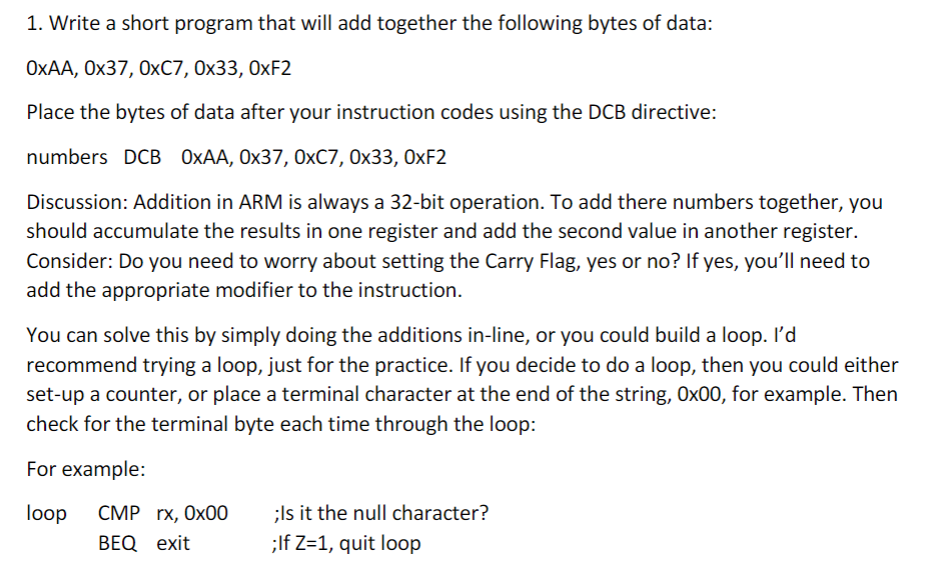
1. Write a short program that will add together the following bytes of data: OXAA, 0x37, 0xC7, 0x33, 0xF2 Place the bytes of data after your instruction codes using the DCB directive: numbers DCB OXAA, Ox37, 0xC7, 0x33, 0xF2 Discussion: Addition in ARM is always a 32-bit operation. To add there numbers together, you should accumulate the results in one register and add the second value in another register. Consider: Do you need to worry about setting the Carry Flag, yes or no? If yes, you'll need to add the appropriate modifier to the instruction. You can solve this by simply doing the additions in-line, or you could build a loop. I'd recommend trying a loop, just for the practice. If you decide to do a loop, then you could either set-up a counter, or place a terminal character at the end of the string, 0x00, for example. Then check for the terminal byte each time through the loop: For example: loop CMP rx, Ox00 BEQ exit ;Is it the null character? ;If Z=1, quit loop 1. Write a short program that will add together the following bytes of data: OXAA, 0x37, 0xC7, 0x33, 0xF2 Place the bytes of data after your instruction codes using the DCB directive: numbers DCB OXAA, Ox37, 0xC7, 0x33, 0xF2 Discussion: Addition in ARM is always a 32-bit operation. To add there numbers together, you should accumulate the results in one register and add the second value in another register. Consider: Do you need to worry about setting the Carry Flag, yes or no? If yes, you'll need to add the appropriate modifier to the instruction. You can solve this by simply doing the additions in-line, or you could build a loop. I'd recommend trying a loop, just for the practice. If you decide to do a loop, then you could either set-up a counter, or place a terminal character at the end of the string, 0x00, for example. Then check for the terminal byte each time through the loop: For example: loop CMP rx, Ox00 BEQ exit ;Is it the null character? ;If Z=1, quit loop
Step by Step Solution
There are 3 Steps involved in it

Get step-by-step solutions from verified subject matter experts
 Study Help