







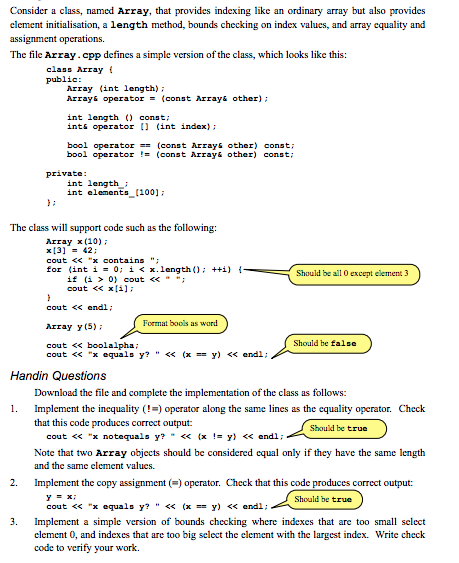
Question: Array.cpp: #include using namespace std; // definition #define MAX_LENGTH 100 #define INIT_VALUE 0 class Array { public: Array(int length); Array& operator=(const Array& other); int length()
Array.cpp:
#includeusing namespace std; // definition #define MAX_LENGTH 100 #define INIT_VALUE 0 class Array { public: Array(int length); Array& operator=(const Array& other); int length() const; int& operator[](int index); bool operator==(const Array& other) const; bool operator!=(const Array& other) const; private: int length_; int elements_[MAX_LENGTH]; }; // implementation Array::Array(int length) { length_ = length; if (length_ > MAX_LENGTH) length_ = MAX_LENGTH; for (int i = 0; i Please answer it with some explaniation. also please do each part sepretly
Consider a class, named Array, that provides indexing like an ordinary array but also provides element initialisation, a length mcthod, bounds checking on index values, and array cquality and assignment operations The file Array.cpp defines a simple version of the class, which looks like this: class Array public Array int length); Array& operator (const Array&other) int length const ints operator [] (int index) bool operator-= (const Array& other) const bool operator (const Array& other) const; privato int lengthi int elenents [100] The class will support code such as the following: Array x(10) cout 0) cout
Step by Step Solution
There are 3 Steps involved in it
1 Expert Approved Answer
Step: 1 Unlock

Question Has Been Solved by an Expert!
Get step-by-step solutions from verified subject matter experts
Step: 2 Unlock
Step: 3 Unlock
 Study Help