Question: Arrow's Impossibility Theorem Problem C. Imagine a three-judge panel trying a capital case, with a bifurcated-trial format (one trial for verdict, another, second trial for
Arrow's Impossibility Theorem Problem
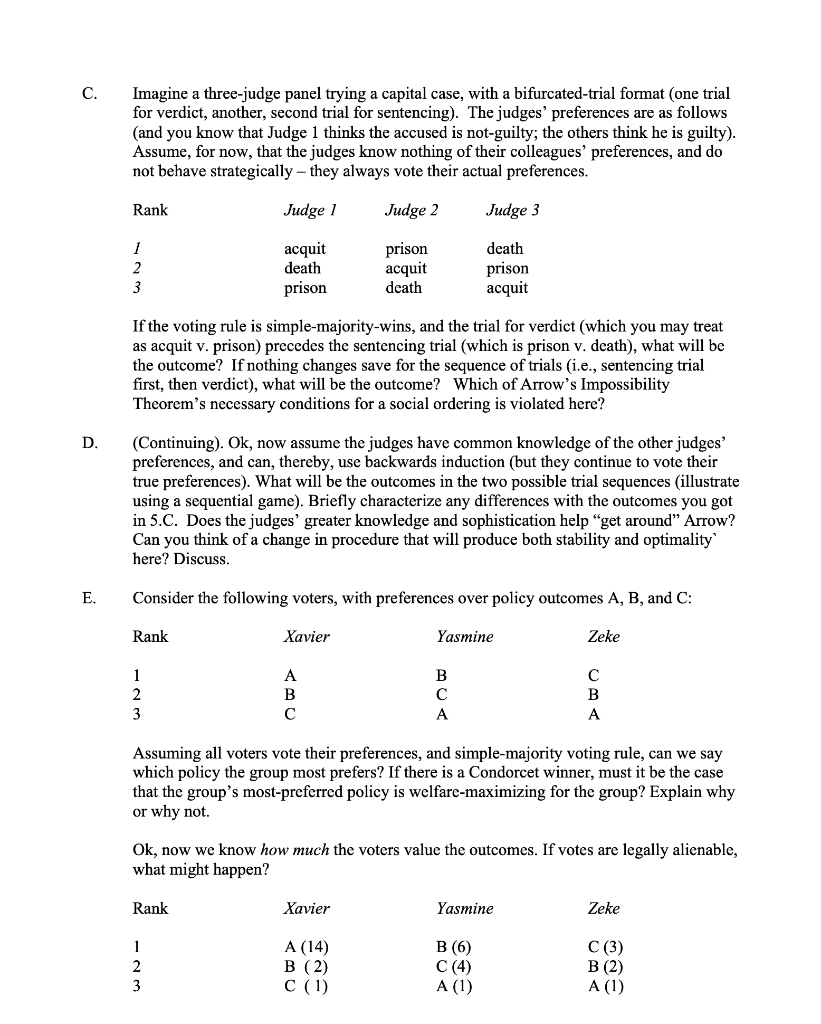
C. Imagine a three-judge panel trying a capital case, with a bifurcated-trial format (one trial for verdict, another, second trial for sentencing). The judges' preferences are as follows (and you know that Judge 1 thinks the accused is not-guilty; the others think he is guilty). Assume, for now, that the judges know nothing of their colleagues' preferences, and do not behave strategically - they always vote their actual preferences. Rank Judge 1 Judge 2 Judge 3 1 2 3 acquit death prison prison acquit death death prison acquit If the voting rule is simple-majority-wins, and the trial for verdict (which you may treat as acquit v. prison) precedes the sentencing trial (which is prison v. death), what will be the outcome? If nothing changes save for the sequence of trials (i.e., sentencing trial first, then verdict), what will be the outcome? Which of Arrow's Impossibility Theorem's necessary conditions for a social ordering is violated here? D. (Continuing). Ok, now assume the judges have common knowledge of the other judges' preferences, and can, thereby, use backwards induction (but they cont to vote their true preferences). What will be the outcomes in the two possible trial sequences (illustrate using a sequential game). Briefly characterize any differences with the outcomes you got in 5.C. Does the judges' greater knowledge and sophistication help "get around" Arrow? Can you think of a change in procedure that will produce both stability and optimality here? Discuss. E. Consider the following voters, with preferences over policy outcomes A, B, and C: Rank Xavier Yasmine Zeke 1 2 3 A B C B A B A Assuming all voters vote their preferences, and simple-majority voting rule, can we say which policy the group most prefers? If there is a Condorcet winner, must it be the case that the group's most-preferred policy is welfare-maximizing for the group? Explain why or why not. Ok, now we know how much the voters value the outcomes. If votes are legally alienable, what might happen? Rank Xavier Yasmine Zeke 1 2 3 A (14) B (2) B (6) C (4) A (1) C (3) B (2) A (1) C (1)









 Study Help