Question: article 1 Algorithmic hiring: why hire by numbers article 2 Recruiting algorithms: Appraising their limits and benefits Hiring algorithms have been in the headlines --
article 1
Algorithmic hiring: why hire by numbers
article 2
Recruiting algorithms: Appraising their limits and benefits
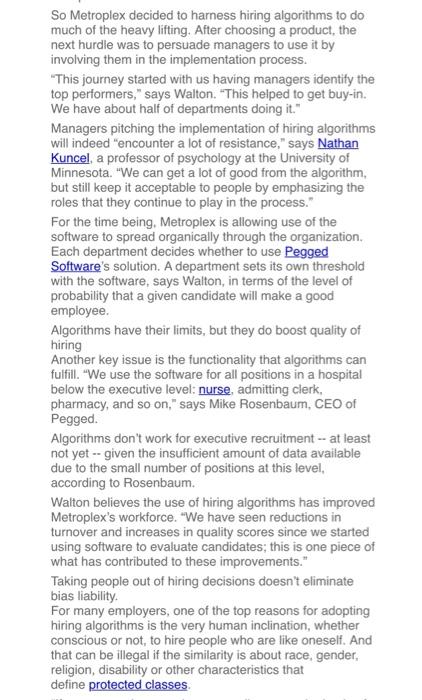
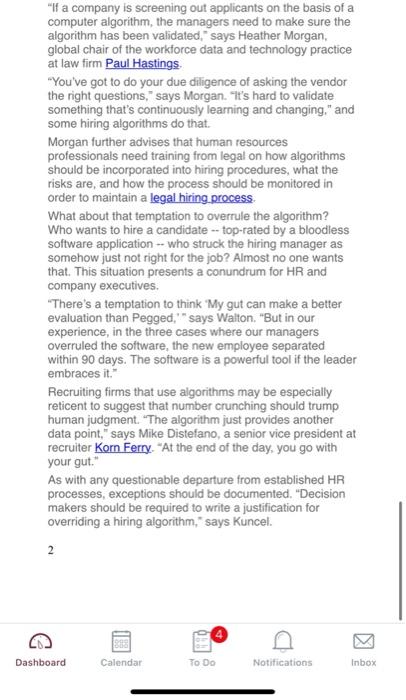
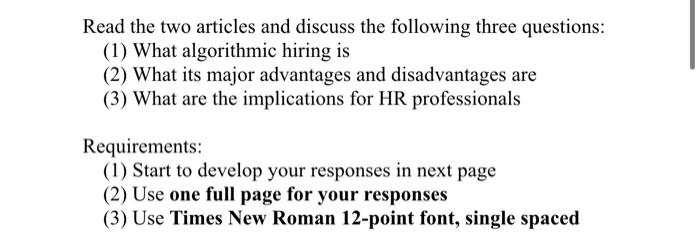
Hiring algorithms have been in the headlines -- and for good reason. Study after study, including this recent whitepaperpublished by the National Bureau of Economic Researchers, suggest that number-crunching can produce higher-quality hires than recruiters and hiring managers. What's not to like about the promise of boosting objectivity in candidate assessment, reduced bias and the ability to identify applicants that are most likely to become productive employees with long tenure? Before employers, recruiters or staffing firms jump on the analytics band wagon, they need to understand what goes into data-driven talent acquisition. So let's take a look at what goes into hiring algorithms and how data analytics might help organizations set aside human foibles to hire the best candidate. What is an algorithm, anyway? For our purposes, an algorithm is a set of operations -- from calculating simple averages to performing complex statistical analysis. When applied to a large quantity of data, it generates information that decision makers can act on. In evaluating candidates, data types can include resumes. publicly available information, as well as responses to candidate assessments that delve into personality, temperament, aptitude for skills such as problem solving and more. The rules and operations of this calculation might be as simple as a spreadsheet that consolidates multiple ratings of a candidate's potential or as complex as state-of-the-art predictive analytics or for that matter, machine learning. Can software and silicon offer more balanced evaluations than gray matter? Proponents of hiring algorithms -- and their legion is growing -- want to put human foibles in their place when it comes to finding employees. "We haven't concluded that human judgments have no value," says Nathan Kuncel, professor of psychology at the University of Minnesota. "It's just that these judgments come with a package that includes bias. People can get hung up on one piece of information and make too much of it." Using big data to evaluate individual candidates. More complex hiring algorithms use data science to correlate the performance of large numbers of employees with data gathered on candidates. "We've collected 2.5 million assessments of professionals, studied human performance factors, looked at what profile works best for each given role," says Mike Distefano, a Consider the data sources. Hiring algorithms may work within a narrow scope of information --such as the results of a single assessment -- or with a wide range of data. "We're collecting information from three kinds of sources: publicly available information, background info supplied by candidates such as a resume and interaction data," which can include metrics of keystrokes, says Mike Rosenbaum, CEO of Pegged Software, a firm that specializes in hiring algorithms for the healthcare industry, Odd as it may sound, in some cases the number of keystrokes or words that a candidate enters in response to an assessment question can sometimes be a better correlation with future job performance than the actual content of that response. Correlating the candidate's data with employee performance. "We compare each person's data set with outcomes like first-year retention," says Rosenbaum. "We've seen lower turnover for every client, with a median reduction of 38 percent." Pegged's software also weighs in with predictions of whether each applicant is likely to drive up or down institutional quality metrics, such as patient satisfaction and medical errors. Some hiring algorithms also correlate candidate data with employment outcomes such as productivity and performance ratings. Some employers put faith in black-box hiring algorithms. Let's face it: Data science is complex. Thus many corporate decision makers won't understand the inner workings of the software that will have major input into who gets hired. "What appealed to me is that Pegged aggregates our own data with other data in their database," says Carlyle Walton, CEO of Metroplex Health System in Killeen, Texas. "I love the concept, even though I don't understand all the math." Scientific, maybe. Irreproachable, no. "The Pegged Software solution employs a strictly scientific approach," says the company's web site. The software uses mathematical equations to enable what Pegged calls evidence-based hiring. But not all algorithms automatically eliminate the human tendency for individuals to favor people who are like themselves. And a lot of expertise may be required to evaluate the potential of an algorithm to avoid bias in the context of a given data set. Algorithms can't always ensure diversity. Even when an organization has won broad buy-in for diverse hiring, there are many recruitment factors that algorithms alone cannot compensate for -- such as a homogeneous pool of applicants. Google, for example, has very publicly aired its goal of changing the demographic makeup of its workforce, which is overwhelmingly male and white or Asian. Yet the 2015 edition of Google's diversity report, which shows that only 2 percent of its staff are black, 3 percent Hispanic, and 30 percent are women, points to the challenges of changing workforce demographics. As noted in part one of our look at algorithmic hiring, many studies, including this research from the American Psychological Association, show that when employers lean heavily on hiring algorithms, their workers are more productive, earn higher performance ratings (from humans, not just computers) and have higher employee retention rates. But replacing human judgment with fancy analytics, trendy big data, or a spreadsheet tally of qualifications can create challenges in organizational psychology. Here's our brief tour of these complex issues and some approaches to incorporating algorithms into your organizational hiring. The starting point: It's not easy to hire the right people and keep them Many business veterans want to believe they're developed an eye for candidates who will succeed. Yet countless organizations have found out the hard way that a hiring manager's instinct and a recruiter's experience often fall short. "For many years we struggled with recruitment and retention," says Carlyle Walton, CEO of Metroplex Health Systemin Killeen, Texas. "We were always looking for tools to improve this." So Metroplex decided to harness hiring algorithms to do much of the heavy lifting. After choosing a product, the next hurdle was to persuade managers to use it by involving them in the implementation process. "This journey started with us having managers identity the top performers," says Walton. "This helped to get buy-in. We have about half of departments doing it." Managers pitching the implementation of hiring algorithms will indeed "encounter a lot of resistance," says Nathan Kuncel, a professor of psychology at the University of Minnesota. "We can get a lot of good from the algorithm, but still keep it acceptable to people by emphasizing the roles that they continue to play in the process." For the time being, Metroplex is allowing use of the software to spread organically through the organization. Each department decides whether to use Pegged Software's solution. A department sets its own threshold with the software, says Walton, in terms of the level of probability that a given candidate will make a good employee. Algorithms have their limits, but they do boost quality of hiring Another key issue is the functionality that algorithms can fulfill. "We use the software for all positions in a hospital below the executive level: nurse, admitting clerk, pharmacy, and so on," says Mike Rosenbaum, CEO of Pegged. Algorithms don't work for executive recruitment -- at least not yet -- given the insufficient amount of data available due to the small number of positions at this level, according to Rosenbaum. Walton believes the use of hiring algorithms has improved Metroplex's workforce. "We have seen reductions in turnover and increases in quality scores since we started using software to evaluate candidates; this is one piece of what has contributed to these improvements." Taking people out of hiring decisions doesn't eliminate bias liability. For many employers, one of the top reasons for adopting hiring algorithms is the very human inclination, whether conscious or not, to hire people who are like oneself. And that can be illegal if the similarity is about race, gender, religion, disability or other characteristics that define protected classes "If a company is screening out applicants on the basis of a computer algorithm, the managers need to make sure the algorithm has been validated," says Heather Morgan, global chair of the workforce data and technology practice at law firm Paul Hastings "You've got to do your due diligence of asking the vendor the right questions," says Morgan. It's hard to validate something that's continuously learning and changing," and some hiring algorithms do that. Morgan further advises that human resources professionals need training from legal on how algorithms should be incorporated into hiring procedures, what the risks are, and how the process should be monitored in order to maintain a legal hiring process What about that temptation to overrule the algorithm? Who wants to hire a candidate -- top-rated by a bloodless software application -- who struck the hiring manager as somehow just not right for the job? Almost no one wants that. This situation presents a conundrum for HR and company executives "There's a temptation to think 'My gut can make a better evaluation than Pegged," says Walton. "But in our experience, in the three cases where our managers overruled the software, the new employee separated within 90 days. The software is a powerful tool if the leader embraces it." Recruiting firms that use algorithms may be especially reticent to suggest that number crunching should trump human judgment. "The algorithm just provides another data point," says Mike Distefano, a senior vice president at recruiter Korn Ferry. At the end of the day, you go with your gut." As with any questionable departure from established HR processes, exceptions should be documented. "Decision makers should be required to write a justification for overriding a hiring algorithm," says Kuncel. Dashboard Calendar To Do Notifications Inbox Read the two articles and discuss the following three questions: (1) What algorithmic hiring is (2) What its major advantages and disadvantages are (3) What are the implications for HR professionals Requirements: (1) Start to develop your responses in next page (2) Use one full page for your responses (3) Use Times New Roman 12-point font, single spaced









 Study Help