





Question: Article review: 3 MILITARY STRATEGY PERSPECTIVE Sylvie Jackson BASIC PRINCIPLES It could be considered that much of what we think of as strategy and indeed

Article review:
Article review: 3 MILITARY STRATEGY PERSPECTIVE

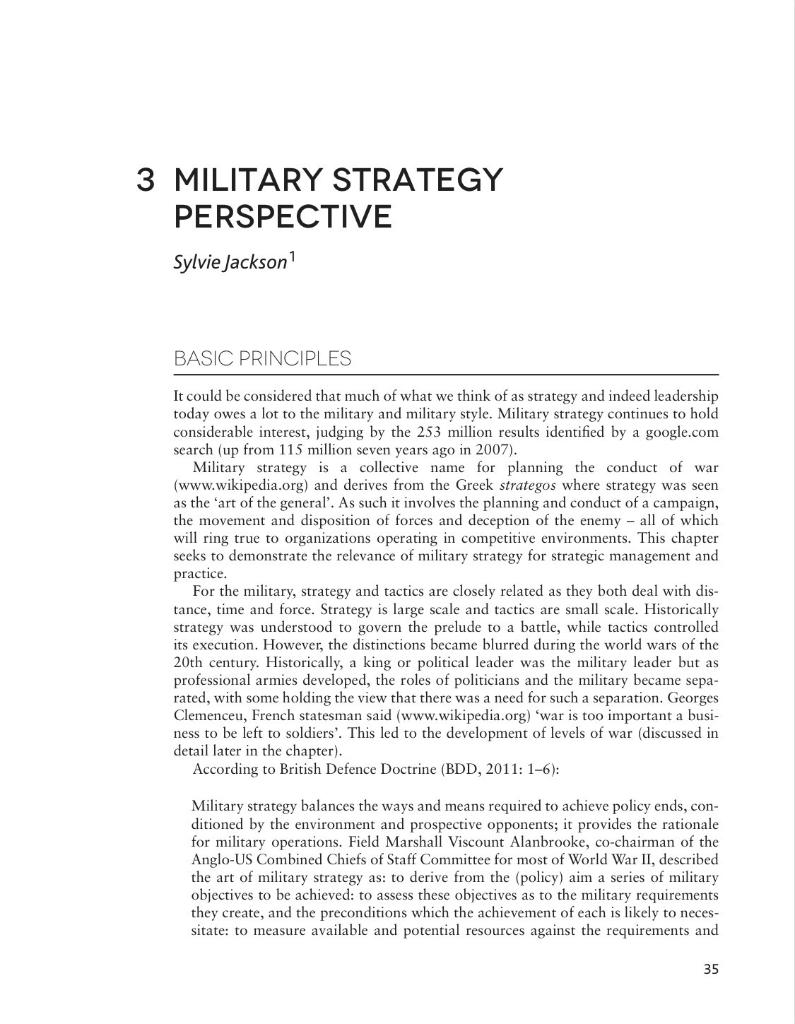
3 MILITARY STRATEGY PERSPECTIVE Sylvie Jackson BASIC PRINCIPLES It could be considered that much of what we think of as strategy and indeed leadership today owes a lot to the military and military style. Military strategy continues to hold considerable interest, judging by the 253 million results identified by a google.com search (up from 115 million seven years ago in 2007). Military strategy is a collective name for planning the conduct of war (www.wikipedia.org) and derives from the Greek strategos where strategy was seen as the art of the general'. As such it involves the planning and conduct of a campaign, the movement and disposition of forces and deception of the enemy - all of which will ring true to organizations operating in competitive environments. This chapter seeks to demonstrate the relevance of military strategy for strategic management and practice. For the military, strategy and tactics are closely related as they both deal with dis- tance, time and force. Strategy is large scale and tactics are small scale. Historically strategy was understood to govern the prelude to a battle, while tactics controlled its execution. However, the distinctions became blurred during the world wars of the 20th century. Historically, a king or political leader was the military leader but as professional armies developed, the roles of politicians and the military became sepa- rated, with some holding the view that there was a need for such a separation. Georges Clemenceu, French statesman said (www.wikipedia.org) 'war is too important a busi- ness to be left to soldiers'. This led to the development of levels of war (discussed in detail later in the chapter). According to British Defence Doctrine (BDD, 2011: 1-6): Military strategy balances the ways and means required to achieve policy ends, con- ditioned by the environment and prospective opponents; it provides the rationale for military operations. Field Marshall Viscount Alanbrooke, co-chairman of the Anglo-US Combined Chiefs of Staff Committee for most of World War II, described the art of military strategy as: to derive from the policy) aim a series of military objectives to be achieved: to assess these objectives as to the military requirements they create, and the preconditions which the achievement of each is likely to neces- sitate: to measure available and potential resources against the requirements and 35

Step by Step Solution

There are 3 Steps involved in it

1 Expert Approved Answer
Step: 1 Unlock blur-text-image

Question Has Been Solved by an Expert!

Get step-by-step solutions from verified subject matter experts

Step: 2 Unlock
Step: 3 Unlock

Students Have Also Explored These Related General Management Questions!