







Question: article, you will need to cite the article in APA format. Sleeping with the Enemy: Wikipedia in the College Classroom 249Students, these faculty would say,
article, you will need to cite the article in APA format.
Sleeping with the Enemy: Wikipedia in the College Classroom 249Students, these faculty would say, need to be more aware of the drawbacksof Wikipedia and the need to be careful using it. Many college instruc-tors ban the use of Wikipedia for these reasons. But, if critical thinkingis part of a college education, why not teach students about the nature ofWikipedia like we do for primary and secondary sources and thus help tosharpen their critical awareness?Lycoming College is a small, private liberal arts college located inWilliamsport, Pennsylvania. With an enrollment of about 1,500 students,Lycoming is a close-knit community where faculty know their studentsand where faculty collaborations are strongly encouraged. Lycoming'sstudents are like most other undergraduates?^trying, often for the first time,to do research. They attempt to find at least nominally relevant resources,preferably available in ill-text online. Wikipedia seems a "godsend"to these novice researchers; one need only Google the topic, see whatWikipedia has to say, and "Voila!"?research completed. Two faculty atLycoming College wanted to incorporate this resource into a research andinformation literacy project, with the goal of enhancing students' criticalawareness of its strengths and limitations.Dr. Cullen J. Chandler, Assistant Professor in the History Departmentat Lycoming College, has struggled, like other faculty members, to helpstudents learn how to do appropriate college-level research (i.e., goingbeyond Google.) A purist. Chandler believes that traditional publicationslike books and journals are still the gold standard, as they are produced byexperts and are frequently peer-reviewed. He also sees the quite valuablepotential of the Internet in making quality sources widely available as wellas the many online resources that are not necessarily of high quality. Tiredof seeing Wikipedia in his students' bibliographies. Chandler decided toban its use entirely for papers in his classes. Use Wikipedia and the paperwould receive a grade of zero, no questions asked.This banning tactic represents one end of the spectrum of ideas collegeprofessors have about Wikipedia; on the other end are those faculty mem-bers who tolerate, even if they do not embrace, its use. There are thosewho instead say, "Why rush to ban the single most impressive collaborativeintellectual tool produced at least since the Oxford English Dictionary,which started when a non-academic organization, the Philological Society,decided to enlist hundreds of volunteer readers to copy down unusual us-ages of so-called unregistered words."'In the summer of 2007, Chandler saw an idea in the "H-Teach: Teachinghistory in the University" listserv that made him reconsider his approachto the place of Wikipedia in his classes.'" The listserv dialogue was abouta class project that had students deliberately insert false information into 250 Cullen J. Chandler and Alison S. Gregoryexisting Wikipedia articles, with the goal of teaching students that anyonecan edit the famous free encyclopedia and not always for the greater good.Intrigued with the idea of embracing the controversial resource ratherthan fighting it. Chandler began to consult with Alison Gregory, an As-sistant Professor in the Snowden Library at Lycoming College. "What if,instead of having the students tamper with Wikipedia, we had the studentsactually write the articles?" he asked. Chandler and Gregory thus setabout constructing an assignment that would blend research, technology,and information-literacy goals with the standard aim of building criticalthinking abilities.The perfect opportunity for this enterprise presented itself in the form of"History 232: The Rise of Islam," scheduled for the Spring 2008 semester.Twenty-six students registered for the class?a manageable number for aproject of this nature?and it is a course that addresses topics that are eitherfrequently debated (i.e., jihad, Sharia, and the Crusades) or are little known(i.e., the battle of Jacob's Ford, Bukhtishu, and Abd al-Aziz ibn Musa).The goals of this project were fourfold. Chandler and Gregory wantedthe students to leam how to do college-level research, in this case ontopics of Islamic history. The second goal was to have the students leamabout the use of Wikipedia as a research tool, with the third goal of havingstudents leam wiki-technology. The final goal was to have the studentsbecome better, more informed "information consumers."After students in the course paired up. Chandler gave them a list oftopics from which to choose. These topics were either completely miss-ing from Wikipedia, or they had only a "stub" article (the designation thatWikipedia gives to very brief articles that are lacking in stmcture.)" Thefirst stage ofthe project was to have the students research their topics, thenwrite a four- to five-page paper based on primary and scholarly sources,and finally (after approval from Chandler) either create a new Wikipediaarticle or insert their research into the appropriate existing article.While Chandler was generating a list of potential topics, Gregory wasengrossed in a crash-course in the mechanics of Wikipedia. While it isquite simple to make minor edits or additions to existing text, it provedslightly more complex to establish a course page and to leam Wikipedia'scoding system. Much to her relief, Gregory found a Wikipedia ProjectsPage that included a boilerplate template for projects of this nature.'^ TheWikipedia Projects Page shows that Wikipedia is aware of, and in supportof, initiatives like the Lycoming College Islamic history research venture.The Lycoming History 232 course page follows the pattem ofthe projecttemplate, giving students an introduction to the project, brief exercises tocomplete, and project deadlines.'^Early in the semester. Chandler brought the students to the multimedia Sleeping with the Enemy: Wikipedia in the College Classroom 251library classroom for a session on finding appropriate resources for re-searcing their topics, and also for a discussion ofthe Wikipedia projectand its mechanics. The first step was to show students how to establish ausemame?Gregory also stressed the importance of always logging in toWikipedia prior to making any edits, so the edits can be tracked by user-name, and Chandler would be able to verify the students' work. Gregoryinstructed the students to not use their real names, but to create a namethat was neutral and at least did not detract from the group's credibility.One student group's first attempt to register a usemame?"thejesuschrist-vampirehunters"?was almost immediately censored by Wikipedia, whichwas an interesting first lesson for the students.After establishing a usemame, students were asked to go to the coursepage where they had to complete three exercises. The first exercise askedstudents to experiment in a Wikipedia Sandbox, a special page designedfor trial-and-error leaming. When properly created, the Sandbox is auto-matically restored to its original version on a regular basis. The Sandboxfor this course page was not correctly coded, requiring periodic manualresets by Gregory. Despite this minor setback, the practice sessions paiddividends. Students did their Sandbox practice in pairs during class, andtheir classmates, as well as Chandler and Gregory, could hear expressionsof triumph and/or frustration. True to the nature ofthe wiki-enterprise,collaboration was the key ingredient; pairs of students helped other pairswith technical issues, modified each others' Sandbox entries, and workedwith each other both online and by calling out across the room.The second exercise was to make a small change to any Wikipediaarticle. The students were allowed to choose any topic, since the purposeofthe exercise was to expose them to the Wikipedia editing system. Manyof the students made changes to the Wikipedia article a:bout LycomingCollege; some made changes to articles about favorite cartoon characters,movies, or music groups. For this exercise, one pair of students (using theusemame "Screaminghistoriansofdoom") created the athletics section ofthe Wikipedia entry for Lycoming College.'"?The third exercise required students to add a reference to a Wikipediaarticle (most of the students added a reference for the change they hadmade for Exercise 2). Because this project was for a college course, thestudents would have to document the sources they used just as they wouldfor a more traditional research paper. Chandler and Gregory wanted thestudents to be familiar with how Wikipedia incorporates the documentationof sources, an important lesson to leam for both technical and academicreasons. "Screaminghistoriansofdoom," when creating the athletics sec-tion for Lycoming College, linked to the college's athletic pages using theWikipedia code editing features. 252 Cullen J, Chandler and Alison S, GregoryIn addition to wiki-technology skills, students deepened their abilitiesto work with other online technologies, Lycoming College uses an open-source course management system called Moodle, Within the Moodleapplication for History 232 was a link to the Wikipedia course page, sothat students could easily access the page, along with an online fommdedicated to this project. Students were required to record their Wikipe-dia usemames on one thread within the fomm, and additional threads foreach exercise allowed students to document their work in the Sandbox, thechanges they had made to an existing article, and the references they hadadded. The fomm functioned as a communal message board for studentsto report their progress, ask questions, and express fmstrations. Chandlerand Gregory used the fomm to respond to questions and to track effortsand accomplishments.The students had approximately seven weeks to research their topics andto compose the four- to five-page "working papers," Chandler reviewedthese papers and made suggestions to strengthen the content; all contenthad to receive approval from Chandler before the students were allowedto add their work to Wikipedia. These hard-copy papers, rather than theWikipedia entries, were the basis for the students' grades on the project.This was done for two reasons: first, where students were adding to anexisting article, they frequently had to reapportion their work to insertparagraphs (and sometimes only sentences) to blend with the existingcontent, and secondly, given the ever-changing nature of Wikipedia, weanticipated that some ofthe students' work would be almost immediatelychanged and we wanted to be sure that the unadulterated work was whatwas graded.After all ofthe groups had posted their research on Wikipedia, the proj-ect moved into a second stage. The students were required to monitor thearticles to see what changes other users would make to the page as a wholeand to the students' information in particular. The students posted theirfindings?and often irritated comments?on the fomm within Moodle,addressing what changes others had made to "their" Wikipedia page. Thestudents' ownership ofthe articles was overwhelming! For the studentsin this course, it was the first time they had the "opportunity to becomeinvolved with creative work that, throughout the past century, has beenlargely a one-way stream from producers to consumers,"'^Several intriguing incidents arose from this project. One pair of stu-dents (self-dubbed "iraka_verona") eamed the honor of having a fact fromtheir article on "Islamic Civilization During the European Renaissance"appear in the Wikipedia "Did you know..," box on March 11, 2008, justsix days after creating the page. "Did you know,,." features vignettesfrom newly created articles and recently expanded stub articles.'* It was Sleeping with the Enemy: Wikipedia in the College Classroom 253a mark of distinction for the students to have their work highlighted thisway for public consumption.Unfortunately, not all ofthe student groups fared so well. In addition tothe one student pair who had their initial usemame censored, the studentsencountered other breaches of "wikietiquette." Wikipedia banned one pairof students for a 72-hour period because they repeatedly re-posted copy-righted song lyrics on the "History of Istanbul" page; the students wereindignant because they felt that a simple reference to the musical groupshould negate the copyright issue (an unanticipated lesson in copyrightas opposed to plagiarism). Another student group copied a picture from amovie studio site and posted it on Wikipedia; the image was removed andthe students were prepared to re-post until Gregory reminded them thatWikipedia could ban them, too. One student article on Sharia (Islamic law)suffered from severe, profane vandalism; Wikipedia "bots" automaticallydetected the offensive words and reverted the changes to the previous articleversions, but the page history still shows these incidents.Perhaps the most interesting incident resulting from this project wasthat a professor at Illinois Central College contacted Chandler asking tosee a copy of a student paper. Lycoming College and Illinois CentralCollege both utilize Tumitin.com, a subscription-based plagiarism preven-tion service. (Chandler required the students in this class to submit theirwork through Tumitin.com prior to putting the material on Wikipedia.)Evidently, a student at the Illinois Central College plagiarized from aWikipedia page that had been created by a student group involved in thisproject. Tumitin.com reported the match with the Lycoming students'paper, which had become the Wikipedia article. There was much twitter-ing in the classroom about this?could you imagine taking your researchfrom some other undergraduate taking basically the same class?! A veryenlightening lesson indeed. The students began to see the importanceof author authority by contemplating the differences between a creditedauthor and an anonymous author.The students leamed many lessons from this project; some were inten-tional and some were added bonuses. Chandler and Gregory wanted thestudents to leam that anyone could have written the Wikipedia entry?doyou really want to be quoting a person whose usemame is "pinkbunnyslip-pers" in your research paper? The author could be an expert with a senseof humor, or he or she could be the crazy cat collector down the street. Un-intentionally, the students leamed that Wikipedians do monitor usemames,profanity, and copyright. They also leamed that their work is not sacrosanctand that there are many other Wikipedia editors out there who may or maynot be polite in pointing out that the article is poorly written, or who maychange the article contents to information that contradicts the sources! 254 Cullen J. Chandler and Alison S. GregoryAn unintended?but most welcome?project outcome was that thestudents took a great deal of ownership of the articles that they createdor supplemented. Knowing that their research would be out there for theworld to see really made them more cautious with what they wrote thanthey would have been if they thought the only audience their work wouldhave was Dr. Chandler and a drawer in a filing cabinet. "I'm proud ofwhat we wrote," commented one student. Another commented, "We hadto look at dozens of sources to find all of the necessary information foreven this short article. We compiled it all in one place and that will behelpful for other people who want to know about this topic."Student reactions to this project ranged from irritation to pride. Be-ginning on the first day of class, when Chandler introduced the projectto the students, they reacted with a greater degree of worry and anxietythan expected. They all acknowledged using Wikipedia and yet they wereterribly worried about how complex they feared the project would be andthey voiced many complaints about having to do another group project.On the day of the library session where the actual mechanics of Wikipediawere introduced, student reactions eased. Once they saw how easy it was0 make changes, their anxiety levels decreased and they even began tocomment that, "this isn't such a big deal."On the last day of class, the students had the opportunity to do a "showand tell" of their articles, the page histories, and the discussion pages forthe articles. The students reactions by and large were indignation?howdare someone make changes to our article?! One student group referredto the article's other editors as "Wikijerks." For the few articles that sawno changes by others, those students now consider themselves to be theworld's foremost experts (at least through Wikipedia) on the topic. Thisthought brought a fair amount of amusement to the class at the expenseof said "experts," making the students contemplate once again the valueof authority. Would you cite research done by your classmate?How well did the project meet the goals? Chandler and Gregory werepleased with the outcome for the first goal?having students learn to docollege-level research. The students did learn how to locate and use theappropriate research sources for this course through a variety of print andelectronic resources. As a whole, the research that they did was of a goodquality, complete with ample references. They utilized a number of printencyclopedias, an online database dedicated to Islamic studies, the coursetextbooks, and a variety of other resources. Chandler was pleased withthe overall quality of the papers generated by this class and saw a strongerresearch base than he had seen with previous semesters' papers.The second project goal was to increase the students' awareness of usingWikipedia as a research tool. Most of us, as academics, have consulted Sleeping with the Enemy: Wikipedia in the College Classroom 255Wikipedia for fact-checking or other simple information needs. Most ofour students have consulted Wikipedia and have approached it relativelyuncritically. The students started off as avid Wikipedia fans. One ofthemany hidden benefits of this project (from the professors' viewpoint,anyway) was that the students could not use Wikipedia?there was noinformation on their topics because they were to create it! By the end ofthe project, the majority of students in the class (roughly 80%) said thatthey now thought Wikipedia was less useful than they originally thought,but that it is still a good place to find citations directing readers to usablesources.The students exceeded expectations for goal three (leaming wiki-technology.) In fact, the students leamed more about the ftanctionality ofwikis than did Chandler or Gregory. They became quite adept with thewiki-technology and used it effectively, taking advantage of Wikipedia for-matting options such as adding images, linking to non-Wikipedia sources,and using the Wikipedia discussion: pages quite adeptly. Two studentsexpressed their discomfort with computers in general and said that madethe project difficult for them, but that they both found- the project usefulbecause it made them aware of how a wiki works and they also becamemore comfortable with computers in general.The fourth and final goal of the project was to help the students becomebetter, more informed "information- consumers." To succeed with, thisproject, the students had to decide what kinds of information they needed,find said information, then absorb and integrate it. They had to evaluatethe existing Wikipedia articles to decide what content could stay and whatshould be removed, or replaced by their own research. These studentsdefinitely became' more educated and more critically aware "informationconsumers."Fundamentally, the students came to appreciate what Wikipedia is and-what it is not. Students expressed that they think Wikipedia is acceptablefor a quick reference, and that the references for the individual articles canbe quite helpful, but they were quick to point out that Wikipedia is not thebe all and end all of research. As one student remarked at the conclusionofthe project, "It's okay for the layperson to get an overview, but it's notgood for research unless you just use it for the references."Jimmy Wales would be proud! 256 Cullen J. Chandler and Alison S. GregoryNotes1. University of Pennsylvania, "Linking in Web 2.0 Panel" at the HyperlinkedSociety: Questioning Connections in the Digital Age Conference, 9 June 2006,
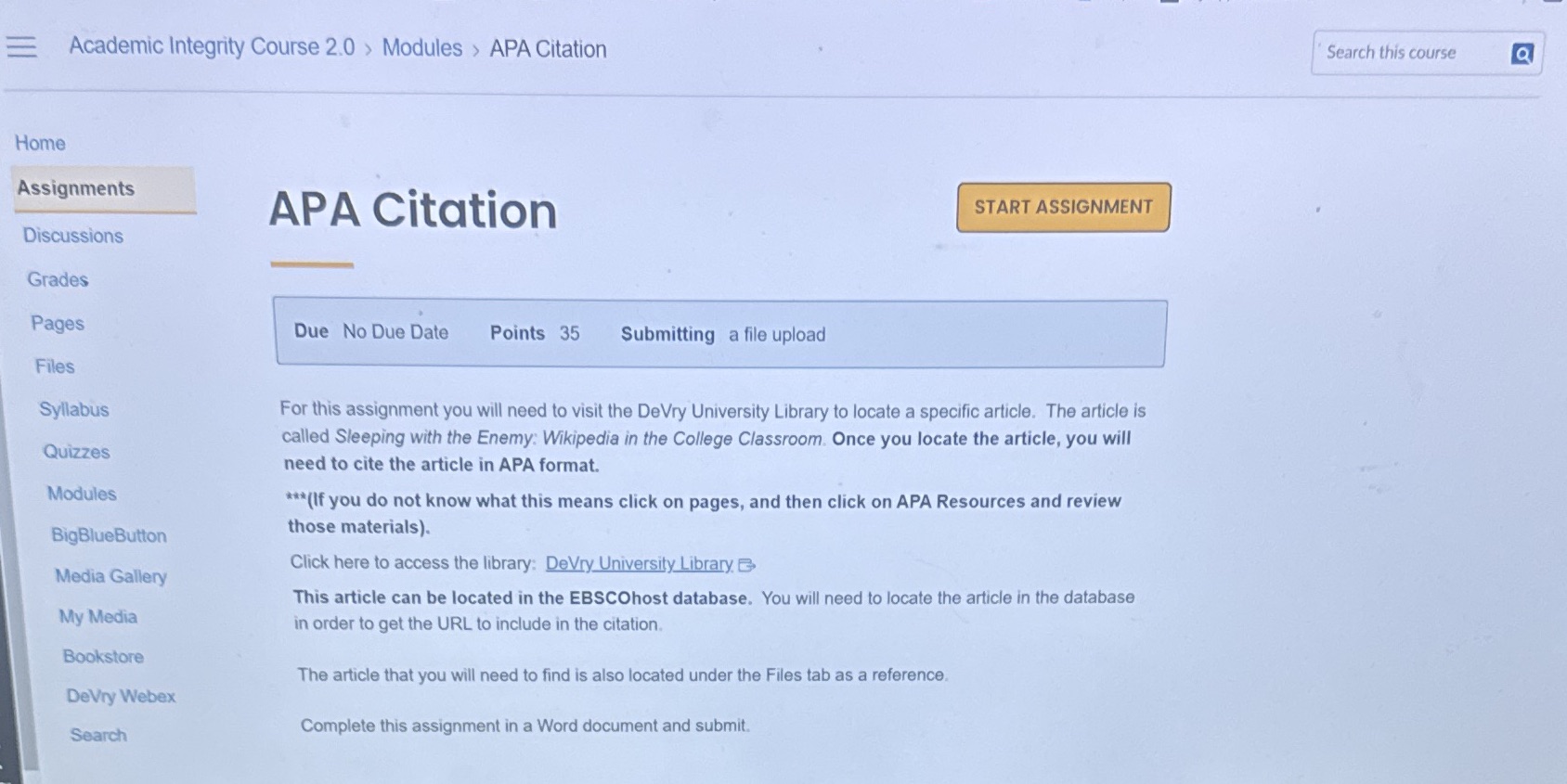
9 / 12. For this assignment you will need to visit the DeVry University Library to locate a specific article. The article is called Sleeping with the Enemy: Wikipedia in the College Classroom. Once you locate the article, you will need to cite the article in APA format.
***(If you do not know what this means click on pages, and then click on APA Resources and review those materials).
Click here to access the library: DeVry University LibraryLinks to an external site.
This article can be located in the EBSCOhost database. You will need to locate the article in the database in order to get the URL to include in the citation.
The article that you will need to find is also located under the Files tab as a reference.
Complete this assignment in a Word document and submit.
 Academic Integrity Course 2.0 > Modules > APA Citation Search this course Q Home Assignments APA Citation START ASSIGNMENT Discussions Grades Pages Due No Due Date Points 35 Submitting a file upload Files Syllabus For this assignment you will need to visit the Devry University Library to locate a specific article. The article is called Sleeping with the Enemy: Wikipedia in the College Classroom. Once you locate the article, you will Quizzes need to cite the article in APA format. Modules *(If you do not know what this means click on pages, and then click on APA Resources and review BigBlueButton those materials). Click here to access the library: Devry University Library. Media Gallery This article can be located in the EBSCOhost database. You will need to locate the article in the database My Media in order to get the URL to include in the citation. Bookstore The article that you will need to find is also located under the Files tab as a reference. Devry Webex Search Complete this assignment in a Word document and submit
Step by Step Solution
There are 3 Steps involved in it

Get step-by-step solutions from verified subject matter experts
 Study Help