


Question: Articles: CS6 Apple Obsolescence Wired Article 2020.pdf CS6 Apple Obsolescence Wired Article 2017.pdf DUE by midnight Wednesday, 10/12 Case study: Apple iPhones and Planned Obsolescence:

Articles:
CS6 Apple Obsolescence Wired Article 2020.pdf
CS6 Apple Obsolescence Wired Article 2017.pdf
Articles: CS6 Apple Obsolescence Wired Article
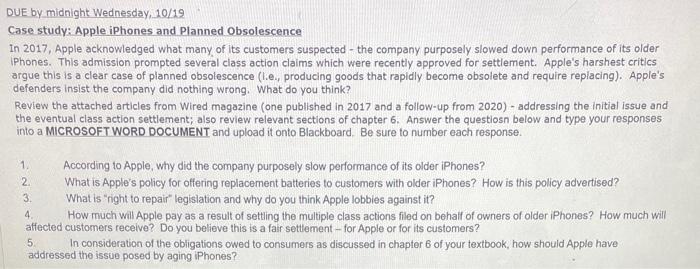
DUE by midnight Wednesday, 10/12 Case study: Apple iPhones and Planned Obsolescence: In 2017, Apple acknowledged what many of its customers suspected - the company purposely slowed down performance of its older IPhones. This admission prompted several class action claims which were recently approved for settlement. Apple's harshest critics argue this is a clear case of planned obsolescence (lie., producing goods that rapidly become obsolete and require replacing). Apple's defenders insist the company did nothing wrong. What do you think? Review the attached articles from Wired magazine (one published in 2017 and a follow-up from 2020) - addressing the initial issue and the eventual class action settlement; also review relevant sections of chapter 6 . Answer the questiosn below and type your responses into a MICROSOFT WORD DOCUMENT and upload it onto Blackboard. Be sure to number each response. 1. According to Apple, why did the company purposely slow performance of its older iPhones? 2. What is Apple's policy for offering replacement batteries to customers with older iPhones? How is this policy advertised? 3. What is "right to repair" legislation and why do you think Apple lobbies against it? 4. How much will Apple pay as a result of settling the multiple class actions filed on behalf of owners of older iPhones? How much will affected customers receive? Do you believe this is a fair settement-for Apple or for its customers? 5. In consideration of the obligations owed to consumers as discussed in chapter 6 of your textbook, how should Apple have addressed the issue posed by aging iPhones? DUE by midnight Wednesday, 10/12 Case study: Apple iPhones and Planned Obsolescence: In 2017, Apple acknowledged what many of its customers suspected - the company purposely slowed down performance of its older IPhones. This admission prompted several class action claims which were recently approved for settlement. Apple's harshest critics argue this is a clear case of planned obsolescence (lie., producing goods that rapidly become obsolete and require replacing). Apple's defenders insist the company did nothing wrong. What do you think? Review the attached articles from Wired magazine (one published in 2017 and a follow-up from 2020) - addressing the initial issue and the eventual class action settlement; also review relevant sections of chapter 6 . Answer the questiosn below and type your responses into a MICROSOFT WORD DOCUMENT and upload it onto Blackboard. Be sure to number each response. 1. According to Apple, why did the company purposely slow performance of its older iPhones? 2. What is Apple's policy for offering replacement batteries to customers with older iPhones? How is this policy advertised? 3. What is "right to repair" legislation and why do you think Apple lobbies against it? 4. How much will Apple pay as a result of settling the multiple class actions filed on behalf of owners of older iPhones? How much will affected customers receive? Do you believe this is a fair settement-for Apple or for its customers? 5. In consideration of the obligations owed to consumers as discussed in chapter 6 of your textbook, how should Apple have addressed the issue posed by aging iPhones

Step by Step Solution

There are 3 Steps involved in it

1 Expert Approved Answer
Step: 1 Unlock blur-text-image

Question Has Been Solved by an Expert!

Get step-by-step solutions from verified subject matter experts

Step: 2 Unlock
Step: 3 Unlock

Students Have Also Explored These Related General Management Questions!