







Question: artificial intelligence Problem 1 You are asked to design a Naive Bayes detector to detect drones using features captured from 3 sensors: Telemetry frequency band,
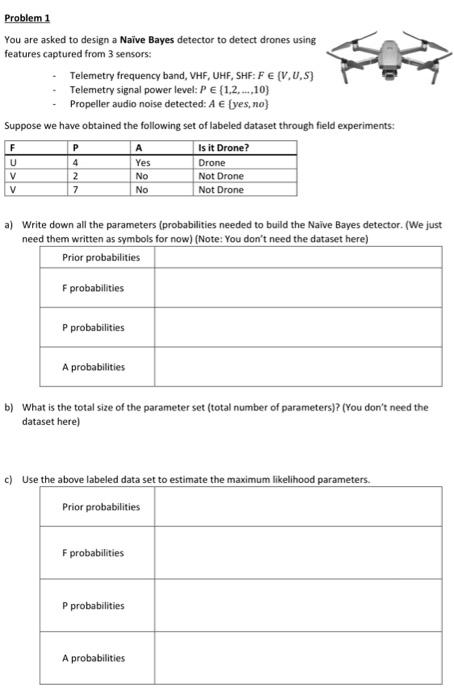
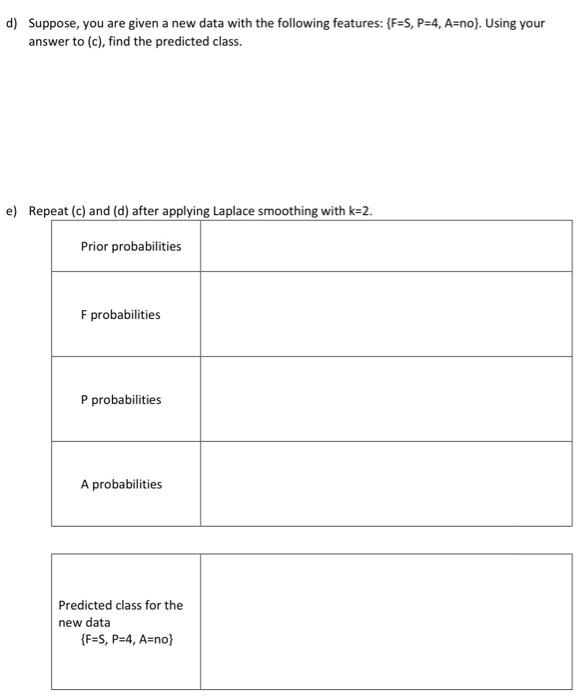
Problem 1 You are asked to design a Naive Bayes detector to detect drones using features captured from 3 sensors: Telemetry frequency band, VHF, UHF, SHF: FE [V.0.5) Telemetry signal power level: PE (1,2....,10) Propeller audio noise detected: A (yes, no} Suppose we have obtained the following set of labeled dataset through field experiments: Is it Drone? Drone Not Drone Not Drone F kkc 4 2 7 A Yes No No a) Write down all the parameters (probabilities needed to build the Naive Bayes detector. (We just need them written as symbols for now) (Note: You don't need the dataset here) Prior probabilities F probabilities P probabilities A probabilities b) What is the total size of the parameter set (total number of parameters)? (You don't need the dataset here) c) Use the above labeled data set to estimate the maximum likelihood parameters. Prior probabilities F probabilities P probabilities A probabilities d) Suppose, you are given a new data with the following features: {F=S, P=4, A=no). Using your answer to (c), find the predicted class. e) Repeat (c) and (d) after applying Laplace smoothing with k=2. Prior probabilities F probabilities P probabilities A probabilities Predicted class for the new data {F=S, P=4, A=no}
Step by Step Solution
There are 3 Steps involved in it

Get step-by-step solutions from verified subject matter experts
 Study Help