







Question: artificial intelligence subject 3. (12 points) Imagine a problem where there are n numbered blocks on top of a table. Blocks can be stacked on
artificial intelligence subject
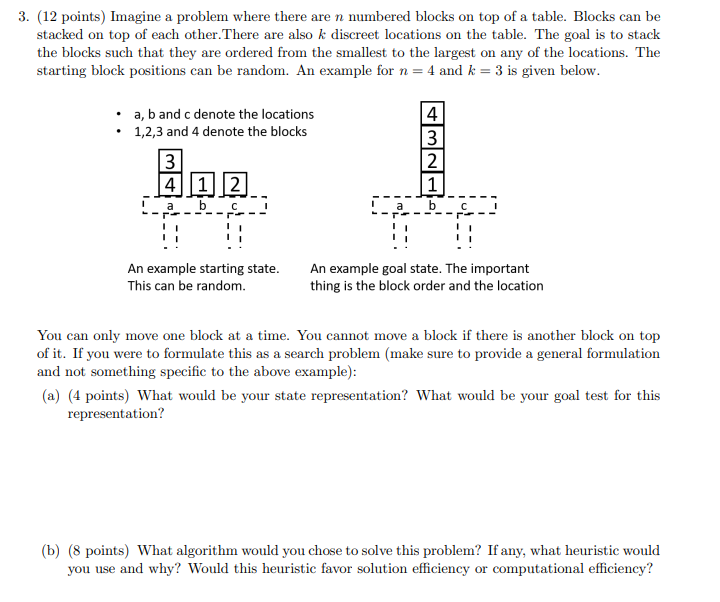
3. (12 points) Imagine a problem where there are n numbered blocks on top of a table. Blocks can be stacked on top of each other. There are also k discreet locations on the table. The goal is to stack the blocks such that they are ordered from the smallest to the largest on any of the locations. The starting block positions can be random. An example for n = 4 and k = 3 is given below. a, b and c denote the locations 1,2,3 and 4 denote the blocks 3 412 . 4 3 2 1 a b a An example starting state. This can be random. An example goal state. The important thing is the block order and the location You can only move one block at a time. You cannot move a block if there is another block on top of it. If you were to formulate this as a search problem (make sure to provide a general formulation and not something specific to the above example): (a) (4 points) What would be your state representation? What would be your goal test for this representation? (b) (8 points) What algorithm would you chose to solve this problem? If any, what heuristic would you use and why? Would this heuristic favor solution efficiency or computational efficiency
Step by Step Solution
There are 3 Steps involved in it

Get step-by-step solutions from verified subject matter experts
 Study Help