







Question: As a C program ..1 Verizon? 11:43 AM Lab 6.docx Project 1 (Check Protection) Computers are frequently used in check-writing systems, such as payroll and
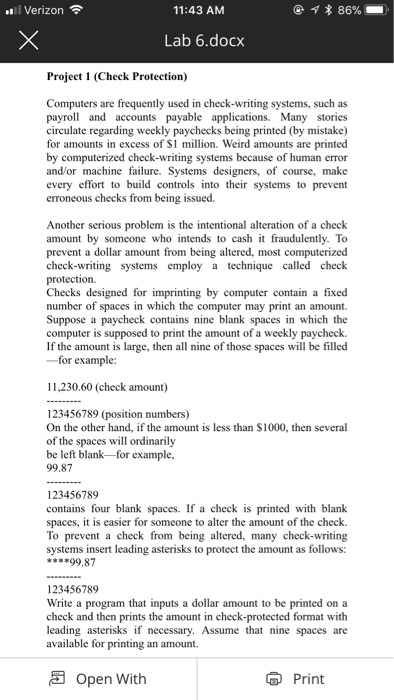
..1 Verizon? 11:43 AM Lab 6.docx Project 1 (Check Protection) Computers are frequently used in check-writing systems, such as payroll and accounts payable applications. Many stories circulate regarding weekly paychecks being printed (by mistake) for amounts in excess of $1 million. Weird amounts are printed by computerized check-writing systems because of human error and/or machine failure. Systems designers, of course, make every effort to build controls into their systems to prevent erroneous checks from being issued Another serious problem is the intentional alteration of a check amount by someone who intends to cash it fraudulently. To prevent a dollar amount from being altered, most computerized check-writing systems employ a technique called check Checks designed for imprinting by computer contain a fixed number of spaces in which the computer may print an amount. Suppose a paycheck contains nine blank spaces in which the computer is supposed to print the amount of a weekly paycheck. If the amount is large, then all nine of those spaces will be filled -for example: 11,230.60 (check amount) 123456789 (position numbers) On the other hand, if the amount is less than $1000, then several of the spaces will ordinarily be left blank for example, 99.87 123456789 contains four blank spaces. If a check is printed with blank spaces, it is easier for someone to alter the amount of the check. To prevent a check from being altered, many check-writing systems insert leading asterisks to protect the amount as follows: 99.87 123456789 Write a program that inputs a dollar amount to be printed on a check and then prints the amount in check-protected format with leading asterisks if necessary. Assume that nine spaces are available for printing an amount. Open With Print ..1 Verizon? 11:43 AM Lab 6.docx Project 1 (Check Protection) Computers are frequently used in check-writing systems, such as payroll and accounts payable applications. Many stories circulate regarding weekly paychecks being printed (by mistake) for amounts in excess of $1 million. Weird amounts are printed by computerized check-writing systems because of human error and/or machine failure. Systems designers, of course, make every effort to build controls into their systems to prevent erroneous checks from being issued Another serious problem is the intentional alteration of a check amount by someone who intends to cash it fraudulently. To prevent a dollar amount from being altered, most computerized check-writing systems employ a technique called check Checks designed for imprinting by computer contain a fixed number of spaces in which the computer may print an amount. Suppose a paycheck contains nine blank spaces in which the computer is supposed to print the amount of a weekly paycheck. If the amount is large, then all nine of those spaces will be filled -for example: 11,230.60 (check amount) 123456789 (position numbers) On the other hand, if the amount is less than $1000, then several of the spaces will ordinarily be left blank for example, 99.87 123456789 contains four blank spaces. If a check is printed with blank spaces, it is easier for someone to alter the amount of the check. To prevent a check from being altered, many check-writing systems insert leading asterisks to protect the amount as follows: 99.87 123456789 Write a program that inputs a dollar amount to be printed on a check and then prints the amount in check-protected format with leading asterisks if necessary. Assume that nine spaces are available for printing an amount. Open With Print
Step by Step Solution
There are 3 Steps involved in it

Get step-by-step solutions from verified subject matter experts
 Study Help