







Question: As a junior analyst, you have been tasked by your line manager to prepare supporting calculations in your report for a presentation to be made
As a junior analyst, you have been tasked by your line manager to prepare supporting calculations in your report for a presentation to be made before Teachers Pension Fund's management. These calculations should essentially demonstrate derivative pricing using the No Arbitrage Principle. To do so, you choose to demonstrate the pricing of futures and options contract on BT Group listed on Eurex Exchange. The line manager also wants to understand more about risk neutral pricing and expects you to provide some explanation of the underlying concepts. Required:
A. Estimate the fair price of any BT Group futures contract on Eurex using the cost of carry model. You are required to cover the following too: provide (select and make assumptions) any missing inputs. explain all the inputs in your pricing model and justify each. compare the price from your cost of carry model against the actual price at the day close and explain any underlying reasons for the under-pricing or over-pricing.
B. i). Estimate the prices of both a BT Group call and a BT Group put option trading on Eurex Exchange using two and three period binomial option pricing models as well as the BSM model. You must cover the following: provide (select and make assumptions) any missing inputs. explain all the inputs in your pricing model and justify each. evaluate whether the call and the put options are over or under-valued based on the price estimates from your calculations compared to their actual prices on Eurex Exchange.
ii). For the two period binomial model, demonstrate that the estimated price of the call is fair using the hedge portfolio calculations over the two period and adjusting the hedge ratio accordingly.
C. Estimate the value of the risk free bonds from the put-call parity using first the prices of calls and puts from the BSM model in B above and then the actual prices of calls and puts available from Eurex Exchange for the same calls and puts. Discuss the factors that could explain the differences in pricing across the two put-call parity calculations.
The following are screenshots are of a solution of the same question that was done in 2020, i hope this will help understand how to approach the question
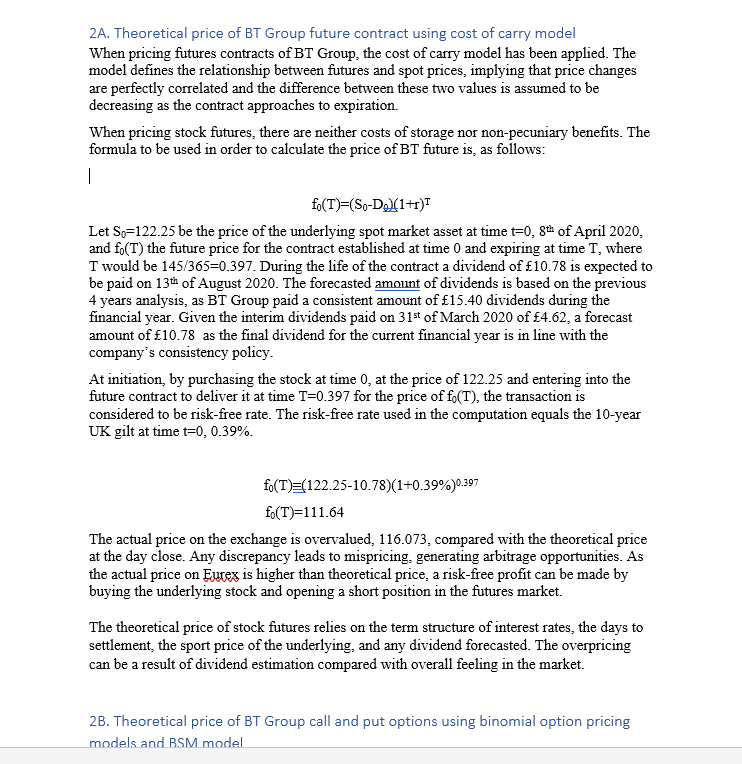
2A. Theoretical price of BT Group future contract using cost of carry model When pricing futures contracts of BT Group, the cost of carry model has been applied. The model defines the relationship between futures and spot prices, implying that price changes are perfectly correlated and the difference between these two values is assumed to be decreasing as the contract approaches to expiration. When pricing stock futures, there are neither costs of storage nor non-pecuniary benefits. The formula to be used in order to calculate the price of BT future is, as follows: | fo(T)=(S.-D.)(1+r) Let S=122.25 be the price of the underlying spot market asset at time t=0, 8th of April 2020, and fo(T) the future price for the contract established at time 0 and expiring at time T, where T would be 145/365=0.397. During the life of the contract a dividend of 10.78 is expected to be paid on 13th of August 2020. The forecasted amount of dividends is based on the previous 4 years analysis, as BT Group paid a consistent amount of 15.40 dividends during the financial year. Given the interim dividends paid on 31st of March 2020 of 4.62, a forecast amount of 10.78 as the final dividend for the current financial year is in line with the company's consistency policy. At initiation, by purchasing the stock at time 0, at the price of 122.25 and entering into the future contract to deliver it at time T=0.397 for the price of f.(T), the transaction is considered to be risk-free rate. The risk-free rate used in the computation equals the 10-year UK gilt at time t=0.0.39%. f.(T)=(122.25-10.78)(1+0.39%)0.397 fo(T)=111.64 The actual price on the exchange is overvalued, 116.073, compared with the theoretical price at the day close. Any discrepancy leads to mispricing, generating arbitrage opportunities. As the actual price on Eurex is higher than theoretical price, a risk-free profit can be made by buying the underlying stock and opening a short position in the futures market. The theoretical price of stock futures relies on the term structure of interest rates, the days to settlement, the sport price of the underlying, and any dividend forecasted. The overpricing can be a result of dividend estimation compared with overall feeling in the market. 2B. Theoretical price of BT Group call and put options using binomial option pricing models and BSM model 2A. Theoretical price of BT Group future contract using cost of carry model When pricing futures contracts of BT Group, the cost of carry model has been applied. The model defines the relationship between futures and spot prices, implying that price changes are perfectly correlated and the difference between these two values is assumed to be decreasing as the contract approaches to expiration. When pricing stock futures, there are neither costs of storage nor non-pecuniary benefits. The formula to be used in order to calculate the price of BT future is, as follows: | fo(T)=(S.-D.)(1+r) Let S=122.25 be the price of the underlying spot market asset at time t=0, 8th of April 2020, and fo(T) the future price for the contract established at time 0 and expiring at time T, where T would be 145/365=0.397. During the life of the contract a dividend of 10.78 is expected to be paid on 13th of August 2020. The forecasted amount of dividends is based on the previous 4 years analysis, as BT Group paid a consistent amount of 15.40 dividends during the financial year. Given the interim dividends paid on 31st of March 2020 of 4.62, a forecast amount of 10.78 as the final dividend for the current financial year is in line with the company's consistency policy. At initiation, by purchasing the stock at time 0, at the price of 122.25 and entering into the future contract to deliver it at time T=0.397 for the price of f.(T), the transaction is considered to be risk-free rate. The risk-free rate used in the computation equals the 10-year UK gilt at time t=0.0.39%. f.(T)=(122.25-10.78)(1+0.39%)0.397 fo(T)=111.64 The actual price on the exchange is overvalued, 116.073, compared with the theoretical price at the day close. Any discrepancy leads to mispricing, generating arbitrage opportunities. As the actual price on Eurex is higher than theoretical price, a risk-free profit can be made by buying the underlying stock and opening a short position in the futures market. The theoretical price of stock futures relies on the term structure of interest rates, the days to settlement, the sport price of the underlying, and any dividend forecasted. The overpricing can be a result of dividend estimation compared with overall feeling in the market. 2B. Theoretical price of BT Group call and put options using binomial option pricing models and BSM model
Step by Step Solution
There are 3 Steps involved in it

Get step-by-step solutions from verified subject matter experts
 Study Help