Question: As mentioned in the case, a structured process is used to evaluate the technical feasibility and market potential of new drugs. What is the structure
- As mentioned in the case, a structured process is used to evaluate the technical feasibility and market potential of new drugs. What is the structure described in the text?
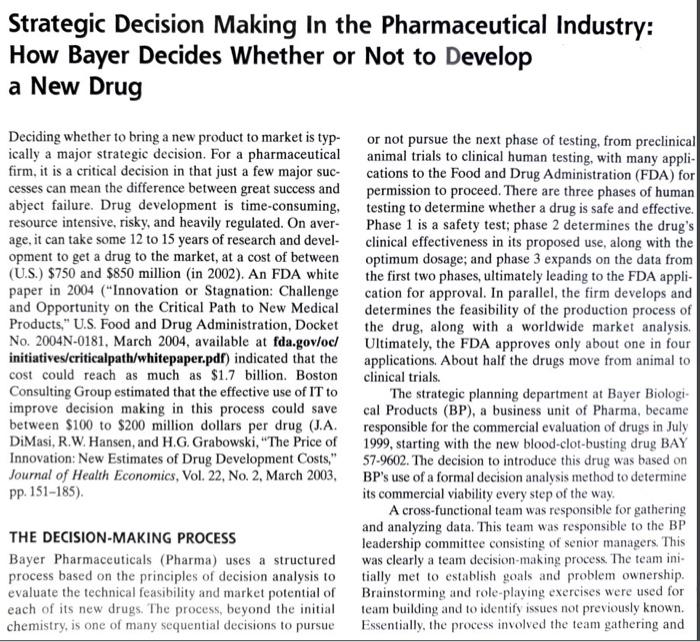
Strategic Decision Making in the Pharmaceutical Industry: How Bayer Decides Whether or Not to Develop a New Drug Deciding whether to bring a new product to market is typ- ically a major strategic decision. For a pharmaceutical firm, it is a critical decision in that just a few major suc- cesses can mean the difference between great success and abject failure. Drug development is time-consuming, resource intensive, risky, and heavily regulated. On aver- age, it can take some 12 to 15 years of research and devel- opment to get a drug to the market, at a cost of between (U.S.) $750 and $850 million (in 2002). An FDA white paper in 2004 ("Innovation or Stagnation: Challenge and Opportunity on the Critical Path to New Medical Products," U.S. Food and Drug Administration, Docket No. 2004N-0181, March 2004, available at fda.gov/oc/ initiatives/criticalpath/whitepaper.pdf) indicated that the cost could reach as much as $1.7 billion. Boston Consulting Group estimated that the effective use of IT to improve decision making in this process could save between $100 to $200 million dollars per drug (J.A. DiMasi, R.W. Hansen, and H.G. Grabowski, "The Price of Innovation: New Estimates of Drug Development Costs." Journal of Health Economics, Vol. 22, No. 2, March 2003, pp. 151-185). or not pursue the next phase of testing, from preclinical animal trials to clinical human testing, with many appli- cations to the Food and Drug Administration (FDA) for permission to proceed. There are three phases of human testing to determine whether a drug is safe and effective. Phase 1 is a safety test; phase 2 determines the drug's clinical effectiveness in its proposed use, along with the optimum dosage; and phase 3 expands on the data from the first two phases, ultimately leading to the FDA appli- cation for approval. In parallel, the firm develops and determines the feasibility of the production process of the drug, along with a worldwide market analysis. Ultimately, the FDA approves only about one in four applications. About half the drugs move from animal to clinical trials. The strategic planning department at Bayer Biologi cal Products (BP), a business unit of Pharma, became responsible for the commercial evaluation of drugs in July 1999, starting with the new blood-clot-busting drug BAY 57-9602. The decision to introduce this drug was based on BP's use of a formal decision analysis method to determine its commercial viability every step of the way, A cross-functional team was responsible for gathering and analyzing data. This team was responsible to the BP leadership committee consisting of senior managers. This was clearly a team decision-making process. The team ini. tially met to establish goals and problem ownership. Brainstorming and role-playing exercises were used for team building and to identify issues not previously known. Essentially, the process involved the team gathering and THE DECISION-MAKING PROCESS Bayer Pharmaceuticals (Pharma) uses a structured process based on the principles of decision analysis to evaluate the technical feasibility and market potential of each of its new drugs. The process, beyond the initial chemistry, is one of many sequential decisions to pursue synthesizing data and meeting with experts every step of the way to estimate costs and risks. For example, following preclinical animal trials, experts estimated the viability of the drug. This included estimates of the costs of continued testing and application, along with those of production, and probability estimates of success. Influence diagrams were used throughout the process due to the complexity of the problem. Each particular drug is viewed as a project. As new data are available, essentially at the end of each phase of testing, knowledge updates are made, and a goo go decision is made. If the estimate of the drug's profitabil- ity, including risk adjustments, is not worth the effort, then the development of the drug is cancelled. It is important to remember that the input from many experts, ranging from chemists to packaging engineers, to production engineers, to marketing specialists, is utilized both in a financial sense and a risk sense. The likelihood of success is a primary factor in making the final decision. Also, sensitivity analysis was utilized to determine whether the decision would fluctuate based on small and large changes in the estimates. RESULTS When the results were presented to the BP leadership committee, several surprises occurred. One important one was that certain factors thought to be key in decision making were not because Bayer, unlike many other firms, actually manufactures its own products. This directly affected the estimates of risk and, consequently, success. Ultimately, BAY 57-9602 was deemed commercially viable and moved through all phases of development, as the results were validated at the end of each phase of test- ing via adjustments. The project team did a great job in analyzing this situation, leading to a set of new standards for BP in analyzing the commercial viability of new drugs









 Study Help