







Question: As noted within the chapter, CON 7 describes techniques for calculating present value, including the following illustration of the expected cash flow approach, reproduced from
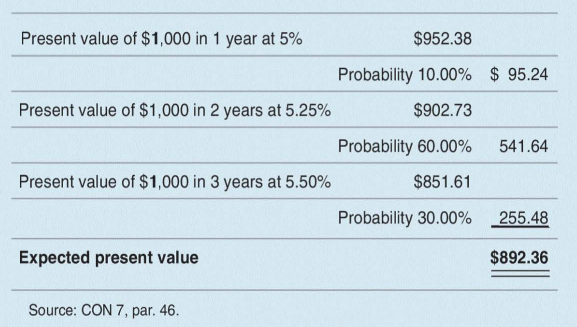
As noted within the chapter, CON 7 describes techniques for calculating present value, including the following illustration of the expected cash flow approach, reproduced from CON 7. This example illustrates how the expected cash flow approach can be used to assign probability factors to the likelihood of receiving a $1,000 cash flow in any of three possible future years.
a. Review the guidance in CON 7 and, in your own words, explain in approximately one paragraph the difference between the traditional (best estimate) and expected present value techniques for measuring fair value.
b. Assume that you are a lender determining the present value of this sample receivable illustrated in CON 7. Under the traditional approach, what would the present value of that receivable be?
c. Show the math that would be necessary to add a fou1th scenario: collection of the $1,000 in 5 years at 6%, with a probability of 10%. (No need for a calculator, just write out how you would compute this scenario).
d. Which approach would you expect users of the lender's financial statements to prefer, and why?
Present value of $1,000 in 1 year at 5% $952.38 Probability 10.00% $ 95.24 Present value of $1,000 in 2 years at 5.25% $902.73 Probability 60.00% 541.64 Present value of $1,000 in 3 years at 5.50% $851.61 Probability 30.00% 255.48 Expected present value $892.36 Source: CON 7 par. 46. Present value of $1,000 in 1 year at 5% $952.38 Probability 10.00% $ 95.24 Present value of $1,000 in 2 years at 5.25% $902.73 Probability 60.00% 541.64 Present value of $1,000 in 3 years at 5.50% $851.61 Probability 30.00% 255.48 Expected present value $892.36 Source: CON 7 par. 46
Step by Step Solution
There are 3 Steps involved in it

Get step-by-step solutions from verified subject matter experts
 Study Help