







Question: As Soon As possible, direct thumps up :) Problem 2: Given the first-order plant described by x (k+1) = 0.6 x (k) + 0.5 u
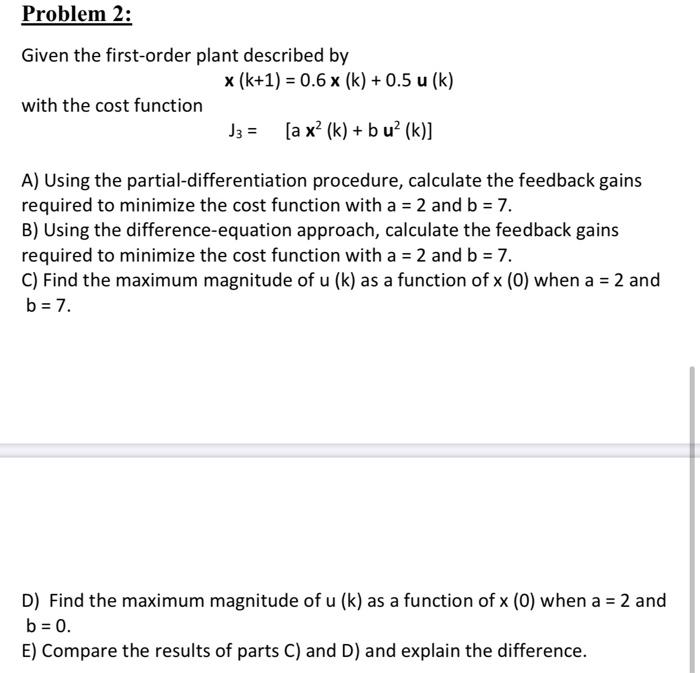
Problem 2: Given the first-order plant described by x (k+1) = 0.6 x (k) + 0.5 u (k) with the cost function J3 = [a x(k) + b u? (k)] A) Using the partial-differentiation procedure, calculate the feedback gains required to minimize the cost function with a = 2 and b = 7. B) Using the difference-equation approach, calculate the feedback gains required to minimize the cost function with a = 2 and b = 7. C) Find the maximum magnitude of u (k) as a function of x (0) when a = 2 and b = 7. D) Find the maximum magnitude of u (k) as a function of x (0) when a = 2 and b = 0. E) Compare the results of parts C) and D) and explain the difference. Problem 2: Given the first-order plant described by x (k+1) = 0.6 x (k) + 0.5 u (k) with the cost function J3 = [a x(k) + b u? (k)] A) Using the partial-differentiation procedure, calculate the feedback gains required to minimize the cost function with a = 2 and b = 7. B) Using the difference-equation approach, calculate the feedback gains required to minimize the cost function with a = 2 and b = 7. C) Find the maximum magnitude of u (k) as a function of x (0) when a = 2 and b = 7. D) Find the maximum magnitude of u (k) as a function of x (0) when a = 2 and b = 0. E) Compare the results of parts C) and D) and explain the difference
Step by Step Solution
There are 3 Steps involved in it

Get step-by-step solutions from verified subject matter experts
 Study Help