





Question: As the result shows, this balancing process yields the efficiency of 77%. How can we improve the balancing process? With the given constraints, is there
As the result shows, this balancing process yields the efficiency of 77%. How can we improve the balancing process? With the given constraints, is there a better approach to reduce the idle times in workstations? Try balancing the assembly line by rule b first and break ties with rule a.
1. Show the sequential relationships among tasks using a precedent diagram.
2. Calculate the required workstation cycle time.
3. Determine the theoretical number of workstations.
4. Assign tasks by rule b and break ties by rule a.
5. Calculate the efficiency of the balance.
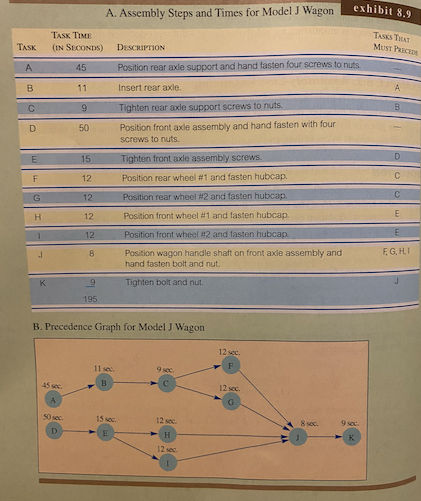
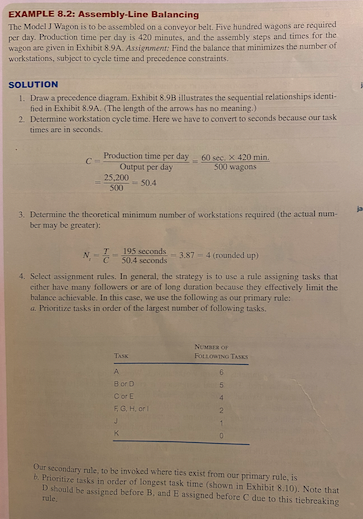
EXAMPLE 8.2: Assembly-Line Balancing The Model J Wagon is to be assembled on a conveyor belt. Five hundred wagons are required per day. Production time per day is 420 minutes, and the assembly steps and times for the wagon are given in Exhibit 8.9A. Assignment: Find the balance that minimizes the number of workstations, subject to cycle time and precedence constraints. SOLUTION 1. Draw a procedence diagram. Exhibit 8.9B illustrates the sequential relationships identi- fied in Exhibit 8.9A. (The length of the arrows has no meaning.) 2. Determine workstation cycle time. Here we have to convert to seconds because our task times are in seconds Production time per day 60 sec X 420 min Output per day 500 wagons 25.200 504 500 3. Determine the theoretical minimum number of workstations required (the actual num- ber may be greater): 195 seconds - 3.87 - 4 (rounded up) 50.4 seconds 4. Select assignment rules. In general, the strategy is to use a rule assigning tasks that cither have many followers or are of long duration because they effectively limit the balance achievable. In this case, we use the following as our primary rule: .. Prioritize tasks in order of the largest number of following tasks. TAS FOLLOWING TANKS 5 A Boro COPE F, G, H, or 4 2 0 Our secondary rule, to be invoked where ties exist from our primary rule, is b. Prioritize tasks in order of longest task time (shown in Exhibit 8.10). Note that D) should be assigned before B, and E assigned before C due to this tiebreaking

