







Question: As we discussed this unit, there are at least 5 kinds of I RIS R * Passive euthanasia: withholding or withdrawing life- sustaining treatment (like
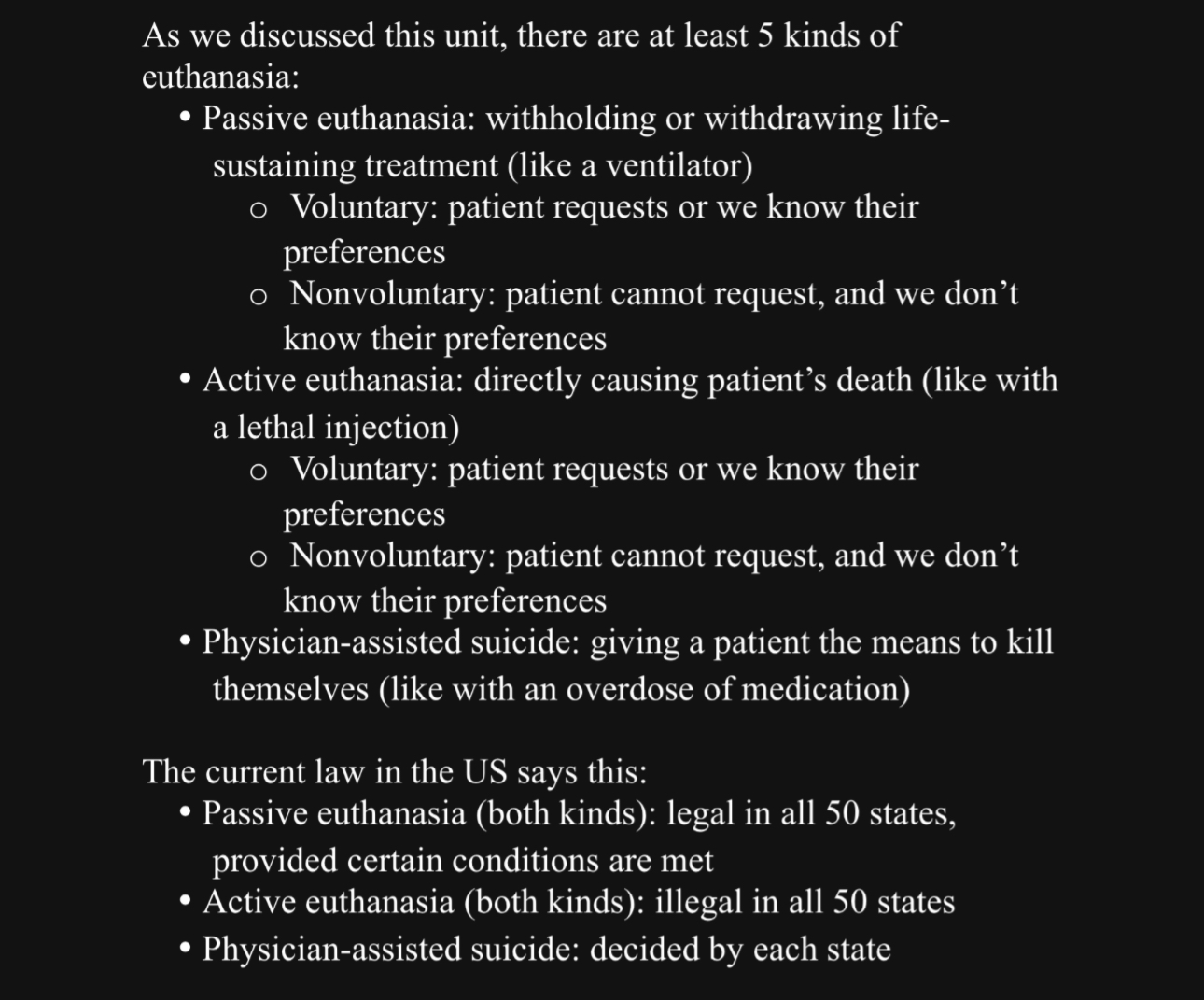
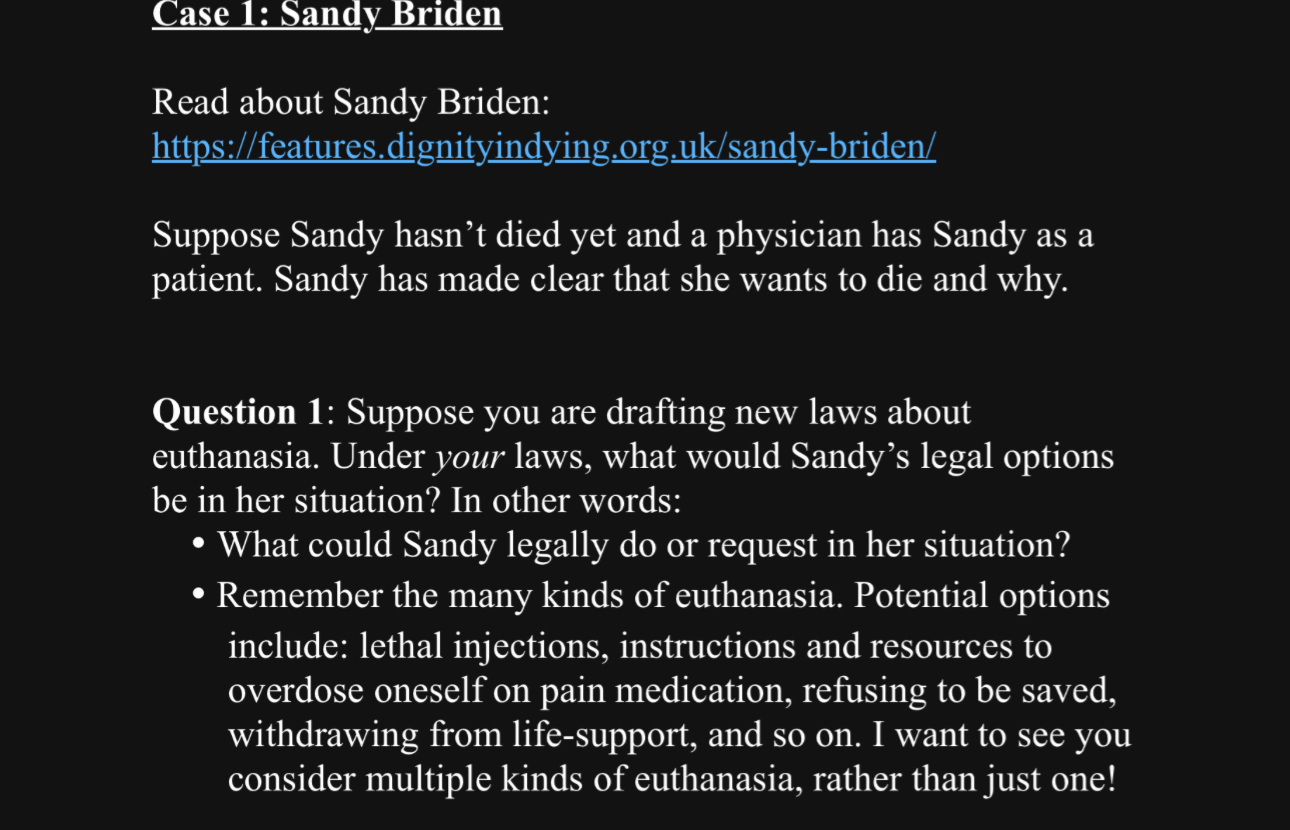
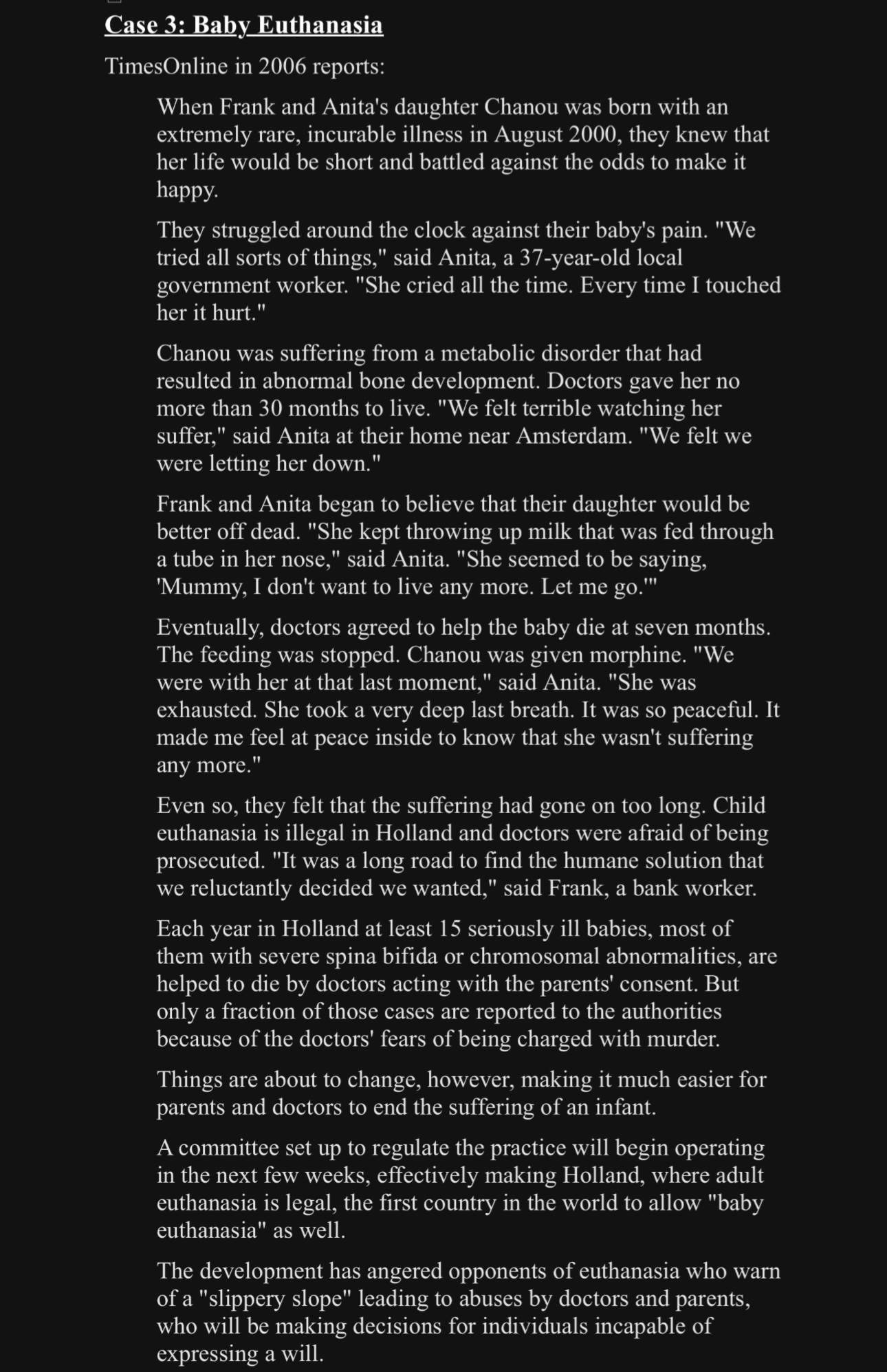
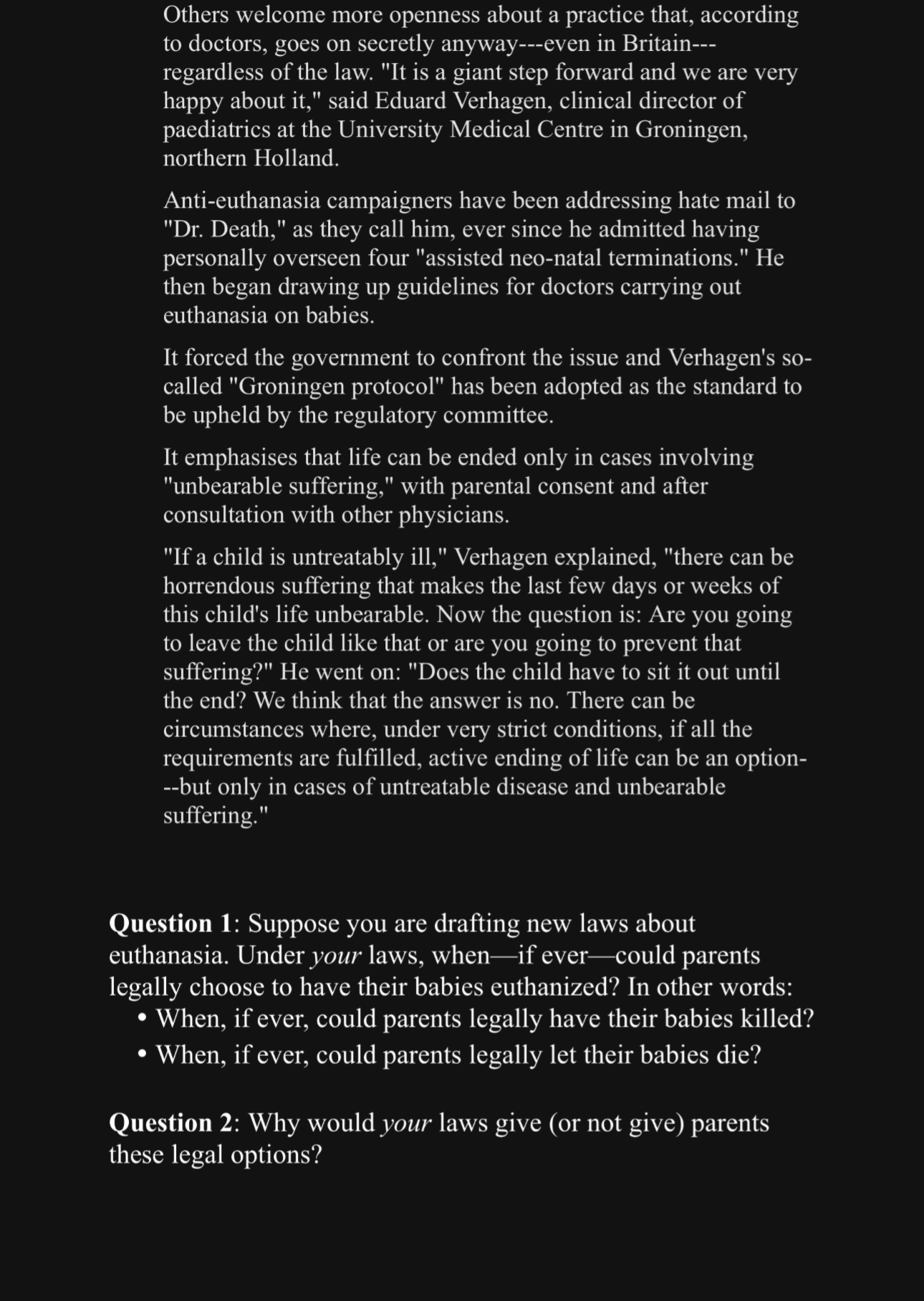
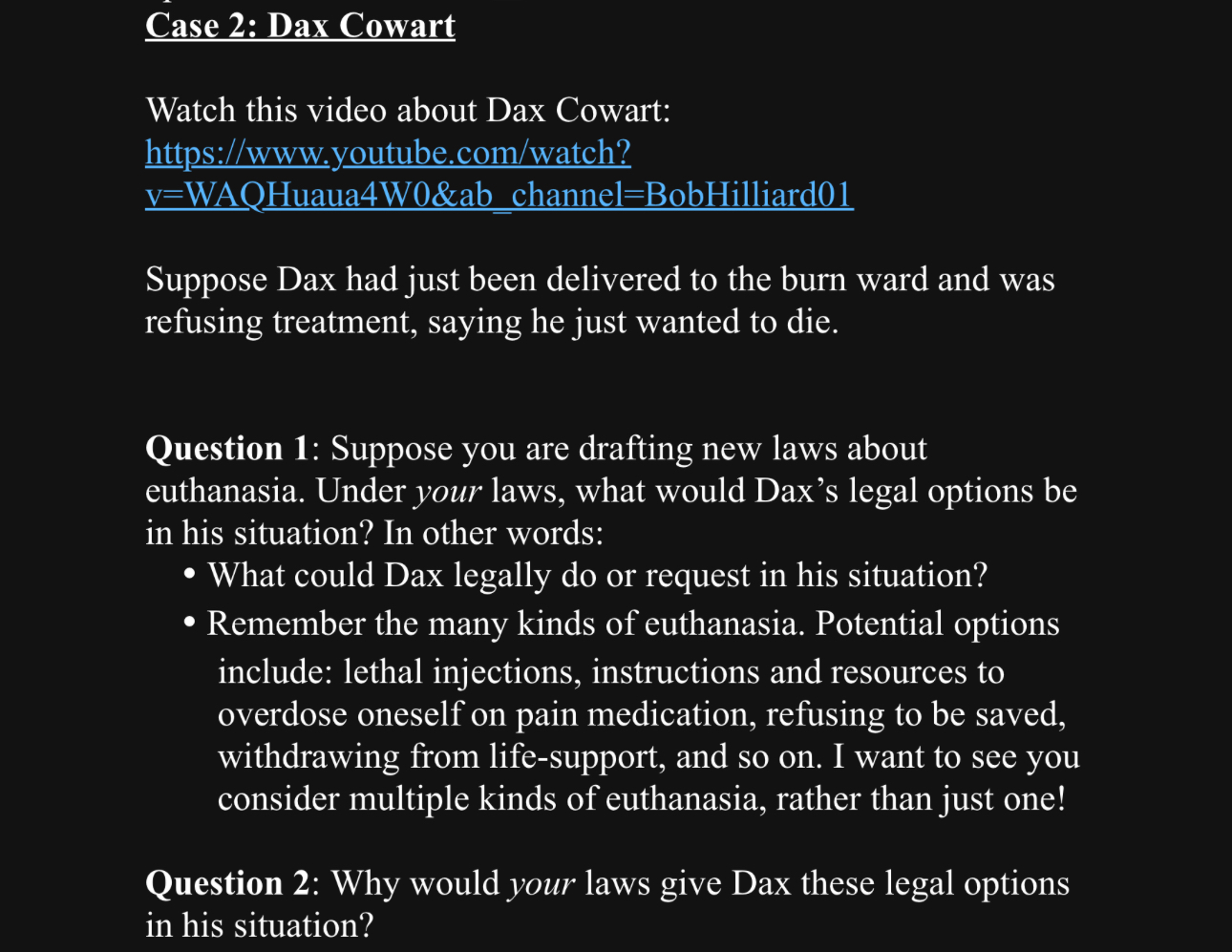
As we discussed this unit, there are at least 5 kinds of I RIS R * Passive euthanasia: withholding or withdrawing life- sustaining treatment (like a ventilator) o Voluntary: patient requests or we know their preferences o Nonvoluntary: patient cannot request, and we don't know their preferences * Active euthanasia: directly causing patient's death (like with a lethal injection) o Voluntary: patient requests or we know their QIS S (S IV o Nonvoluntary: patient cannot request, and we don't know their preferences * Physician-assisted suicide: giving a patient the means to kill themselves (like with an overdose of medication) The current law in the US says this: * Passive euthanasia (both kinds): legal in all 50 states, provided certain conditions are met * Active euthanasia (both kinds): illegal in all 50 states * Physician-assisted suicide: decided by each state Read about Sandy Briden: https://features.dignityindyin y-briden Suppose Sandy hasn't died yet and a physician has Sandy as a patient. Sandy has made clear that she wants to die and why. Question 1: Suppose you are drafting new laws about euthanasia. Under your laws, what would Sandy's legal options be in her situation? In other words: * What could Sandy legally do or request in her situation? * Remember the many kinds of euthanasia. Potential options include: lethal injections, instructions and resources to overdose oneself on pain medication, refusing to be saved, withdrawing from life-support, and so on. I want to see you consider multiple kinds of euthanasia, rather than just one! Case 3: Baby Euthanasia TimesOnline in 2006 reports: When Frank and Anita's daughter Chanou was born with an extremely rare, incurable illness in August 2000, they knew that her life would be short and battled against the odds to make it happy. They struggled around the clock against their baby's pain. "We tried all sorts of things," said Anita, a 37-year-old local government worker. "She cried all the time. Every time I touched TR Chanou was suffering from a metabolic disorder that had resulted in abnormal bone development. Doctors gave her no more than 30 months to live. "We felt terrible watching her suffer," said Anita at their home near Amsterdam. "We felt we were letting her down." Frank and Anita began to believe that their daughter would be better off dead. "She kept throwing up milk that was fed through a tube 1n her nose," said Anita. "She seemed to be saying, 'Mummy, I don't want to live any more. Let me go." Eventually, doctors agreed to help the baby die at seven months. The feeding was stopped. Chanou was given morphine. "We were with her at that last moment," said Anita. "She was exhausted. She took a very deep last breath. It was so peaceful. It made me feel at peace inside to know that she wasn't suffering any more." Even so, they felt that the suffering had gone on too long. Child euthanasia 1s illegal in Holland and doctors were afraid of being prosecuted. "It was a long road to find the humane solution that we reluctantly decided we wanted," said Frank, a bank worker. Each year in Holland at least 15 seriously ill babies, most of them with severe spina bifida or chromosomal abnormalities, are helped to die by doctors acting with the parents' consent. But only a fraction of those cases are reported to the authorities because of the doctors' fears of being charged with murder. Things are about to change, however, making it much easier for parents and doctors to end the suffering of an infant. A committee set up to regulate the practice will begin operating in the next few weeks, effectively making Holland, where adult euthanasia is legal, the first country in the world to allow "baby euthanasia" as well. The development has angered opponents of euthanasia who warn of a "slippery slope" leading to abuses by doctors and parents, who will be making decisions for individuals incapable of DGR Others welcome more openness about a practice that, according to doctors, goes on secretly anyway---even in Britain--- regardless of the law. "It is a giant step forward and we are very happy about it," said Eduard Verhagen, clinical director of paediatrics at the University Medical Centre in Groningen, northern Holland. Anti-euthanasia campaigners have been addressing hate mail to "Dr. Death," as they call him, ever since he admitted having personally overseen four "assisted neo-natal terminations." He then began drawing up guidelines for doctors carrying out euthanasia on babies. [t forced the government to confront the issue and Verhagen's so- called "Groningen protocol" has been adopted as the standard to be upheld by the regulatory committee. [t emphasises that life can be ended only in cases involving "unbearable suffering," with parental consent and after consultation with other physicians. "If a child is untreatably ill," Verhagen explained, "there can be horrendous suffering that makes the last few days or weeks of this child's life unbearable. Now the question is: Are you going to leave the child like that or are you going to prevent that suffering?" He went on: "Does the child have to sit it out until the end? We think that the answer is no. There can be circumstances where, under very strict conditions, if all the requirements are fulfilled, active ending of life can be an option- --but only in cases of untreatable disease and unbearable SlIlieelra Question 1: Suppose you are drafting new laws about euthanasia. Under your laws, whenif evercould parents legally choose to have their babies euthanized? In other words: * When, if ever, could parents legally have their babies killed? * When, if ever, could parents legally let their babies die? Question 2: Why would your laws give (or not give) parents these legal options? Case 2: Dax Cowart Watch this video about Dax Cowart: https://www.youtube.com/watch? v=WAQHuaua4W0&ab_ channel=BobHilliard0] Suppose Dax had just been delivered to the burn ward and was refusing treatment, saying he just wanted to die. Question 1: Suppose you are drafting new laws about euthanasia. Under your laws, what would Dax's legal options be in his situation? In other words: * What could Dax legally do or request in his situation? * Remember the many kinds of euthanasia. Potential options include: lethal injections, instructions and resources to overdose oneself on pain medication, refusing to be saved, withdrawing from life-support, and so on. I want to see you consider multiple kinds of euthanasia, rather than just one! Question 2: Why would your laws give Dax these legal options in his situation
Step by Step Solution
There are 3 Steps involved in it

Get step-by-step solutions from verified subject matter experts
 Study Help