



Question: asap asap 2. Did their marketing program deliver the value proposed by their marketing strategy? Briefly justify your answer. 3. If you were the marketing
asap
asap
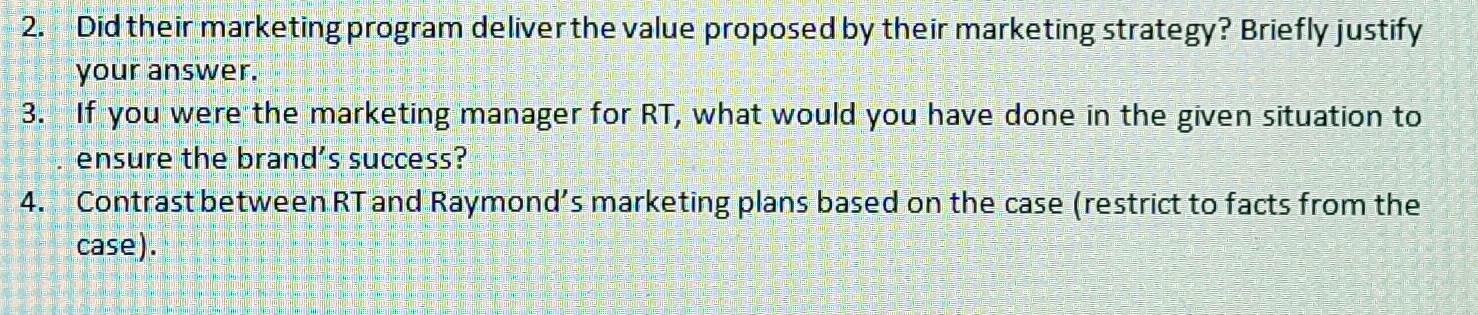
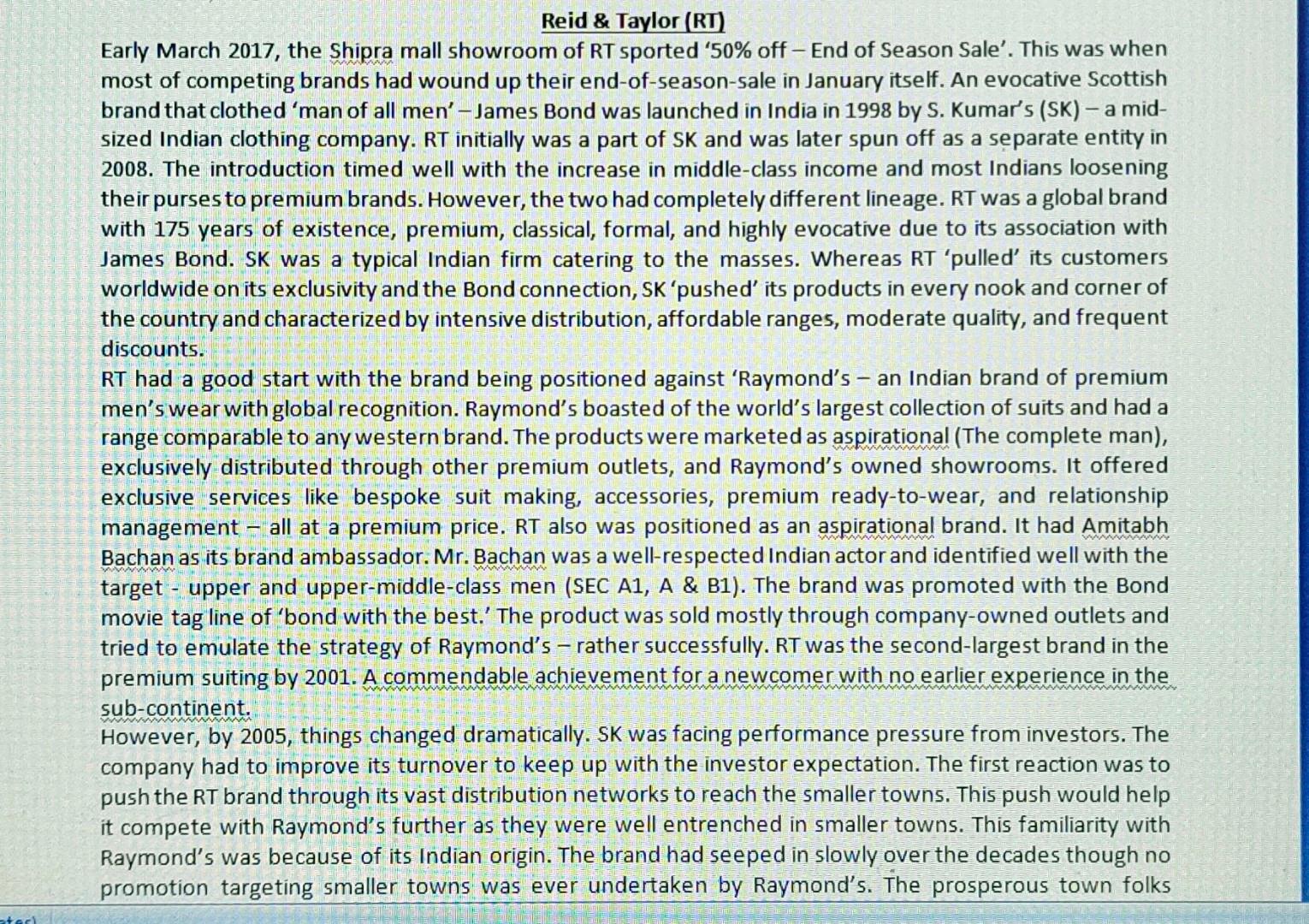
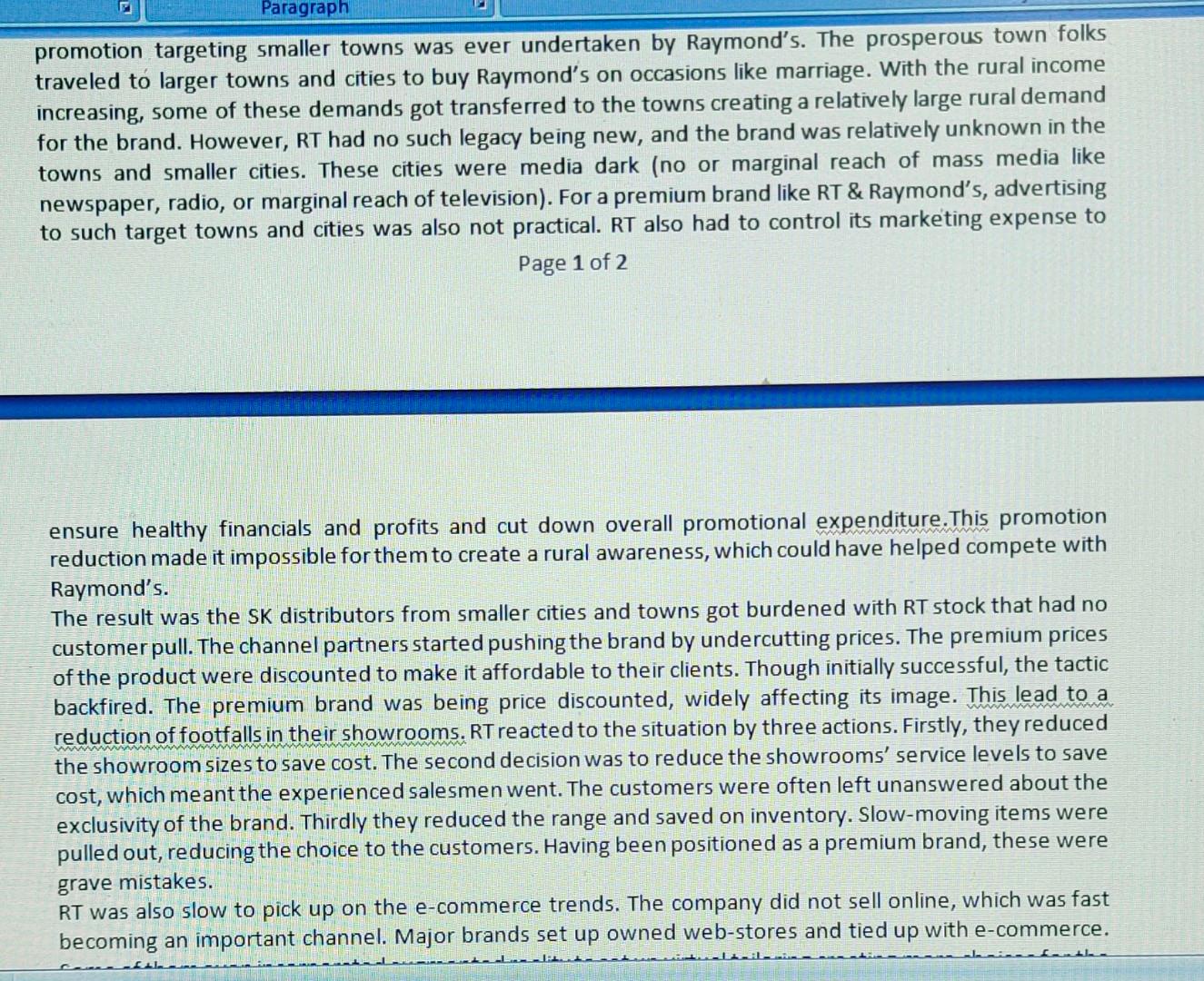
2. Did their marketing program deliver the value proposed by their marketing strategy? Briefly justify your answer. 3. If you were the marketing manager for RT, what would you have done in the given situation to ensure the brand's success? 4. Contrast between RT and Raymond's marketing plans based on the case (restrict to facts from the case). TO un Que ED TERED TELE TELE bol HELD HE Reid & Taylor (RT) Early March 2017, the Shipra mall showroom of RT sported '50% off - End of Season Sale'. This was when most of competing brands had wound up their end-of-season-sale in January itself. An evocative Scottish brand that clothed 'man of all men'- James Bond was launched in India in 1998 by S. Kumar's (SK) - a mid- sized Indian clothing company. RT initially was a part of SK and was later spun off as a separate entity in 2008. The introduction timed well with the increase in middle-class income and most Indians loosening their purses to premium brands. However, the two had completely different lineage. RT was a global brand with 175 years of existence, premium, classical, formal, and highly evocative due to its association with James Bond. SK was a typical Indian firm catering to the masses. Whereas RT 'pulled its customers worldwide on its exclusivity and the Bond connection, SK'pushed' its products in every nook and corner of the country and characterized by intensive distribution, affordable ranges, moderate quality, and frequent discounts. RT had a good start with the brand being positioned against 'Raymond's an Indian brand of premium men's wear with global recognition. Raymond's boasted of the world's largest collection of suits and had a range comparable to any western brand. The products were marketed as aspirational (The complete man), exclusively distributed through other premium outlets, and Raymond's owned showrooms. It offered exclusive services like bespoke suit making, accessories, premium ready-to-wear, and relationship management - all at a premium price. RT also was positioned as an aspirational brand. It had Amitabh Bachan as its brand ambassador. Mr. Bachan was a well-respected Indian actor and identified well with the target - upper and upper-middle-class men (SEC A1, A & B1). The brand was promoted with the Bond movie tag line of 'bond with the best.' The product was sold mostly through company-owned outlets and tried to emulate the strategy of Raymond's - rather successfully. RT was the second-largest brand in the premium suiting by 2001. A commendable achievement for a newcomer with no earlier experience in the sub-continent. However, by 2005, things changed dramatically. SK was facing performance pressure from investors. The company had to improve its turnover to keep up with the investor expectation. The first reaction was to push the RT brand through its vast distribution networks to reach the smaller towns. This push would help it compete with Raymond's further as they were well entrenched in smaller towns. This familiarity with Raymond's was because of its Indian origin. The brand had seeped in slowly over the decades though no promotion targeting smaller towns was ever undertaken by Raymond's. The prosperous town folks 12.62001. Acom Paragraph promotion targeting smaller towns was ever undertaken by Raymond's. The prosperous town folks traveled to larger towns and cities to buy Raymond's on occasions like marriage. With the rural income increasing, some of these demands got transferred to the towns creating a relatively large rural demand for the brand. However, RT had no such legacy being new, and the brand was relatively unknown in the towns and smaller cities. These cities were media dark (no or marginal reach of mass media like newspaper, radio, or marginal reach of television). For a premium brand like RT & Raymond's, advertising to such target towns and cities was also not practical. RT also had to control its marketing expense to Page 1 of 2 ensure healthy financials and profits and cut down overall promotional expenditure. This promotion reduction made it impossible for them to create a rural awareness, which could have helped compete with Raymond's. The result was the SK distributors from smaller cities and towns got burdened with RT stock that had no customer pull. The channel partners started pushing the brand by undercutting prices. The premium prices of the product were discounted to make it affordable to their clients. Though initially successful, the tactic backfired. The premium brand was being price discounted, widely affecting its image. This lead to a reduction of footfalls in their showrooms. RT reacted to the situation by three actions. Firstly, they reduced the showroom sizes to save cost. The second decision was to reduce the showrooms' service levels to save cost, which meant the experienced salesmen went. The customers were often left unanswered about the exclusivity of the brand. Thirdly they reduced the range and saved on inventory. Slow-moving items were pulled out, reducing the choice to the customers. Having been positioned as a premium brand, these were grave mistakes. RT was also slow to pick up on the e-commerce trends. The company did not sell online, which was fast becoming an important channel. Major brands set up owned web-stores and tied up with e-commerceStep by Step Solution
There are 3 Steps involved in it
1 Expert Approved Answer
Step: 1 Unlock

Question Has Been Solved by an Expert!
Get step-by-step solutions from verified subject matter experts
Step: 2 Unlock
Step: 3 Unlock