







Question: asap thanks 1. ( T/F) If the difference between means is not statistically significant the F value will be small 2. (T/F) With a P
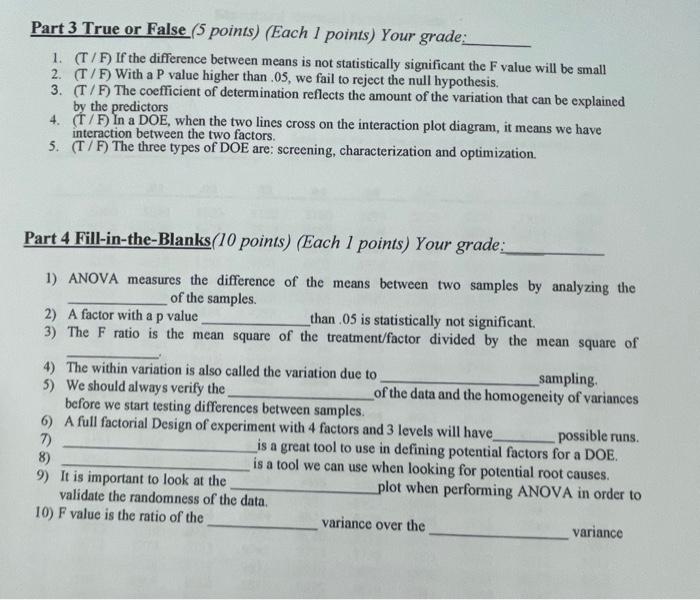
1. ( T/F) If the difference between means is not statistically significant the F value will be small 2. (T/F) With a P value higher than .05 , we fail to reject the null hypothesis. 3. (T/F) The coefficient of determination reflects the amount of the variation that can be explained by the predictors 4. (T/F) In a DOE, when the two lines cross on the interaction plot diagram, it means we have interaction between the two factors. 5. (T/F) The three types of DOE are: screening, characterization and optimization. Part 4 Fill-in-the-Blanks(10 points) (Each 1 points) Your grade: 1) ANOVA measures the difference of the means between two samples by analyzing the of the samples. 2) Afactorwithapvalue than .05 is statistically not significant. 3) The F ratio is the mean square of the treatment/factor divided by the mean square of 4) The within variation is also called the variation due to 5) We should always verify the sampling. before we start testing differences between samples. of the data and the homogeneity of variances 6) A full factorial Design of experiment with 4 factors and 3 levels will have possible runs. 7) is a great tool to use in defining potential factors for a DOE. 8) is a tool we can use when looking for potential root causes. 9) It is important to look at the plot when performing ANOVA in order to validate the randomness of the data. 10) F value is the ratio of the variance over the variance
Step by Step Solution
There are 3 Steps involved in it

Get step-by-step solutions from verified subject matter experts
 Study Help