



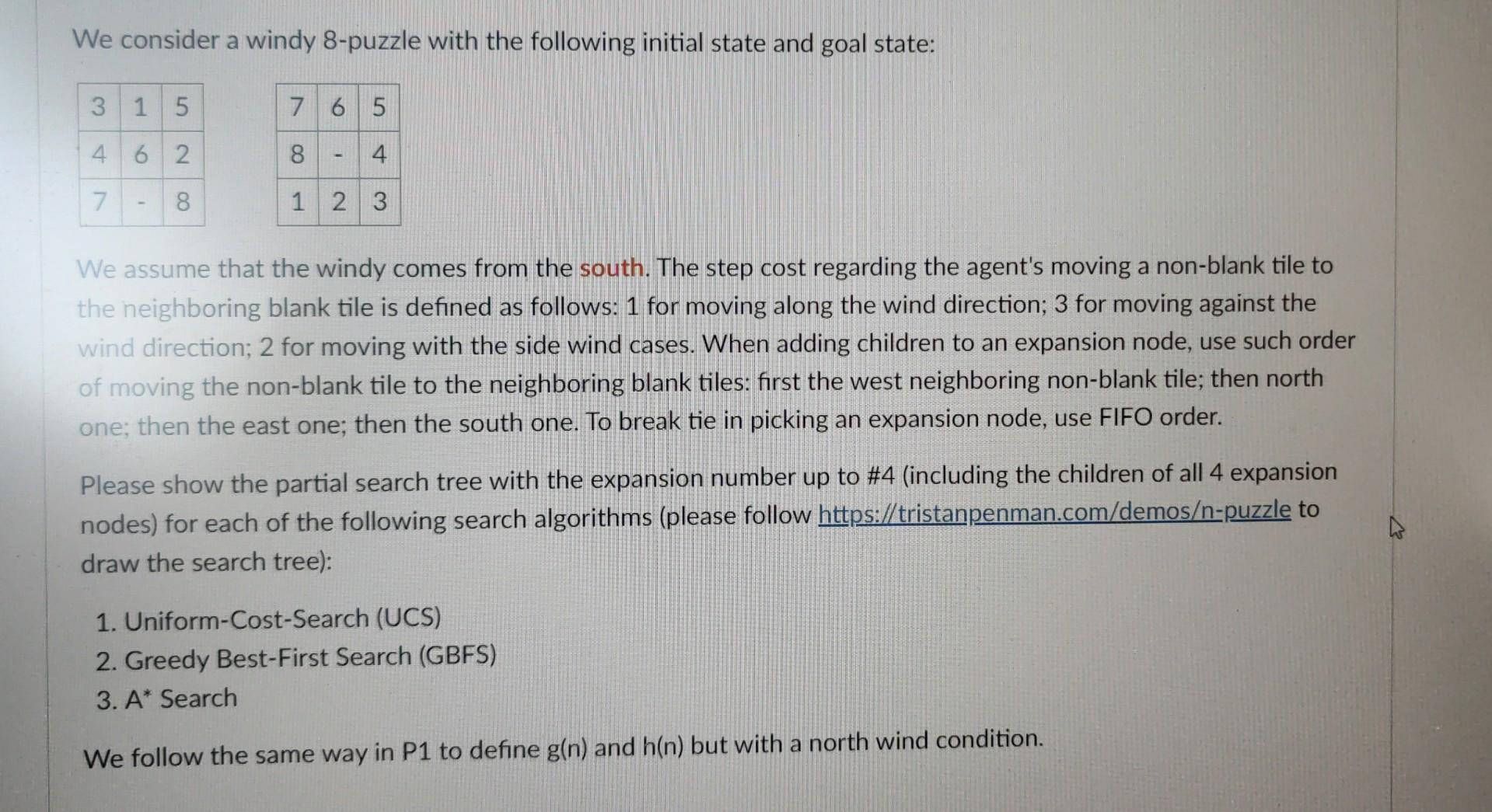
Question: asap We consider a windy 8-puzzle with the following initial state and goal state: We assume that the windy comes from the south. The step
asap
We consider a windy 8-puzzle with the following initial state and goal state: We assume that the windy comes from the south. The step cost regarding the agent's moving a non-blank tile to the neighboring blank tile is defined as follows: 1 for moving along the wind direction; 3 for moving against the wind direction; 2 for moving with the side wind cases. When adding children to an expansion node, use such order of moving the non-blank tile to the neighboring blank tiles: first the west neighboring non-blank tile; then north one; then the east one; then the south one. To break tie in picking an expansion node, use FIFO order. Please show the partial search tree with the expansion number up to \#4 (including the children of all 4 expansion nodes) for each of the following search algorithms (please follow https://tristanpenman.com/demos-puzzle to draw the search tree): 1. Uniform-Cost-Search (UCS) 2. Greedy Best-First Search (GBFS) 3. A Search We follow the same way in P1 to define g(n) and h(n) but with a north wind condition. We consider a windy 8-puzzle with the following initial state and goal state: We assume that the windy comes from the south. The step cost regarding the agent's moving a non-blank tile to the neighboring blank tile is defined as follows: 1 for moving along the wind direction; 3 for moving against the wind direction; 2 for moving with the side wind cases. When adding children to an expansion node, use such order of moving the non-blank tile to the neighboring blank tiles: first the west neighboring non-blank tile; then north one; then the east one; then the south one. To break tie in picking an expansion node, use FIFO order. Please show the partial search tree with the expansion number up to \#4 (including the children of all 4 expansion nodes) for each of the following search algorithms (please follow https://tristanpenman.com/demos-puzzle to draw the search tree): 1. Uniform-Cost-Search (UCS) 2. Greedy Best-First Search (GBFS) 3. A Search We follow the same way in P1 to define g(n) and h(n) but with a north wind condition
Step by Step Solution
There are 3 Steps involved in it

Get step-by-step solutions from verified subject matter experts