







Question: ASDV 2 5 2 0 , Data Structures & Algorithms Hashing & Map Use the hashing methodology of Separate Chaining to implement the
ASDV Data Structures & Algorithms
Hashing & Map
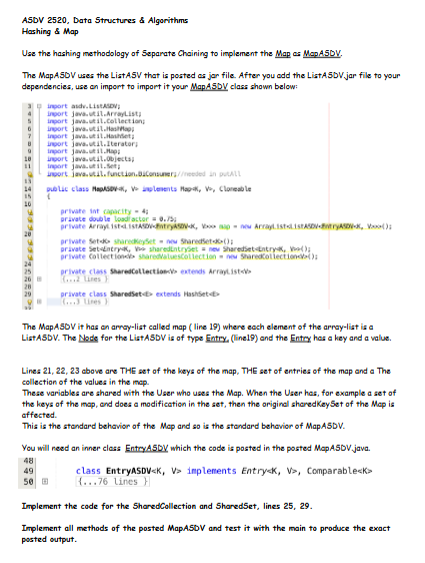
Use the hashing methodology of Separate Chaining to implement the Map as MapASDV.
The MapASOV uses the ListASV that is posted as jar file. After you odd the ListASDV.jar file to your dependencies, use on import to import it your MapASDV class shown below:
import asdvListRspy;
import asdvListRspy;
import asdvListRspy;
import asdvListRspy;
import asdvListRspy;
import asdvListRspy;
import asdvListRspy;
import asdvListRspy;
import asdvListRspy;
import asdvListRspy;
import asdvListRspy;
limport asdvListaspy;
prlware int capacity ;
grivate doble loadiacter a :
private class ShereaCetlectionory entends Arraplistars
it l Lires
grivate class Sharedsetextends HashSet
##
The MapAsOV it has on arrayliat called map line where each element of the arraylist is a ListASDV. The Nade for the LiatASDV is of type Gintry, ine and the Entry has a key and a value.
Lines above are THE set of the heys of the map. THE set of entries of the map and a The collection of the values in the mep.
These variables are shared with the User who uses the Map. When the User has, for example a set of the losys of the map, and does a modification in the set, then the originel sharedKeySet of the Mep is affected.
This is the stondard behavion of the Mep and so is the stondard behevior of MapASDV.
You will reed an inner closs EntryASDV which the code is posted in the posted MapASOV,java.
lines
Implement the code for the SharedCollection and SharedSet, lines
Implement all methods of the posted MapASDV and test it with the main to produce the exact posted output.
Step by Step Solution
There are 3 Steps involved in it
1 Expert Approved Answer
Step: 1 Unlock

Question Has Been Solved by an Expert!
Get step-by-step solutions from verified subject matter experts
Step: 2 Unlock
Step: 3 Unlock
 Study Help