







Question: Asher, your newly appointed boss, has tasked you with evaluating the following financial data for Galaxy Corp. to determine how Galaxy's value has changed over
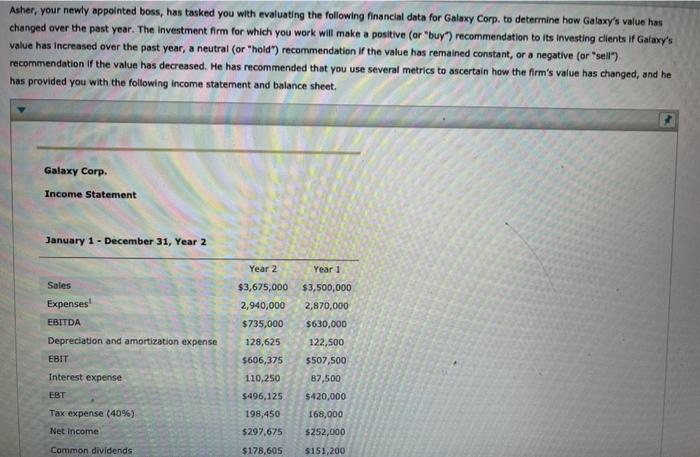
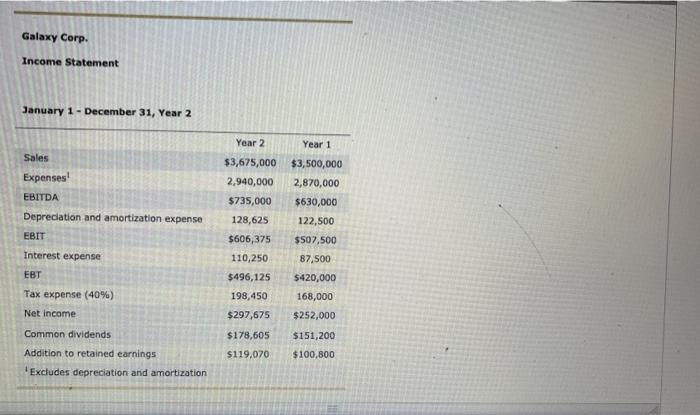
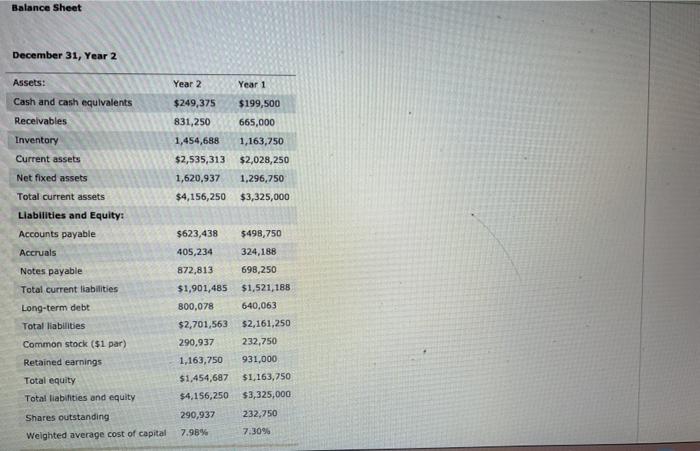
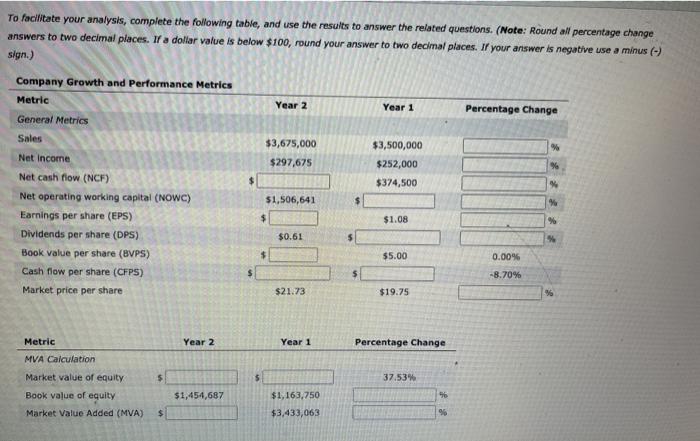
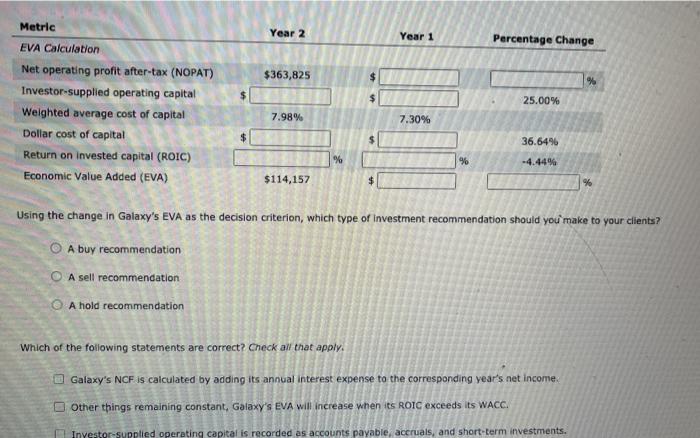
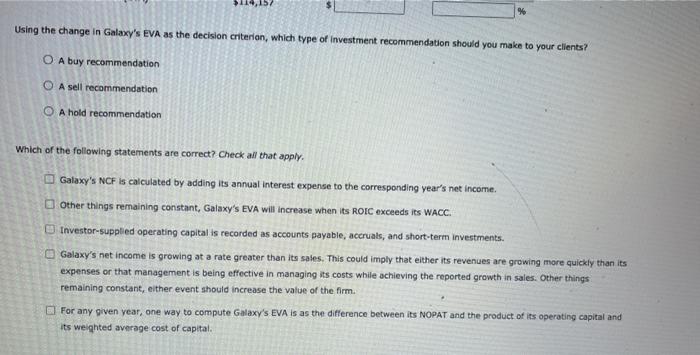
Asher, your newly appointed boss, has tasked you with evaluating the following financial data for Galaxy Corp. to determine how Galaxy's value has changed over the past year. The investment firm for which you work will make a positive (or "buy") recommendation to its investing clients if Galaxy's value has increased over the past year, a neutral (or "hold") recommendation if the value has remained constant, or a negative (or "sell") recommendation If the value has decreased. He has recommended that you use several metrics to ascertain how the firm's value has changed, and he has provided you with the following income statement and balance sheet Galaxy Corp. Income Statement January 1 - December 31, Year 2 Year 2 Year 1 $3,500,000 2,870,000 Sales Expenses! EBITDA Depreciation and amortization expense EBIT $630,000 122,500 $3,675,000 2,940,000 $735,000 128,625 $606,375 110,250 $496,125 198,450 5297,675 $178,605 Interest expense $507,500 87,500 $420,000 168,000 EBT Tax expense (40%) Net Income 5252,000 5151,200 Common dividends Galaxy Corp. Income Statement January 1 - December 31, Year 2 Year 2 Year 1 $3,675,000 2,940,000 $3,500,000 2,870,000 $630,000 Sales Expenses! EBITDA Depreciation and amortization expense EBIT Interest expense EBT 122,500 $507,500 $735,000 128,625 $606,375 110,250 $496,125 198,450 Tax expense (40%) 87,500 $420,000 168,000 $252,000 Net Income Common dividends Addition to retained earnings Excludes depreciation and amortization $297,675 $178,605 $119,070 $151,200 $100,000 Balance Sheet December 31, Year 2 Year 2 Year 1 $249,375 $199,500 831,250 665,000 Assets: Cash and cash equivalents Receivables Inventory Current assets Net fixed assets Total current assets Liabilities and Equity: Accounts payable Accruals 1,454,688 $2,535,313 1,620,937 1,163,750 $2,028,250 1,296,750 $4,156,250 $3,325,000 $623,438 405,234 Notes payable Total current liabilities Long-term debt Total liabilities Common stock ($1 par) 872,813 $1,901,485 800,078 $2,701,563 $498,750 324,188 698,250 $1,521,188 640,063 $2,161,250 232,750 931,000 $1,163,750 $3,325,000 232,750 7.3096 Retained earnings Total equity Total liabilities and equity 290,937 1,163,750 $1,454,687 $4,156,250 290,937 7.98% Shares outstanding Weighted average cost of capital Year 2 Year 1 % To facilitate your analysis, complete the following table, and use the results to answer the related questions. (Note: Round all percentage change answers to two decimal places. If a dollar value is below $100, round your answer to two decimal places. If your answer is negative use a minus (-) sign.) Company Growth and Performance Metrics Metric Percentage Change General Metrics Sales $3,675,000 $3,500,000 $297,675 $252,000 Net cash flow (NCF) $374,500 Net operating working capital (NOWC) $1,506,641 Earnings per share (EPS) Dividends per share (DPS) Book Value per share (BVPS) Cash flow per share (CFPS) Market price per share $19.75 Net Income % * $ $1.08 % $0.61 $ $5.00 0.00% -8.70% $21.73 Metric Year 2 Year 1 Percentage Change MVA Calculation 5 $ 37.53% Market value of equity Book value of equity Market Value Added (MVA) $1,454,687 96 $1,163,750 $3,433,063 $ % Metric Year 2 Year 1 Percentage Change $363,825 25.00% EVA Calculation Net operating profit after-tax (NOPAT) Investor-supplied operating capital Weighted average cost of capital Dollar cost of capital Return on invested capital (ROIC) Economic Value Added (EVA) 7.98% 7.30% 36.6496 % -4.44% $114,157 $ % Using the change in Galaxy's EVA as the decision criterion, which type of investment recommendation should you make to your clients? O A buy recommendation A sell recommendation A hold recommendation Which of the following statements are correct? Check all that apply. Galaxy's NCF is calculated by adding its annual interest expense to the corresponding year's net income. Other things remaining constant, Galaxy's EVA will increase when its ROIC exceeds its WACC. Investor supplied operating capital is recorded as accounts payable, accruals, and short-term investments. 119,157 % Using the change in Galaxy's EVA as the decision criterion, which type of investment recommendation should you make to your clients? O A buy recommendation O A sell recommendation O A hold recommendation Which of the following statements are correct? Check all that apply. Galaxy's NCF is calculated by adding its annual interest expense to the corresponding year's net income. Other things remaining constant, Galaxy's EVA will increase when its ROIC exceeds its WACC. Investor-supplied operating capital is recorded as accounts payable, accruals, and short-term investments. Galaxy's net income is growing at a rate greater than its sales. This could imply that either its revenues are growing more quickly than its expenses or that management is being effective in managing its costs while achieving the reported growth in sales. Other things remaining constant, either event should increase the value of the firm. For any given year, one way to compute Galaxy's EVA is as the difference between its NOPAT and the product of its operating capital and its weighted average cost of capital
Step by Step Solution
There are 3 Steps involved in it

Get step-by-step solutions from verified subject matter experts
 Study Help