







Question: ASIDE: EVERY ADDRESS YOU SEE IS VIRTUAL Ever write a C program that prints out a pointer? The value you see (some large number, often
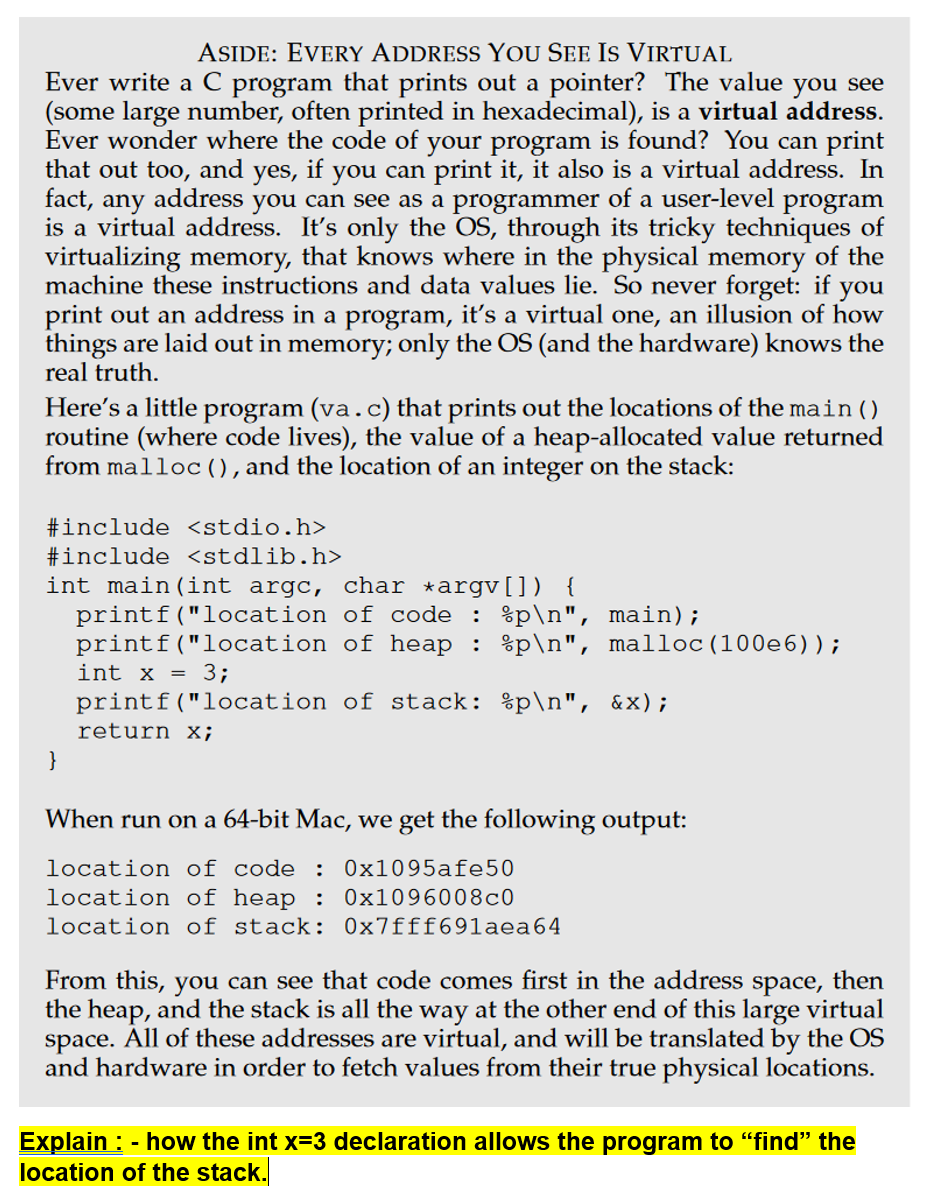
ASIDE: EVERY ADDRESS YOU SEE IS VIRTUAL Ever write a C program that prints out a pointer? The value you see (some large number, often printed in hexadecimal), is a virtual address. Ever wonder where the code of your program is found? You can print that out too, and yes, if you can print it, it also is a virtual address. In fact, any address you can see as a programmer of a user-level program is a virtual address. It's only the OS, through its tricky techniques of virtualizing memory, that knows where in the physical memory of the machine these instructions and data values lie. So never forget: if you print out an address in a program, it's a virtual one, an illusion of how things are laid out in memory; only the OS (and the hardware) knows the real truth. Here's a little program (va.c) that prints out the locations of the main() routine (where code lives), the value of a heap-allocated value returned from malloc(), and the location of an integer on the stack: #include
Step by Step Solution
There are 3 Steps involved in it

Get step-by-step solutions from verified subject matter experts
 Study Help