Question: Ask the contractor to provide additional technicians to reduce the time required to complete electrical and pneumatic construction by two weeks, at a cost premium
Ask the contractor to provide additional technicians to reduce the time required to complete electrical and pneumatic construction by two weeks, at a cost premium of $20,000.
Use two contractors for office construction instead of one. One contractor would be responsible for the office structure; the second contractor would be responsible for installation of fire alarm and safety systems, such as fire alarm, emergency lighting, and sprinklers. This approach would reduce the expected completion time for the office by three weeks but increase costs by $30,000.
Ask the contractor to work overtime on Saturdays to reduce the time to complete the quality/supervisor pod construction by two weeks, at a cost premium of $35,000.
Use a different contractor to install the anodizing line in 10 weeks, at a cost premium of $50,000.
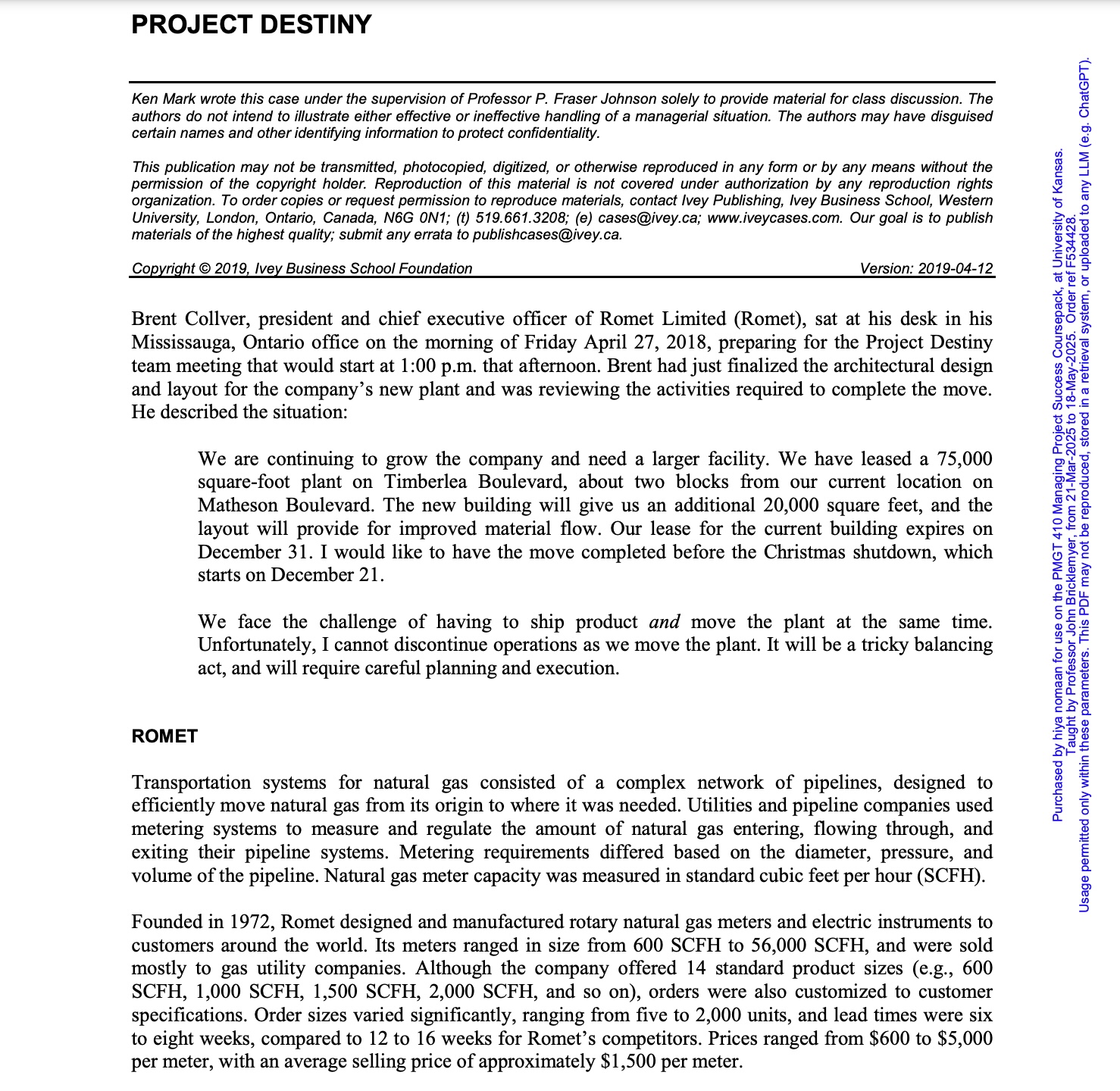
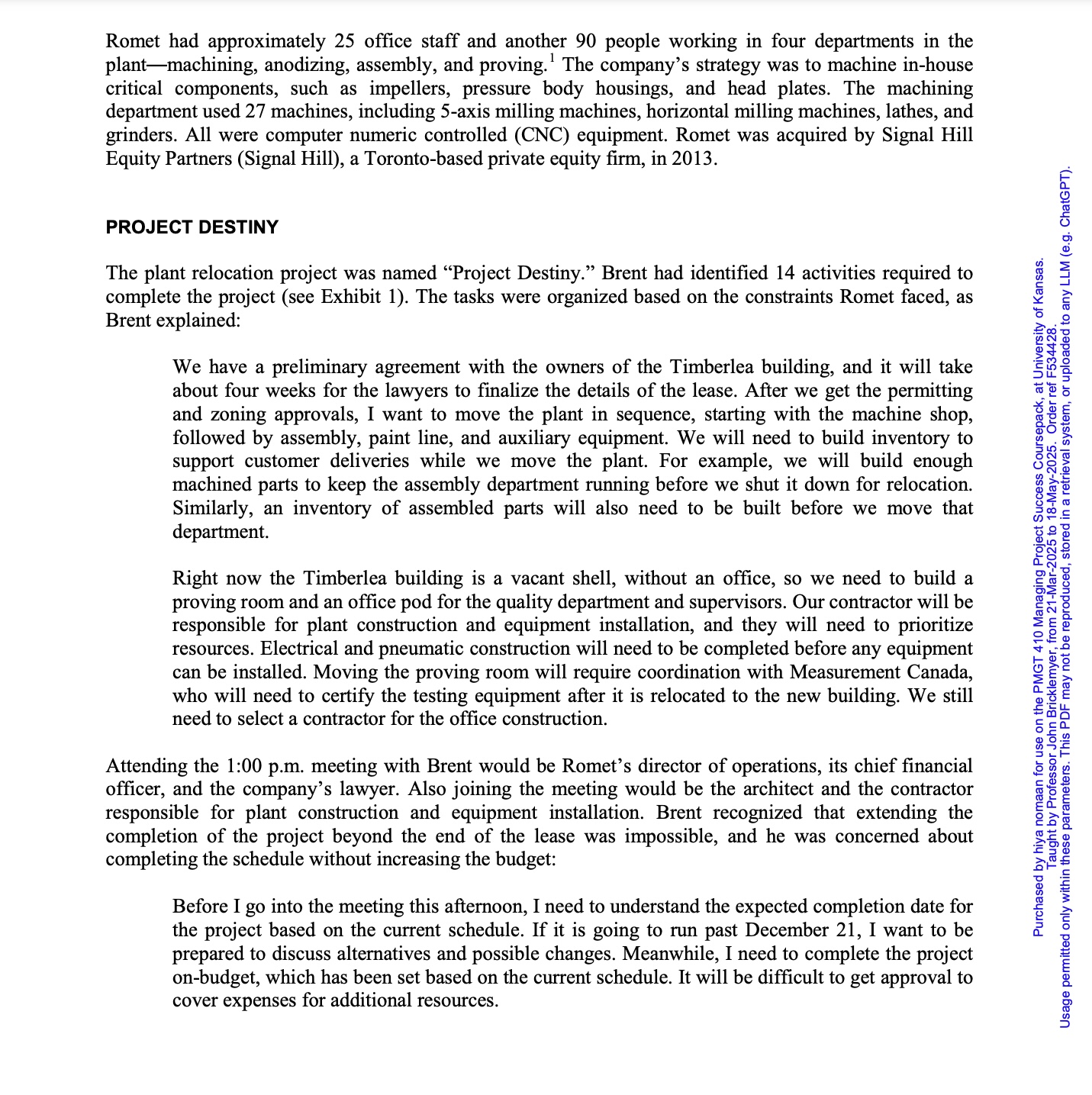
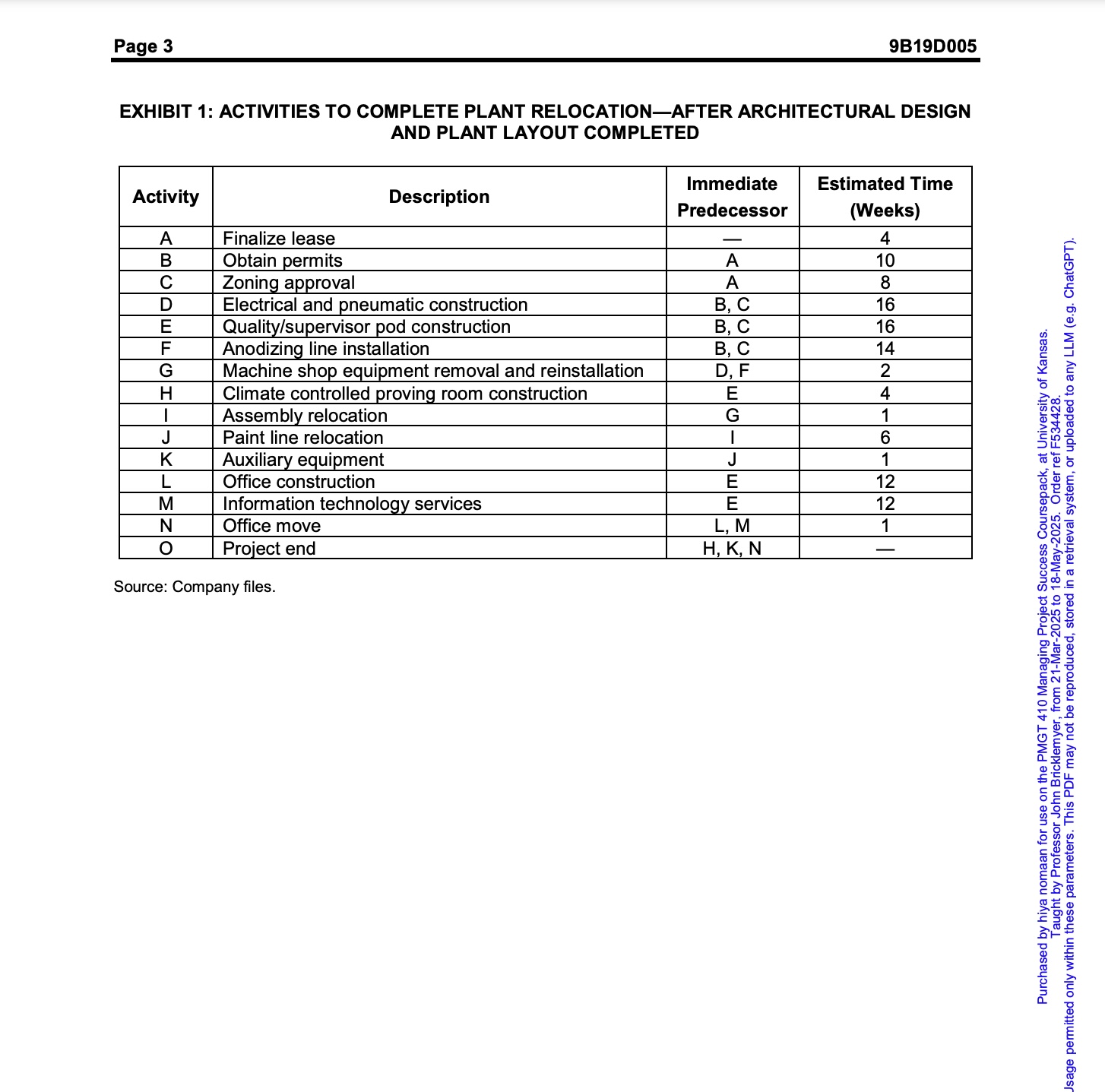
PROJECT DESTINY Ken Mark wrote this case under the supervision of Professor P. Fraser Johnson solely to provide material for class discussion. The authors do not intend to illustrate either effective or ineffective handling of a managerial situation. The authors may have disguised certain names and other identifying information to protect confidentiality. This publication may not be transmitted, photocopied, digitized, or otherwise reproduced in any form or by any means without the permission of the copyright holder. Reproduction of this material is not covered under authorization by any reproduction rights organization. To order copies or request permission to reproduce materials, contact Ivey Publishing, Ivey Business School, Western University, London, Ontario, Canada, N6G ON1; (t) 519.661.3208; (e) cases@ivey.ca; www.iveycases.com. Our goal is to publish materials of the highest quality; submit any errata to publishcases@ivey.ca. Copyright 2019, Ivey Business School Foundation Version: 2019-04-12 Brent Collver, president and chief executive officer of Romet Limited (Romet), sat at his desk in his Mississauga, Ontario office on the morning of Friday April 27, 2018, preparing for the Project Destiny team meeting that would start at 1:00 p.m. that afternoon. Brent had just finalized the architectural design and layout for the company's new plant and was reviewing the activities required to complete the move. He described the situation: We are continuing to grow the company and need a larger facility. We have leased a 75,000 square-foot plant on Timberlea Boulevard, about two blocks from our current location on Matheson Boulevard. The new building will give us an additional 20,000 square feet, and the layout will provide for improved material flow. Our lease for the current building expires on December 31. I would like to have the move completed before the Christmas shutdown, which starts on December 21. We face the challenge of having to ship product and move the plant at the same time. Unfortunately, I cannot discontinue operations as we move the plant. It will be a tricky balancing act, and will require careful planning and execution. ROMET Transportation systems for natural gas consisted of a complex network of pipelines, designed to efficiently move natural gas from its origin to where it was needed. Utilities and pipeline companies used metering systems to measure and regulate the amount of natural gas entering, flowing through, and exiting their pipeline systems. Metering requirements differed based on the diameter, pressure, and volume of the pipeline. Natural gas meter capacity was measured in standard cubic feet per hour (SCFH). Founded in 1972, Romet designed and manufactured rotary natural gas meters and electric instruments to customers around the world. Its meters ranged in size from 600 SCFH to 56,000 SCFH, and were sold mostly to gas utility companies. Although the company offered 14 standard product sizes (e.g., 600 SCFH, 1,000 SCFH, 1,500 SCFH, 2,000 SCFH, and so on), orders were also customized to customer specifications. Order sizes varied significantly, ranging from five to 2,000 units, and lead times were six to eight weeks, compared to 12 to 16 weeks for Romet's competitors. Prices ranged from $600 to $5,000 per meter, with an average selling price of approximately $1,500 per meter. Purchased by hiya nomaan for use on the PMGT 410 Managing Project Success Coursepack, at University of Kansas. Taught by Professor John Bricklemyer, from 21-Mar-2025 to 18-May-2025. Order ref F534428. Usage permitted only within these parameters. This PDF may not be reproduced, stored in a retrieval system, or uploaded to any LLM (e.g. ChatGPT). Romet had approximately 25 office staff and another 90 people working in four departments in the plantmachining, anodizing, assembly, and proving.' The company's strategy was to machine in-house critical components, such as impellers, pressure body housings, and head plates. The machining department used 27 machines, including 5-axis milling machines, horizontal milling machines, lathes, and grinders. All were computer numeric controlled (CNC) equipment. Romet was acquired by Signal Hill Equity Partners (Signal Hill), a Toronto-based private equity firm, in 2013. PROJECT DESTINY The plant relocation project was named \"Project Destiny.\" Brent had identified 14 activities required to complete the project (see Exhibit 1). The tasks were organized based on the constraints Romet faced, as Brent explained: We have a preliminary agreement with the owners of the Timberlea building, and it will take about four weeks for the lawyers to finalize the details of the lease. After we get the permitting and zoning approvals, I want to move the plant in sequence, starting with the machine shop, followed by assembly, paint line, and auxiliary equipment. We will need to build inventory to support customer deliveries while we move the plant. For example, we will build enough machined parts to keep the assembly department running before we shut it down for relocation. Similarly, an inventory of assembled parts will also need to be built before we move that department. Right now the Timberlea building is a vacant shell, without an office, so we need to build a proving room and an office pod for the quality department and supervisors. Our contractor will be responsible for plant construction and equipment installation, and they will need to prioritize resources. Electrical and pneumatic construction will need to be completed before any equipment can be installed. Moving the proving room will require coordination with Measurement Canada, who will need to certify the testing equipment after it is relocated to the new building. We still need to select a contractor for the office construction. Attending the 1:00 p.m. meeting with Brent would be Romet's director of operations, its chief financial officer, and the company's lawyer. Also joining the meeting would be the architect and the contractor responsible for plant construction and equipment installation. Brent recognized that extending the completion of the project beyond the end of the lease was impossible, and he was concerned about completing the schedule without increasing the budget: Before I go into the meeting this afternoon, I need to understand the expected completion date for the project based on the current schedule. If it is going to run past December 21, I want to be prepared to discuss alternatives and possible changes. Meanwhile, I need to complete the project on-budget, which has been set based on the current schedule. It will be difficult to get approval to cover expenses for additional resources. Taught by Professor John Bricklemyer, from 21-Mar-2025 to 18-May-2025. Order ref F534428. Purchased by hiya nomaan for use on the PMGT 410 Managing Project Success Coursepack, at University of Kansas. Usage permitted only within these parameters. This PDF may not be reproduced, stored in a retrieval system, or uploaded to any LLM (e.g. ChatGPT). Page 3 9B19D005 EXHIBIT 1: ACTIVITIES TO COMPLETE PLANT RELOCATION-AFTER ARCHITECTURAL DESIGN AND PLANT LAYOUT COMPLETED Immediate Estimated Time Activity Description Predecessor Weeks Finalize lease 4 Obtain permits A 10 Zoning approval A Electrical and pneumatic construction 3, C Quality/supervisor pod construction B, C |Anodizing line installation B, C |Machine shop equipment removal and reinstallation H Climate controlled proving room construction E G I-NN -O - A N 0 0 00 Assembly relocation J Paint line relocation K Auxiliary equipment mm c - L Office construction M |Information technology services N Office move L, M O |Project end H, K, N Source: Company files. sage permitted only within these parameters. This PDF may not be reproduced, stored in a retrieval system, or uploaded to any LLM (e.g. ChatGPT). Purchased by hiya nomaan for use on the PMGT 410 Managing Project Success Coursepack, at University of Kansas. Taught by Professor John Bricklemyer, from 21-Mar-2025 to 18-May-2025. Order ref F534428
Step by Step Solution
There are 3 Steps involved in it
1 Expert Approved Answer
Step: 1 Unlock
Question Has Been Solved by an Expert!
Get step-by-step solutions from verified subject matter experts
Step: 2 Unlock
Step: 3 Unlock
Students Have Also Explored These Related General Management Questions!









 Study Help