







Question: Asseembly language Project: There are important equations in logical expression: Morgan's Law 1: .NOT. (A. OR. B) = (.NOT. A) .AND. (.NOT. B) Morgan' Law
Asseembly language Project:
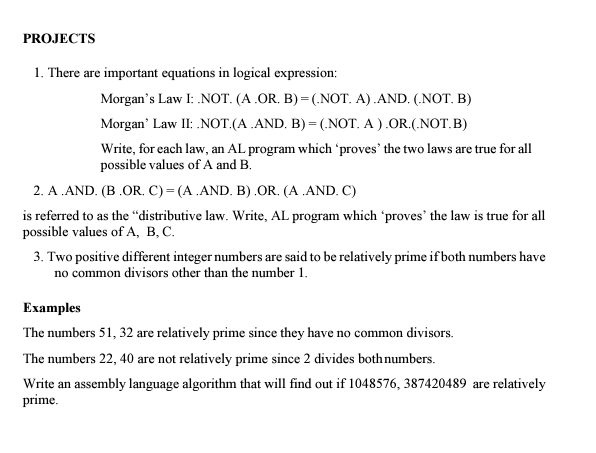
There are important equations in logical expression: Morgan's Law 1: .NOT. (A. OR. B) = (.NOT. A) .AND. (.NOT. B) Morgan' Law II:, NOT.(A .AND. B) = (.NOT. A) OR.(.NOT.B) Write, for each law, an AL program which 'proves' the two laws are true for all possible values of A and B. A .AND. (B .OR. C) = (A .AND. B) .OR. (A .AND. C) is referred to as the "distributive law. Write, AL program which 'proves' the law is true for all possible values of A, B, C. Two positive different integer numbers are said to be relatively prime if both numbers have no common divisors other than the number 1. Examples The numbers 51, 32 are relatively prime since they have no common divisors. The numbers 22, 40 are not relatively prime since 2 divides both numbers. Write an assembly language algorithm that will find out if 1048576, 387420489 are relatively prime
Step by Step Solution
There are 3 Steps involved in it

Get step-by-step solutions from verified subject matter experts
 Study Help