







Question: Assembly code is required to calculate and print the result of an expression entered by user. Here are the details of the code: 1- Code
Assembly code is required to calculate and print the result of an expression entered by user. Here are the details of the code:
1- Code should use the emulator emu8086.
2- Code should ask the user to input an arithmetic expression, then the code will print the result on the screen.
3- Code allow the following operations ONLY:
Addition (+)
Subtraction (-)
Multiplication (*)
Division (/)
Mod (%)
Factorial (!)
4- Code should contains 6 procedures (one procedure per operation). Here are the procedures that should be included in your code:
Addition: This function add two integer numbers.
Subtraction: This function subtract two integer numbers.
Multiplication: This function multiply two integer numbers.
Division: This function divide two integer numbers.
Mod: This function calculate the reminder of division operation between two integer numbers.
Factorial: This function calculate the factorial of a positive integer number. For example:
4! = 4*3*2*1= 24
5! = 5*4*3*2*1 = 120
5- Assume the range of numbers that entered by the user is (-127 - +127)
6- PAY ATTENTION: NOT allowed to use MUL, IMUL, DIV or IDIV instructions in your code.
7- If the user enter any operation or character other than the allowed operation, your code should print Error: The operation is not valid.
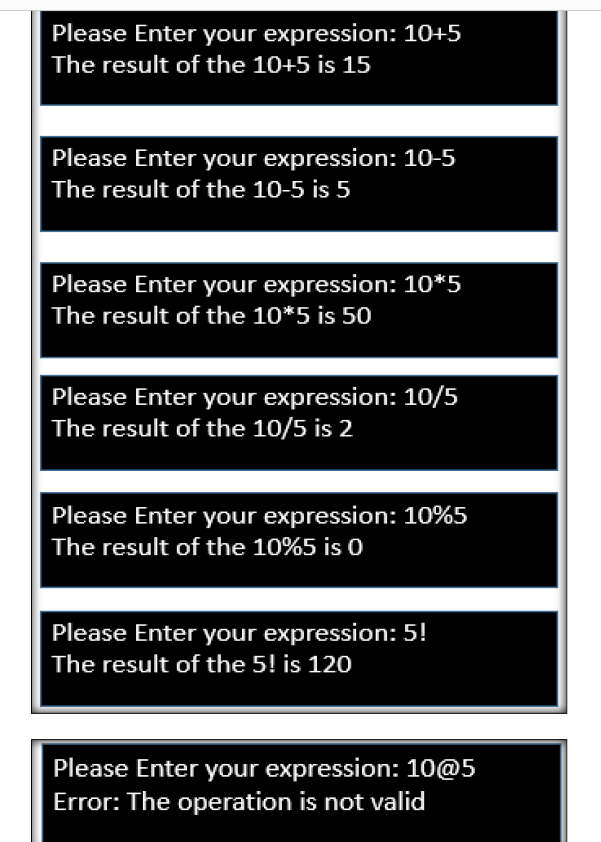
OUTPUT SHOULD BE LIKE THIS
The question is already answered by a chegg expert but its wrong...Plz provide the code(Solution) According to the instructions given above
Please Enter your expression: 10+5 The result of the 10+5 is 15 Please Enter your expression: 10-5 The result of the 10-5 is 5 Please Enter your expression: 10*5 The result of the 10*5 is 50 Please Enter your expression: 10/5 The result of the 10/5 is 2 Please Enter your expression: 10%5 The result of the 10%5 is 0 Please Enter your expression: 5! The result of the 5! is 120 Please Enter your expression: 10@5 Error: The operation is not valid
Step by Step Solution
There are 3 Steps involved in it

Get step-by-step solutions from verified subject matter experts
 Study Help