







Question: ASSEMBLY LANGUAGE PROGRAMMING- please follow the instructions and solve . Execute and show the output- thank you!! Write a program in assembly language using the
ASSEMBLY LANGUAGE PROGRAMMING- please follow the instructions and solve.
Execute and show the output- thank you!!
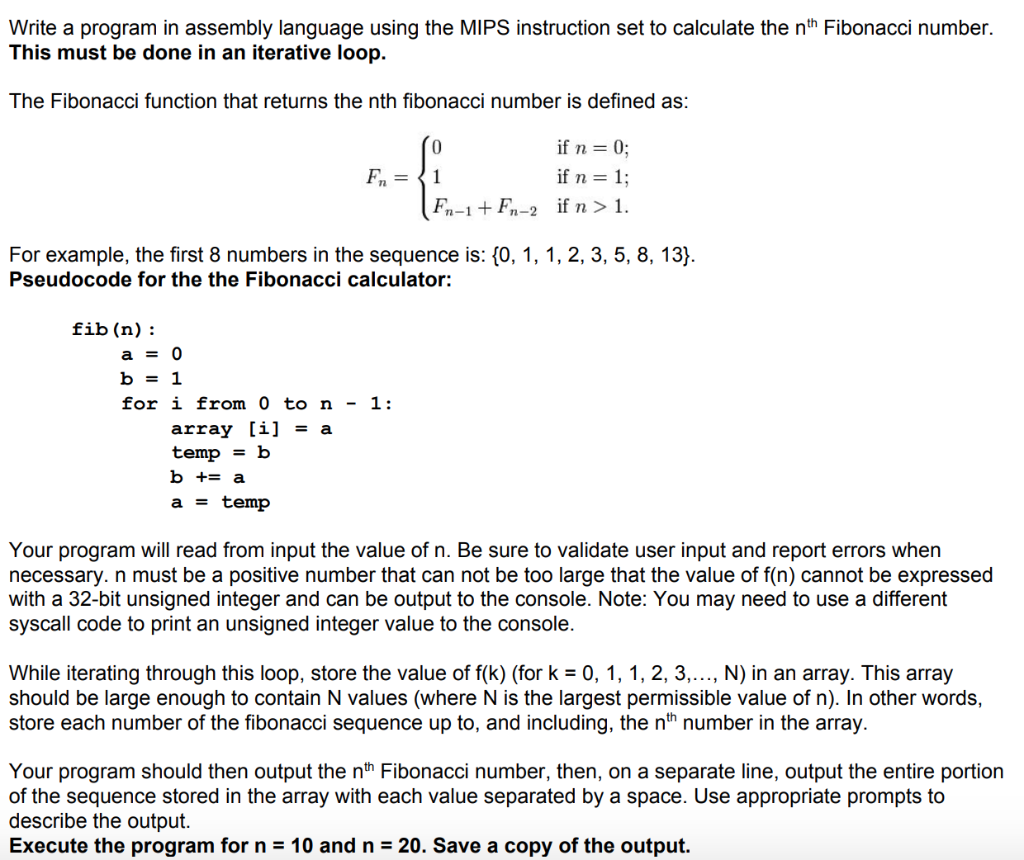
Write a program in assembly language using the MIPS instruction set to calculate the nth Fibonacci number. This must be done in an iterative loop. The Fibonacci function that returns the nth fibonacci number is defined as: if n 0; If n = 1; F-2 if n > 1. Fn-1 For example, the first 8 numbers in the sequence is: s0, 1, 1, 2, 3, 5, 8, 13) Pseudocode for the the Fibonacci calculator: fib (n): b 1 for i from 0 to n - 1: array [i] - a temp - b a = temp Your program will read from input the value of n. Be sure to validate user input and report errors when necessary. n must be a positive number that can not be too large that the value of f(n) cannot be expressed with a 32-bit unsigned integer and can be output to the console. Note: You may need to use a different syscall code to print an unsigned integer value to the console While iterating through this loop, store the value of f(k) (for k-0,1,1, 2, 3,..., N) in an array. This array should be large enough to contain N values (where N is the largest permissible value of n). In other words, store each number of the fibonacci sequence up to, and including, the nth number in the array Your program should then output the nh Fibonacci number, then, on a separate line, output the entire portion of the sequence stored in the array with each value separated by a space. Use appropriate prompts to describe the output. Execute the program for n 10 and n- 20. Save a copy of the output. Write a program in assembly language using the MIPS instruction set to calculate the nth Fibonacci number. This must be done in an iterative loop. The Fibonacci function that returns the nth fibonacci number is defined as: if n 0; If n = 1; F-2 if n > 1. Fn-1 For example, the first 8 numbers in the sequence is: s0, 1, 1, 2, 3, 5, 8, 13) Pseudocode for the the Fibonacci calculator: fib (n): b 1 for i from 0 to n - 1: array [i] - a temp - b a = temp Your program will read from input the value of n. Be sure to validate user input and report errors when necessary. n must be a positive number that can not be too large that the value of f(n) cannot be expressed with a 32-bit unsigned integer and can be output to the console. Note: You may need to use a different syscall code to print an unsigned integer value to the console While iterating through this loop, store the value of f(k) (for k-0,1,1, 2, 3,..., N) in an array. This array should be large enough to contain N values (where N is the largest permissible value of n). In other words, store each number of the fibonacci sequence up to, and including, the nth number in the array Your program should then output the nh Fibonacci number, then, on a separate line, output the entire portion of the sequence stored in the array with each value separated by a space. Use appropriate prompts to describe the output. Execute the program for n 10 and n- 20. Save a copy of the output
Step by Step Solution
There are 3 Steps involved in it

Get step-by-step solutions from verified subject matter experts
 Study Help