







Question: Assembly Language x86 Processors Lab Exercise answer: Continue with the lab exercise, write a program that calculates the following expression: A = (A + B)-(C
Assembly Language
x86 Processors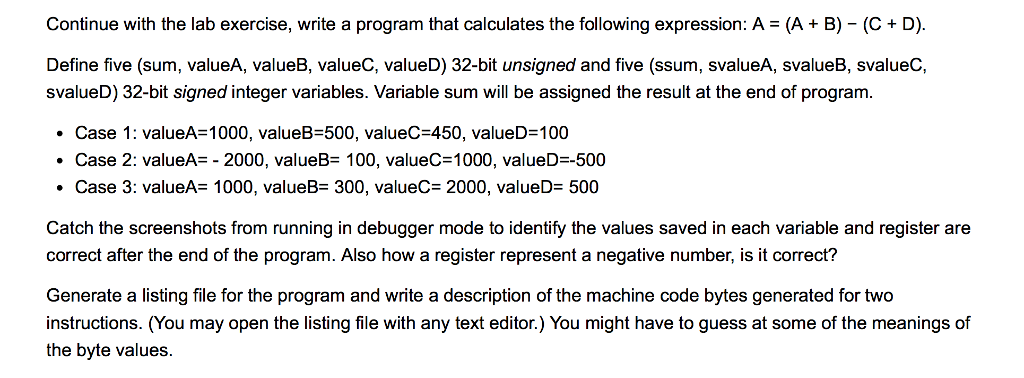
Lab Exercise answer: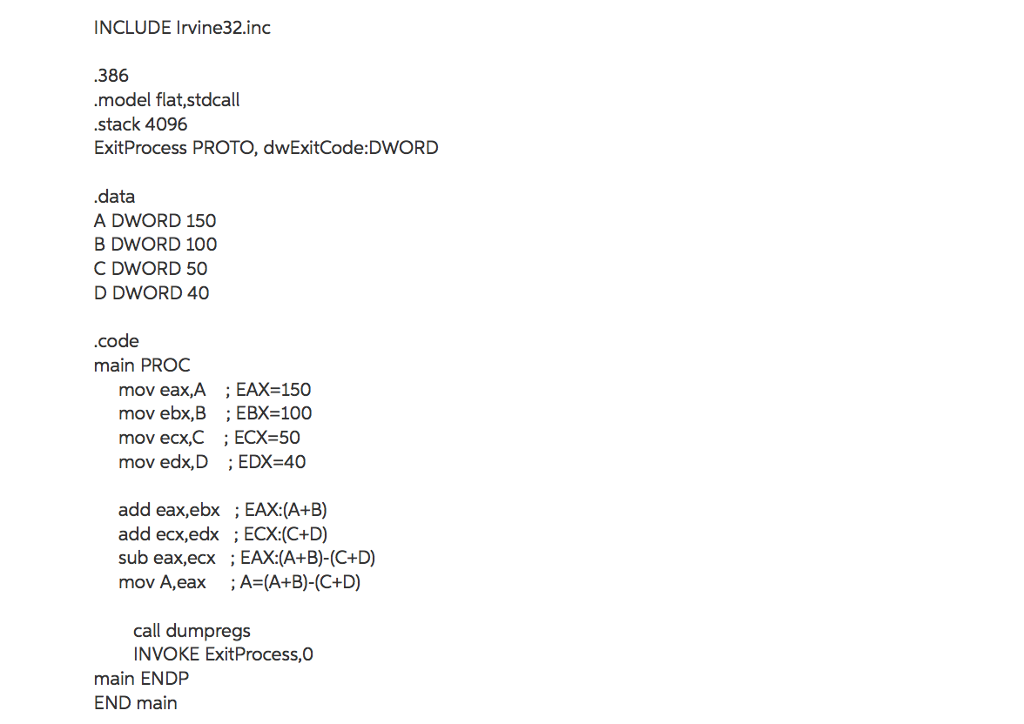
Continue with the lab exercise, write a program that calculates the following expression: A = (A + B)-(C + D). Define five (sum, valueA, valueB, valueC, valueD) 32-bit unsigned and five (ssum, svalueA, svalueB, svalueC, svalueD) 32-bit signed integer variables. Variable sum will be assigned the result at the end of program. Case 1: valueA= 1000, valueB-500, valueC-450, valueD=100 Case 2: valueA_-2000, valueB: 100, valueC=1000, valueD-500 . Case 3: valueA= 1000, valueB-300, valueC= 2000, valueD= 500 Catch the screenshots from running in debugger mode to identify the values saved in each variable and register are correct after the end of the program. Also how a register represent a negative number, is it correct? Generate a listing file for the program and write a description of the machine code bytes generated for two instructions. (You may open the listing file with any text editor.) You might have to guess at some of the meanings of the byte values
Step by Step Solution
There are 3 Steps involved in it

Get step-by-step solutions from verified subject matter experts
 Study Help