







Question: assembly - simple Loop porgramming. Shift array elements by k (see picture) Specifications The objective of this assignment is to create a program that will
assembly - simple Loop porgramming. Shift array elements by k (see picture)
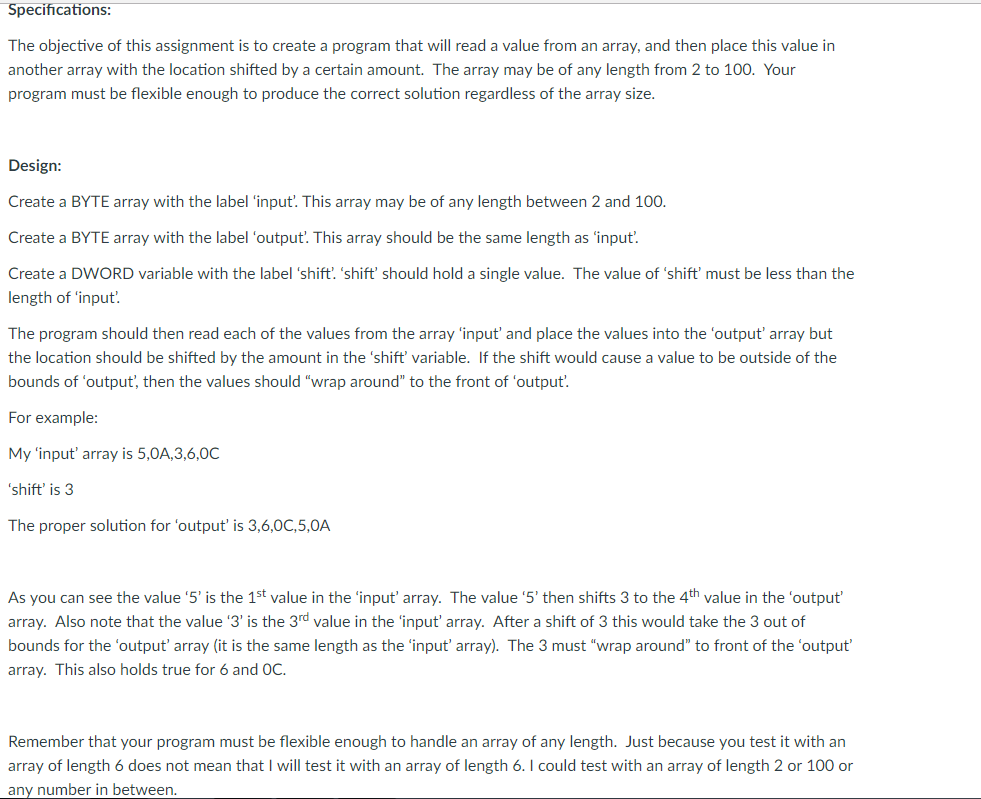
Specifications The objective of this assignment is to create a program that will read a value from an array, and then place this value in another array with the location shifted by a certain amount. The array may be of any length from 2 to 100. Your program must be flexible enough to produce the correct solution regardless of the array size. Design: Create a BYTE array with the label 'input. This array may be of any length between 2 and 100. Create a BYTE array with the label 'output. This array should be the same length as input Create a DWORD variable with the label 'shift. shift, should hold a single value. The value of 'shift, must be less than the length of 'input The program should then read each of the values from the array 'input' and place the values into the 'output' array but the location should be shifted by the amount in the 'shift variable. If the shift would cause a value to be outside of the bounds of 'output', then the values should "wrap around" to the front of 'output For example: My 'input' array is 5,0A,3,6,0C shift' is 3 The proper solution for 'output' is 3,6,0C,5,0A As you can see the value '5' is the 1st value in the 'input' array. The value '5' then shifts 3 to the 4th value in the 'output array. Also note that the value 3' is the 3rd value in the 'input' array. After a shift of 3 this would take the 3 out of bounds for the 'output' array (it is the same length as the 'input' array). The 3 must "wrap around" to front of the 'output array. This also holds true for 6 and OC. Remember that your program must be flexible enough to handle an array of any length. Just because you test it with an array of length 6 does not mean that I will test it with an array of length 6.I could test with an array of length 2 or 100 or any number in between Specifications The objective of this assignment is to create a program that will read a value from an array, and then place this value in another array with the location shifted by a certain amount. The array may be of any length from 2 to 100. Your program must be flexible enough to produce the correct solution regardless of the array size. Design: Create a BYTE array with the label 'input. This array may be of any length between 2 and 100. Create a BYTE array with the label 'output. This array should be the same length as input Create a DWORD variable with the label 'shift. shift, should hold a single value. The value of 'shift, must be less than the length of 'input The program should then read each of the values from the array 'input' and place the values into the 'output' array but the location should be shifted by the amount in the 'shift variable. If the shift would cause a value to be outside of the bounds of 'output', then the values should "wrap around" to the front of 'output For example: My 'input' array is 5,0A,3,6,0C shift' is 3 The proper solution for 'output' is 3,6,0C,5,0A As you can see the value '5' is the 1st value in the 'input' array. The value '5' then shifts 3 to the 4th value in the 'output array. Also note that the value 3' is the 3rd value in the 'input' array. After a shift of 3 this would take the 3 out of bounds for the 'output' array (it is the same length as the 'input' array). The 3 must "wrap around" to front of the 'output array. This also holds true for 6 and OC. Remember that your program must be flexible enough to handle an array of any length. Just because you test it with an array of length 6 does not mean that I will test it with an array of length 6.I could test with an array of length 2 or 100 or any number in between
Step by Step Solution
There are 3 Steps involved in it

Get step-by-step solutions from verified subject matter experts
 Study Help