







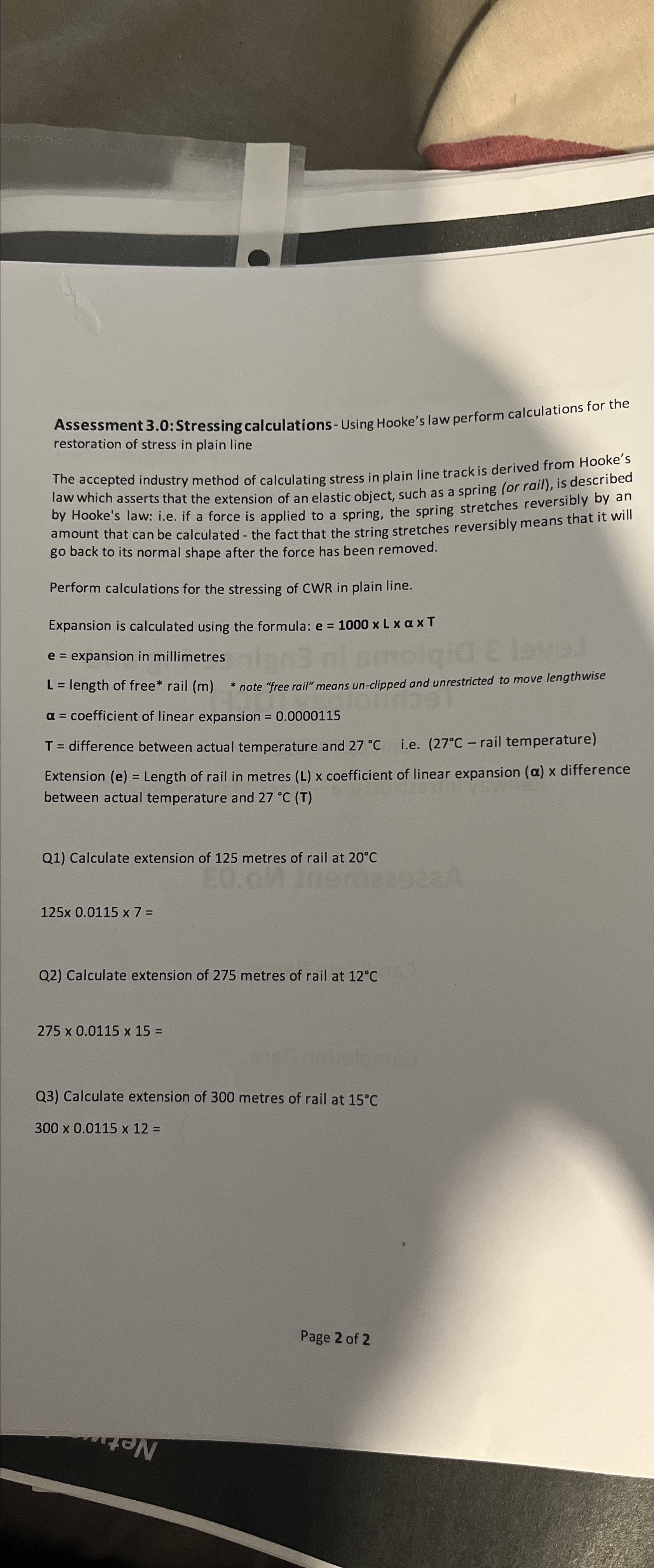
Question: Assessment 3 . 0 : Stressing calculations - Using Hooke's law perform calculations for the restoration of stress in plain line The accepted industry method
Assessment : Stressing calculationsUsing Hooke's law perform calculations for the restoration of stress in plain line
The accepted industry method of calculating stress in plain line track is derived from Hooke's law which asserts that the extension of an elastic object, such as a spring or rail is described by Hooke's law: ie if a force is applied to a spring, the spring stretches reversibly by an amount that can be calculated the fact that the string stretches reversibly means that it will go back to its normal shape after the force has been removed.
Perform calculations for the stressing of CWR in plain line.
Expansion is calculated using the formula:
expansion in millimetres
length of free rail note "free rail" means unclipped and unrestricted to move lengthwise
coefficient of linear expansion
difference between actual temperature and ie rail temperature
Extension Length of rail in metres coefficient of linear expansion difference between actual temperature and
Q Calculate extension of metres of rail at
Q Calculate extension of metres of rail at
Q Calculate extension of metres of rail at
Page of
Step by Step Solution
There are 3 Steps involved in it
1 Expert Approved Answer
Step: 1 Unlock

Question Has Been Solved by an Expert!
Get step-by-step solutions from verified subject matter experts
Step: 2 Unlock
Step: 3 Unlock
 Study Help