







Question: ASSESSMENT ITEM 2: DESCRIPTION Aims In this assignment, you will learn transaction processing skills, from the initial recording of transactions through to the preparation and
ASSESSMENT ITEM 2: DESCRIPTION
Aims
In this assignment, you will learn transaction processing skills, from the initial recording of transactions through to the preparation and presentation of financial reports, in a computerised accounting system environment, using the MYOB software. All enrolled students in this subject are required to use the MYOB software to process the business transactions of WONDEROUS WILDFLOWERS (a case study book), a small business (a proprietary or sole trader firm), for July 2019. Please be aware that it may take up to twenty-five (25) hours to complete this assignment (including learning to use the MYOB software).
Instructions: Individual completion of the practice set
Before commencing your work on this assignment, please make yourself familiar with the content in Chapters 1-3. You may need to read the textbook for a deeper understanding of the concepts and principles underlying business transactions and how they are processed in any manual accounting system. My best advice is to work in groups to learn the content in Chapters 1-3 before you commence working on the assignment (detailed in Appendix 1 and guided by the screenshots in chapter4).
Once you have mastered the techniques of entering transactions in the MYOB software, you can start entering the data from Appendix 1 of your Case study book (pages 66-70) in the MYOB software. Please follow screenshots from Chapter 4 and compare your entries to ensure you MYOB entries are accurate. Your accuracy is crucial before you start working on the rest of the months transactions in pages 66-70 of Appendix 1.
Once you have completed and compared period one transactions in the MYOB software above, you can complete the other transactions in pages 66-70 in three sequences and submit those progressively: (period two, pages 66-67- to be submitted in week 7; period three, pages 67-68, to be submitted in week 7 and period four, pages 69-70, to be submitted in week 9). Chapter 5 is helpful to process period four transactions and to produce the final reports for the period 1 July 2019 to 31 July 2019
(Helpful hints: After entering period two and period three transactions, please compare your results with the check figures provided on page 63. No check figures are available for your entries in period four. Please read additional resources in Appendix 2-4 for difficult transactions and their processing in MYOB).
Useful information
- After entering period two and period three transactions, please compare your results with the check figures provided on page 63. No check figures are available for the transaction in period four. Please read additional resources in Appendix 2-4 for processing difficult transaction items and their processing in MYOB).
Required tasks: After processing all the transactions for July 2019 above, in the MYOB software, you are required to produce the following outputs (page 64 of the case study book) for submission through LearnJCU assignment Dropbox:
Prepare general journal entries for the end of month adjustments, recording each of the adjustments separately.
Prepare the end of month bank reconciliation using the bank statement shown in appendix 1. (See appendix 4 for help with the bank fees.)
Prepare, view, and print the following reports for July:
Sales Accounts Receivable Ageing Summary
Purchases Accounts Payable Ageing Summary
Inventory Items List Summary
GST [Summary Accrual]
Banking Reconciliation Report
Accounts Trial Balance
Accounts Profit & Loss [Accrual]
Accounts Standard Balance Sheet
CRITERIA SHEET:
- Journalising:
- Identify and establish opening account balances in the general and subsidiary ledgers.
- Classify and record transactions in the specialised and general journals.
- Posting to relevant ledger accounts
- Process journals to the general and subsidiary ledgers.
- Preparation of reports:
- Prepare a schedule of accounts as required on page 69 of the case study book and reconcile these with the check figures provided.
- Prepare a trial balance for 31 July 2019 (screenshot on page 68). [AR1]
- Record and post balance daily adjustments in general journals; and
- Prepare and present the financial statements: Income Statement, and Balance Sheet
Submission and return of assessment:
- Use the ASSESSMENT folder, click on it and find out the ASSESSMENT TWO button, then click on ASSIGNMENT TWO- MYOB OUTPUTS to submit your work (pdf or word document).
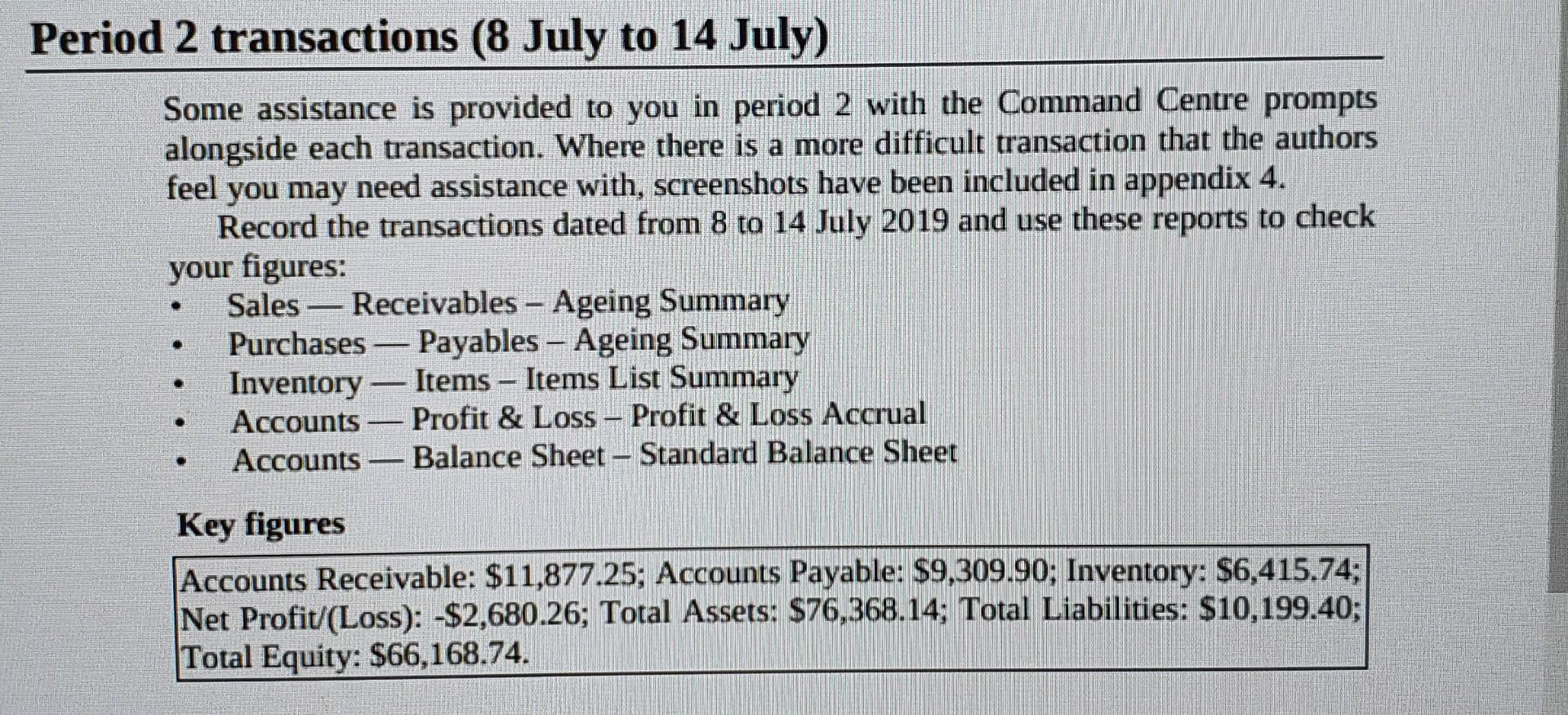
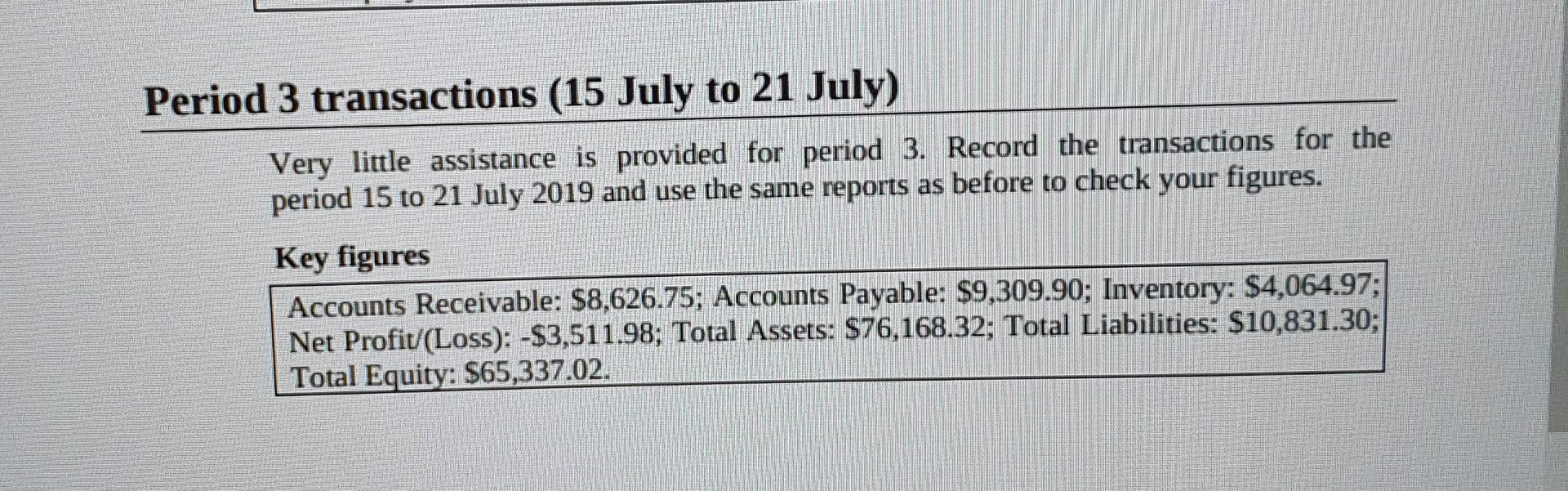
Some assistance is provided to you in period 2 with the Command Centre prompts alongside each transaction. Where there is a more difficult transaction that the authors feel you may need assistance with, screenshots have been included in appendix 4. Record the transactions dated from 8 to 14 July 2019 and use these reports to check your figures: - Sales - Receivables - Ageing Summary - Purchases - Payables - Ageing Summary - Inventory - Items - Items List Summary - Accounts - Profit \& Loss - Profit \& Loss Accrual - Accounts - Balance Sheet - Standard Balance Sheet Key figures Accounts Receivable: $11,877.25; Accounts Payable: $9,309.90; Inventory: $6,415.74; Net Profit/(Loss): $2,680.26; Total Assets: $76,368.14; Total Liabilities: $10,199.40; Total Equity: $66,168.74. Very little assistance is provided for period 3. Record the transactions for the period 15 to 21 July 2019 and use the same reports as before to check your figures. Key figures Accounts Receivable: $8,626.75; Accounts Payable: $9,309.90; Inventory: $4,064.97 Net Profit/(Loss): $3,511.98; Total Assets: $76,168.32; Total Liabilities: \$10,831.30; Total Equity: $65,337.02. Some assistance is provided to you in period 2 with the Command Centre prompts alongside each transaction. Where there is a more difficult transaction that the authors feel you may need assistance with, screenshots have been included in appendix 4. Record the transactions dated from 8 to 14 July 2019 and use these reports to check your figures: - Sales - Receivables - Ageing Summary - Purchases - Payables - Ageing Summary - Inventory - Items - Items List Summary - Accounts - Profit \& Loss - Profit \& Loss Accrual - Accounts - Balance Sheet - Standard Balance Sheet Key figures Accounts Receivable: $11,877.25; Accounts Payable: $9,309.90; Inventory: $6,415.74; Net Profit/(Loss): $2,680.26; Total Assets: $76,368.14; Total Liabilities: $10,199.40; Total Equity: $66,168.74. Very little assistance is provided for period 3. Record the transactions for the period 15 to 21 July 2019 and use the same reports as before to check your figures. Key figures Accounts Receivable: $8,626.75; Accounts Payable: $9,309.90; Inventory: $4,064.97 Net Profit/(Loss): $3,511.98; Total Assets: $76,168.32; Total Liabilities: \$10,831.30; Total Equity: $65,337.02
Step by Step Solution
There are 3 Steps involved in it

Get step-by-step solutions from verified subject matter experts
 Study Help