







Question: Assessment Task 3: Creative Task and Written Reflection - Task description and marking rubric To formally complete the task, submit the following two parts in
Assessment Task 3: Creative Task and Written Reflection - Task description and marking rubric
To formally complete the task, submit the following two parts in the one file:
Part A:?Creative work with artist statement (Five marks)
1. Produce an?original piece ofcreative work?thatreflectson the following:
- What is the relevance of the five UNCC100 module topics to a current?social crisis?related to yourACU?course of study?
2. Write an?artist statement?(two hundred fifty words) that?describes the following:
- What is the inspiration underpinning creative work, and how do its various elements reflect the module topics?
Part B:?Written reflection on?social crisis?(45 marks)
Based onboththe creative workandthe artist statement, write an?argumentative essay?(fifteen hundred words) that continues yourreflectionon the following:
- What is the relevance of the module topics to the?social crisisand its relationship with yourcourse of study?
Throughout the essay:
- Explain(LO1; Criterion 3) at least two of the CST principles in terms of specific issues in thesocial crisis.
- Analyse(LO3; Criterion 4)?and?evaluate(LO3; Criterion 5) the relevance of the module topics to yourcourse of studyin terms of specific issues in thesocial crisis.
Requirements include:
1. naming your selectedsocial crisis?and?course of studyabove or at the beginning of your submissionLinks to an external site.
2. citing (through the text and in the reference list/bibliographyas a bare minimum)
- five Canvas resources (e.g., an article from Module 1, a reading from Module 2, a video from Module 3, etc.)
- one?course of study-specific resource (e.g., from Leganto)
- one?article from the?Journal of Catholic Social ThoughtLinks to an external site.
- following theadvice already provided concerningreferencing
Further instructions:
- Generative-artificial intelligence applications (e.g., ChatGPT), paraphrasing and translation tools are not permitted to be used to prepare this assessment task.
- Please refer to theKey unit glossaryfor definitions of important terms.
- Students may exceed the prescribed word limit on assessments by 10% +/- without penalty. Word limits donotinclude the student information (i.e., student name, student number, etc.), the reference list/bibliography, or any in-text referencing citations/footnoting.
Due date: Monday, 28 October 2024, 11:00pm AEDT
Weighting:50%
Length and/or format: seventeen hundres fifty hundred words - made up of two hundred fifty words for Part A and fifteen hundred words for Part B.
Purpose: This assesses students' ability to apply what they have learned about Catholic social thought (CST) principles. Through the generation of a creative work and a written paper, students reflect on the ideas underlying the work and the ways in which it reflects the themes of the unit.
Learning outcomes assessed: LO1, LO2
How to submit: This assessment task must be submitted electronically via Turnitin on Canvas
Return of assignment: This assessment task will be graded electronically, and your numerical mark (Grades) and feedback (Speedgrader) will be provided on Canvas. An announcement will be posted on Canvas when your numerical mark and feedback is available.
Assessment criteria:
| UNCC100: Self and Community: Exploring the Anatomy of Modern Society Assessment Task 3: Creative Task and Written Reflection (50%) Marking Rubric | ||||||
| Grades and grade descriptors | ||||||
| Criteria | Refer toACU Assessment Policy | |||||
Fail (NN) Didnot provide an acceptablestandard of learning achievement | Pass (PA) Acceptablestandard of learning achievement | Credit (CR) Soundstandard of learning achievement | Distinction (DI) High qualitystandard of learning achievement | High Distinction (HD) Exceptionally high-qualitystandard of learning achievement | ||
| Overall numerical mark range (/100) | 0-49/100 | 50-64/100 | 65-74/100 | 75-84/100 | 85-100/100 | |
| Specific weighted numerical mark range (/50) | 0-24.9/50 | 25-32.4/50 | 32.5-37.4/50 | 37.5-42.4/50 | 42.5-50/50 | |
| Part A: Creative work with artist statement | ||||||
Criterion 1: DESCRIPTION: Connection between creative work and artist statement, with description of inspiration underpinning creative work and how it reflects module topics. | Did not provide an acceptable standard of this connection, with description. | Acceptable standard of this connection, with description. | Sound standard of this connection, with description. | High quality standard of this connection, with description. | Exceptionally high-quality standard of this connection, with description. | |
| 4 marks | 0-1.9/4 | 2-2.5/4 | 2.6-2.9/4 | 3-3.3/4 | 3.4-4/4 | |
Criterion 2: EXPRESSION: Writing style suited to an artist statement, grammar, punctuation, structure and flow, clarity, and readability, balanced and strategic use of word allocation. | Did not provide an acceptable standard of expression. | Acceptable standard of expression. | Sound standard of expression. | High quality standard of expression. | Exceptionally high-quality standard of expression. | |
| 1 mark | 0-0.49/1 | 0.50-0.64/1 | 0.65-0.74/1 | 0.75-0.84/1 | 0.85-1/1 | |
| Part B: Written reflection on social crisis | ||||||
Criterion 3: EXPLANATION: Explanation ofat least two of the CST principles in terms of specific issues in the social crisis, based on engagement with appropriate sources. | Did not provide an acceptable standard of this explanation. | Acceptable standard of this explanation. | Sound standard of this explanation. | High quality standard of this explanation. | Exceptionally high-quality standard of this explanation. | |
| 5 marks | 0-2.4/5 | 2.5-3.2/5 | 3.3-3.7/5 | 3.8-4.2/5 | 4.3-5/5 | |
Criterion 4: ANALYSIS: Analysis ofthe relevance of the module topics to your course of study in terms of specific issues in the social crisis, based on engagement with appropriate sources. | Did not provide an acceptable standard of this analysis. | Acceptable standard of this analysis. | Sound standard of this analysis. | High quality standard of this analysis. | Exceptionally high-quality standard of this analysis. | |
| 10 marks | 0-4.9/10 | 5-6.4/10 | 6.5-7.4/10 | 7.5-8.4/10 | 8.5-10/10 | |
Criterion 5: EVALUATION: Evaluation ofthe relevance of the module topics to your course of study in terms of specific issues in the social crisis, based on engagement with appropriate sources. | Did not provide an acceptable standard of this evaluation | Acceptable standard of this evaluation. | Sound standard of this evaluation. | High quality standard of this evaluation. | Exceptionally high-quality standard of this evaluation. | |
| 15 marks | 0-7.4/15 | 7.5-9.7/15 | 9.8-11.2/15 | 11.3-12.7/15 | 12.8-15/15 | |
Criterion 6: EXPRESSION: Writing style suited to an argumentative essay, grammar, punctuation, structure and flow, clarity, and readability, balanced and strategic use of word allocation. | Did not provide an acceptable standard of expression. | Acceptable standard of expression. | Sound standard of expression. | High quality standard of expression. | Exceptionally high-quality standard of expression. | |
| 10 marks | 0-4.9/10 | 5-6.4/10 | 6.5-7.4/10 | 7.5-8.4/10 | 8.5-10/10 | |
Criterion 7: REFERENCING: Citing appropriate sources accurately and consistently. | Did not provide an acceptable standard of referencing. | Acceptable standard of referencing. | Sound standard of referencing. | High quality standard of referencing. | Exceptionally high-quality standard of referencing. | |
| 5 marks | 0-2.4/5 | 2.5-3.2/5 | 3.3-3.7/5 | 3.8-4.2/5 | 4.3-5/5 |
Part A: Creative work with artist statement
Insert your original piece of creative work of up to a page or 3 minutes (any links must be public)
Write the total word count of artist statement excluding references (which are not necessary)
Write your artist statement in, e.g., 2 x ONE HUNDRED TWENTYFIVE-word paragraphs
--
Part B: Written reflection on social crisis
Write the total word count excluding references
Write a short title in bold
Write your response in, e.g., 10 x HINDRED AND FIFTY WORD-word paragraphs
Write "Reference list" and name your referencing style (e.g., APA, 7th) along with:
...[Required source #1 = Canvas resource from Module 1]
... [Required source #2 = Canvas resource from Module 2]
... [Required source #3 = Canvas resource from Module 3]
... [Required source #4 = Canvas resource from Module 4]
... [Required source #5 = Canvas resource from Module 5]
... [Required source #6 = course of study-specific]
... [Required source #7 = Journal of Catholic Social Thought]
[Required source #1 = Canvas resource from Module 1]
1. What are Module 1a's main questions?
- What are the most important features of this unit? - How can you succeed in UNCC100?
2. Which topics are we exploring in Module 1a?
- The principles of Catholic social thought - Catholic social thought as a kind of political theology
3. Why is Module 1a important for you?
- It provides a roadmap of the unit (UNCC100) and its principal framework (CST principles) - It's foundational to the Core Curriculum and to your social location and identity in ACU
1.What are Module 1b's main questions?
- How are the CST principles of human dignity and the common good interrelated? - What does this interrelationship have to do with your course of study at ACU?
2. Which topics are we exploring in Module 1b?
- Human dignity - The common good
3. Why is Module 1b important for you?
- As a student here, you are beginning to participate in ACU's mission of pursuing "knowledge, the dignity of the human person and the common good" - Whichever course you are studying, your units and educators will bring you back to notions of human dignity and the common good over and again
... [Required source #2 = Canvas resource from Module 2]
Module 2arequires of you up to5hoursin total, includingthe reading and the tutorial.Please come prepared for tutorials. They give you unique chances to discuss ideas and questions based on your individual learning.
//
1.What are Module 2a's main questions?
- What is ubuntu?
- How is relevant to truth and reconciliation?
2. Which topics are we exploring in Module 2a?
- Ubuntu's take on the interplay between individual and community
- Truth and reconciliation processes and Catholic perspectives
3. Why is Module 2a important for you?
- Ubuntu is central to your assessment schedule in UNCC100
- Ubuntu helps us to think about pressing Australian social issues in new ways
Module 2brequires of you up to5hoursin total, includingthe reading and the tutorial.Please come prepared for tutorials. They give you unique chances to discuss ideas and questions based on your individual learning.
//
1.What are Module 2b's main questions?
- What is the relevance of ubuntu in Australia?
- How compatible is ubuntu with truth and reconciliation in Australia?
2. Which topics are we exploring in Module 2b?
- Unresolved issues and problems with the history and usage of ubuntu
- The Uluru Statement from the Heart
3. Why is Module 2b important for you?
- It deals directly with your own social location in Australia
- You'll alsoconnect dots between theoretical points and ongoing Australian social issues in this unit's assessment schedule
... [Required source #3 = Canvas resource from Module 3]
1.What are Module 3a's main questions?
- Is flourishing or the good life possible, and if so, how?
- How important are other species of animals and our natural environments to flourishing and the good life?
2. Which topics are we exploring in Module 3a?
- Flourishing, the good life, wellbeing, happiness
- Climate catastrophes, fracking practices
3. Why is Module 3a important for you?
- It engages fundamental questions about human existence and any one person's place in the world
- The idea of multi-species flourishing canhelp us to think about ourselves as citizens of Australia in new, distinctive ways
- ... [Required source #4 = Canvas resource from Module 4]
1.What are Module 4a's main questions?
- What's empathy's significance to ACU's sense of organisational identity and purpose?
- How are empathy and compassion interrelated?
2. Which topics are we exploring in Module 4a?
- Theoretical issues with both how to understand and how to treat others
- Practical outcomes of empathy and compassion in the real world
3. Why is Module 4a important for you?
- As an ACU student, you have at least some identity with the mission of "impact through empathy"
- Learningempathy and compassion will enhance what you take from your course of study into your chosen profession and sector
1.What are Module 4b's main questions?
- Why are empathy and compassion important for you and for wider society?
- How are empathy and compassion distinct from each other?
2. Which topics are we exploring in Module 4b?
- How and when to practise empathy and compassion
- The pros and cons of empathy, on the one hand, and compassion, on the other hand
3. Why is Module 4b important for you?
- Thinking through how to treat others is a tricky but fundamentally important theoretical and conceptual journey
- Notions of empathy and compassion underpin and dovetail with the CST principles that you're focusing on in this unit
[Required source #5 = Canvas resource from Module 5]
1.What are Module 5a's main questions?
- What do ACU and CST have to do with advocacy and action?
- How do advocacy and action present in particular social issues?
2. Which topics are we exploring in Module 5a?
- The relevance of justice and protest
- Women and children
3. Why is Module 5a important for you?
- You may be in a position - and you may feel responsible - to practise advocacy and action in your own city and community
- Adisposition for advocacy and action is a key part of your ACU studies and your taking up of the CST principles in your future career
1.What are Module 5b's main questions?
- What are the theoretical and practical outcomes of the CST principles?
- How do notions and practices of advocacy matter to your specific course of study?
2. Which topics are we exploring in Module 5b?
- Disability
- Refugees and asylum seekers
3. Why is Module 5b important for you?
- It shows you how you might advocate for particularly marginalised communities
- It's the last in UNCC100 and can help you with your final assignment
- ... [Required source #6 = course of study-specific]
- ... [Required source #7 = Journal of Catholic Social Thought]
Latest Reference with in 5 years and intext citation required.
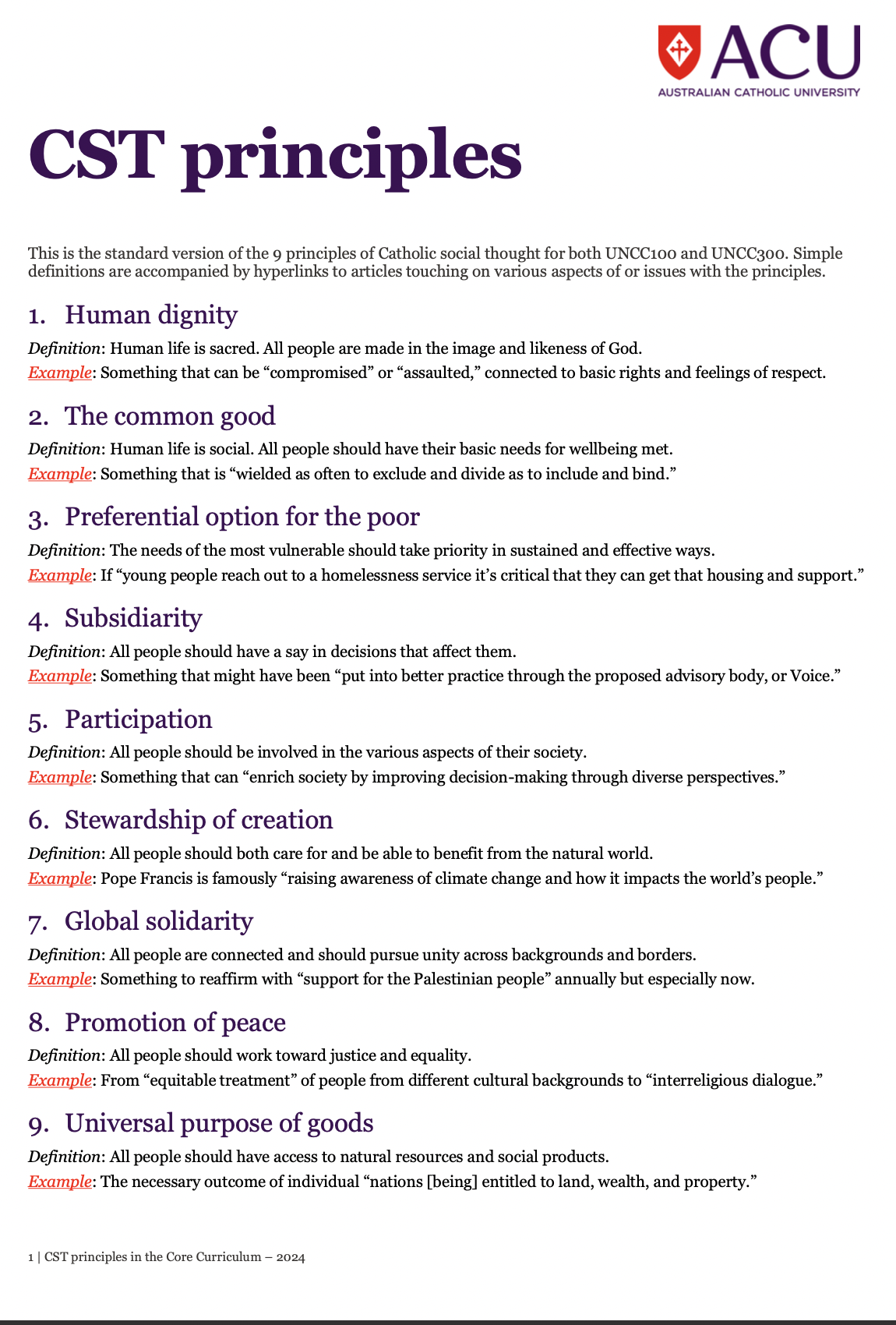 ACU AUSTRALIAN CATHOLIC UNIVERSITY CST principles This is the standard version of the 9 principles of Catholic social thought for both UNCC100 and UNCC300. Simple definitions are accompanied by hyperlinks to articles touching on various aspects of or issues with the principles. 1. Human dignity Definition: Human life is sacred. All people are made in the image and likeness of God. Example: Something that can be "compromised" or "assaulted," connected to basic rights and feelings of respect. 2. The common good Definition: Human life is social. All people should have their basic needs for wellbeing met. Example: Something that is "wielded as often to exclude and divide as to include and bind." 3. Preferential option for the poor Definition: The needs of the most vulnerable should take priority in sustained and effective ways. Example: If "young people reach out to a homelessness service it's critical that they can get that housing and support." 4. Subsidiarity Definition: All people should have a say in decisions that affect them. Example: Something that might have been "put into better practice through the proposed advisory body, or Voice." 5. Participation Definition: All people should be involved in the various aspects of their society. Example: Something that can "enrich society by improving decision-making through diverse perspectives." 6. Stewardship of creation Definition: All people should both care for and be able to benefit from the natural world. Example: Pope Francis is famously "raising awareness of climate change and how it impacts the world's people." 7. Global solidarity Definition: All people are connected and should pursue unity across backgrounds and borders. Example: Something to reaffirm with "support for the Palestinian people" annually but especially now. 8. Promotion of peace Definition: All people should work toward justice and equality. Example: From "equitable treatment" of people from different cultural backgrounds to "interreligious dialogue." 9. Universal purpose of goods Definition: All people should have access to natural resources and social products. Example: The necessary outcome of individual "nations [being] entitled to land, wealth, and property." 1 | CST principles in the Core Curriculum - 2024ACU AUSTRALIAN CATHOLIC UNIVERSITY CST principles This is the standard version of the 9 principles of Catholic social thought for both UNCC100 and UNCC300. Simple definitions are accompanied by hyperlinks to articles touching on various aspects of or issues with the principles. 1. Human dignity Definition: Human life is sacred. All people are made in the image and likeness of God. Example: Something that can be "compromised" or "assaulted," connected to basic rights and feelings of respect. 2. The common good Definition: Human life is social. All people should have their basic needs for wellbeing met. Example: Something that is "wielded as often to exclude and divide as to include and bind." 3. Preferential option for the poor Definition: The needs of the most vulnerable should take priority in sustained and effective ways. Example: If "young people reach out to a homelessness service it's critical that they can get that housing and support." 4. Subsidiarity Definition: All people should have a say in decisions that affect them. Example: Something that might have been "put into better practice through the proposed advisory body, or Voice." 5. Participation Definition: All people should be involved in the various aspects of their society. Example: Something that can "enrich society by improving decision-making through diverse perspectives." 6. Stewardship of creation Definition: All people should both care for and be able to benefit from the natural world. Example: Pope Francis is famously "raising awareness of climate change and how it impacts the world's people." 7. Global solidarity Definition: All people are connected and should pursue unity across backgrounds and borders. Example: Something to reaffirm with "support for the Palestinian people" annually but especially now. 8. Promotion of peace Definition: All people should work toward justice and equality. Example: From "equitable treatment" of people from different cultural backgrounds to "interreligious dialogue." 9. Universal purpose of goods Definition: All people should have access to natural resources and social products. Example: The necessary outcome of individual "nations [being] entitled to land, wealth, and property." 1 | CST principles in the Core Curriculum - 2024
 Step by Step Solution
There are 3 Steps involved in it

Get step-by-step solutions from verified subject matter experts
 Study Help