







Question: Assessment Type Case Study / Problem Based Learning Description You will be asked to make an audio presentation in the format of a podcast (between
| Assessment Type | Case Study / Problem Based Learning |
|---|---|
| Description | You will be asked to make an audio presentation in the format of a podcast (between 11-13 minutes) in which you explore a case study in relation to week 4-8 and the politics of climate justice. Week four: Feminist perspectives on climate justice Week five: Indigenist/Decolonial perspectives on climate justice Week six: Anti-racist /anti genocidal perspectives on climate justice Week seven: Degrowth and other economy perspectives on climate justice Week eight: rest, waste, cycles, grief, healing perspectives on climate justice You may choose any example that fits into the perspective you choose. This can be one studied in class or one that you find from your research, resonances and/or responsibilities. A case study example can be a movement, organisation, campaign. Each week includes examples either as links, podcasts, texts and other resources. |
| Weighting | 35% |
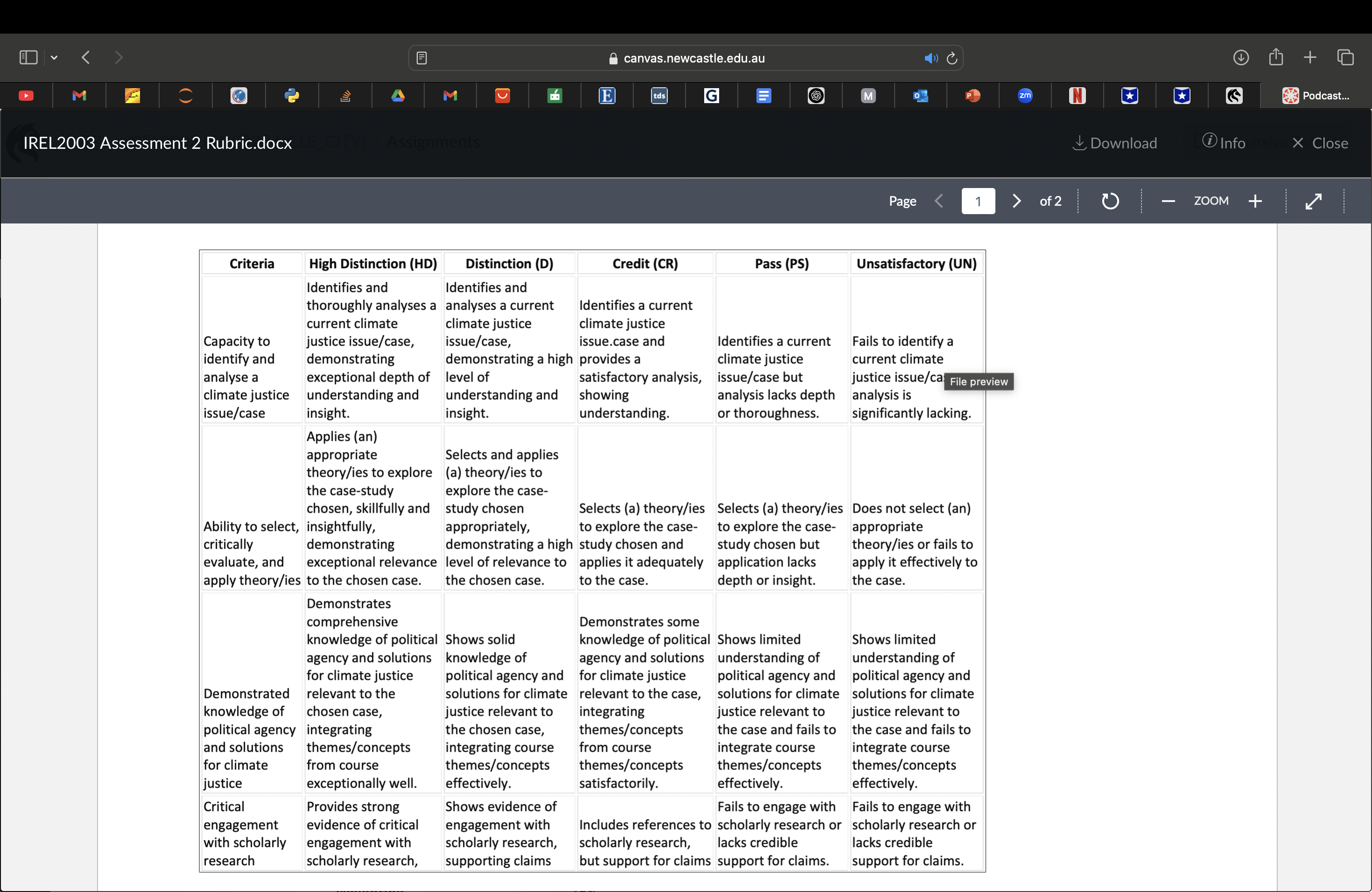
| Assessment Criteria | An overview and rubric are available below with more detailed instructions on how to complete this assignment |
Assessment Information
Students will create a podcast of between 11-13 minutes that tells the story of a case study from week 4-8 inclusive (which can be one studied or of the student's choice).
You are an invited guest due to your work as a climate justice activist on a community led climate justice movement's podcast series which is open access.
There are two parts to this assignment:
1. Create a podcast:
As part of your podcast presentation you must introduce the case-study and explore the relevance of this case study for understanding and illustrating the theme of the week chosen. You need to also explore what kind of political agency and solutions for climate justice the example suggests. You should then critically evaluate the viability of this example as a solution and strategy of climate justice, and explore what might strengthen its viability.
NOTE: You develop your podcast and its content and format with reference to additional references, texts and sources as you would a written text and translate your analysis into the podcast format.
The expected number of additional sources you would cite for this kind of assignment is between 7-9. However, there is flexibility for example if you find a lesser number of sources which contain a complex analysis and you engage with depth and sophistication this suffices and/or if you need to engage with a greater number to make your podcast this is also acceptable. We will evaluate this on a case by case basis.
In general a case study refers to a specific example that falls under the broader umbrella of the perspective to climate justice you are exploring.
This is an audio presentation and you are free to read a script, and/or explore other forms of political expression such as poetry, music, sounds of nature or other to help you explore your case study. However, you must address all the areas outlined above.
2. A 750 word written rationale reflecting on your choice of the design and format of your script and podcast
In this second part of this assignment you are required to tell us about why you made the choices you made in the design and format of your script and resulting podcast. This involves thinking about how the form in which we represent and express ideas and stories for climate justice is also political and is shaped by the ethics and the politics of knowledge which underlay what we believe to be valid forms of political communication and political agency.
Please include the list of references. texts and materials that you used to help develop your podcast at the end of the written rationale. This does NOT count in your word count for this second part of the assignment.
Step by Step Solution
There are 3 Steps involved in it

Get step-by-step solutions from verified subject matter experts
 Study Help