



Question: Asset acquisition vs. stock acquisition (fair value is different from book value) The following financial statement information is for an investor company and an investee
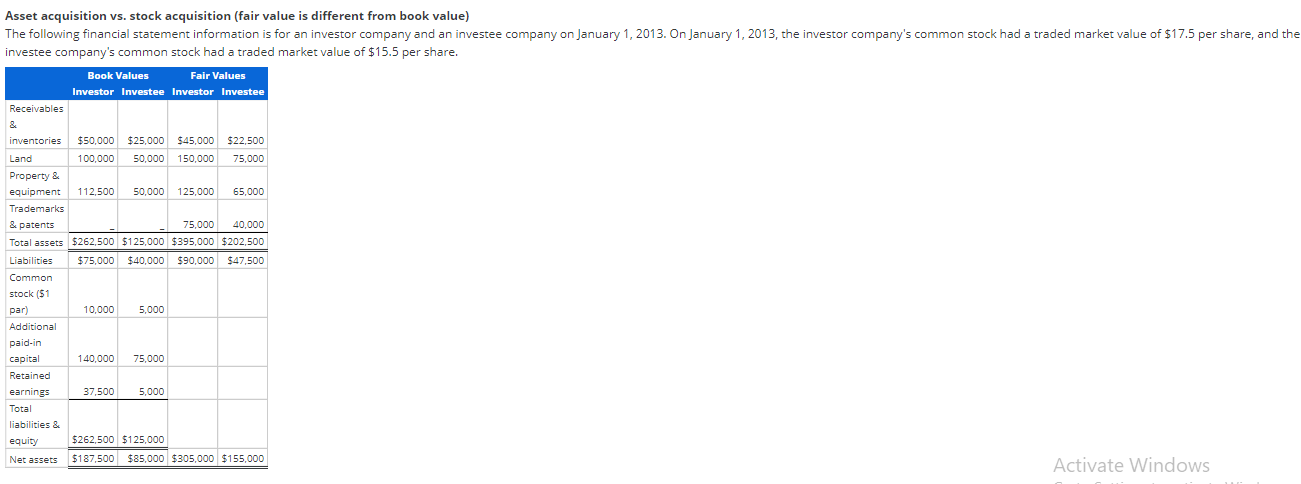
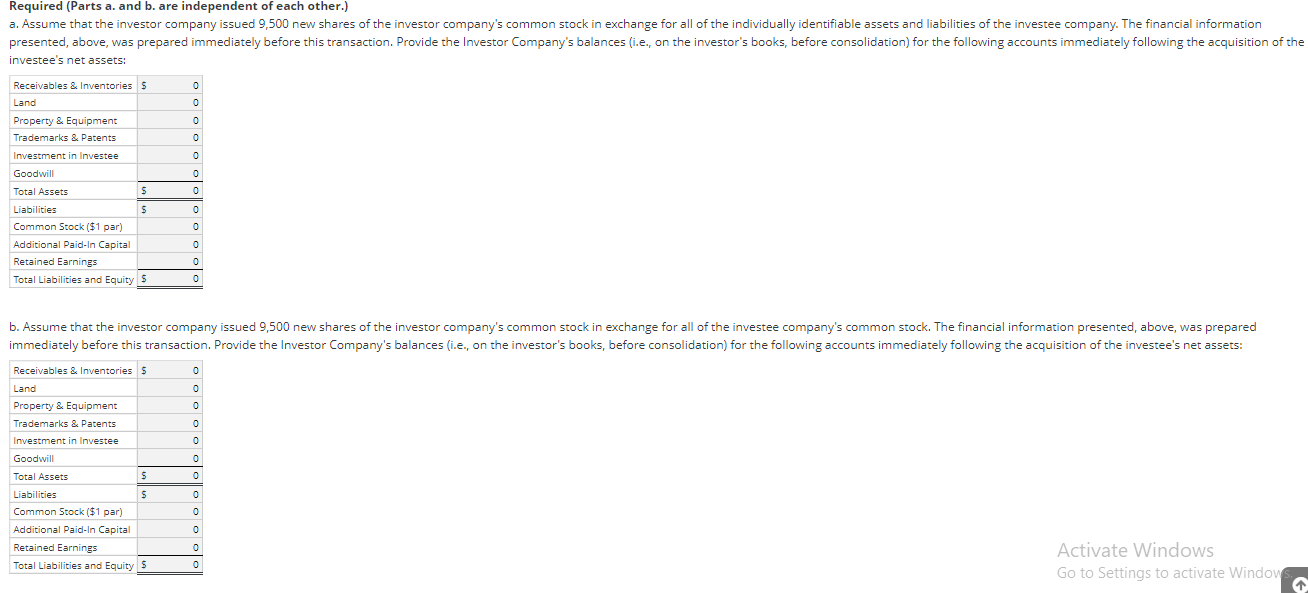
Asset acquisition vs. stock acquisition (fair value is different from book value) The following financial statement information is for an investor company and an investee company on January 1, 2013. On January 1, 2013, the investor company's common stock had a traded market value of $17.5 per share, and the investee company's common stock had a traded market value of $15.5 per share. Book Values Fair Values Investor Investee Investor Investee Receivables & inventories $50,000 $25,000 $45,000 $22.500 Land 100,000 50,000 150,000 75,000 Property & equipment 112.500 50,000 125,000 65.000 Trademarks & patents 75,000 40.000 Total assets $262,500 $125,000 $395,000 $202,500 Liabilities $75,000 $40,000 $90.000 $47,500 Common stock ($1 par) 10,000 5,000 Additional paid-in capital 140,000 75,000 Retained earnings 37.500 5,000 Total liabilities & equity $262,500 $125,000 Net assets $187.500 $85,000 $305,000 $155,000 Activate Windows Required (Parts a. and b. are independent of each other.) a. Assume that the investor company issued 9,500 new shares of the investor company's common stock in exchange for all of the individually identifiable assets and liabilities of the investee company. The financial information presented, above, was prepared immediately before this transaction. Provide the Investor Company's balances (i.e, on the investor's books, before consolidation) for the following accounts immediately following the acquisition of the investee's net assets: 0 Receivables & Inventories $ Land 0 0 0 0 0 0 Property & Equipment Trademarks & Patents Investment in Investee Goodwill Total Assets 5 Liabilities s Common Stock ($1 par) Additional Paid-In Capital Retained Earnings Total Liabilities and Equity 5 0 0 0 0 0 b. Assume that the investor company issued 9,500 new shares of the investor company's common stock in exchange for all of the investee company's common stock. The financial information presented, above, was prepared immediately before this transaction. Provide the Investor Company's balances (i.e., on the investor's books, before consolidation) for the following accounts immediately following the acquisition of the investee's net assets: 0 0 0 Receivables & Inventories 5 Land Property & Equipment Trademarks & Patents Investment in Investee Goodwill 0 0 0 S 0 s 0 0 Total Assets Liabilities Common Stock ($1 par) Additional Paid-In Capital Retained Earnings Total Liabilities and Equity 0 0 0 Activate Windows Go to Settings to activate Window 1 Asset acquisition vs. stock acquisition (fair value is different from book value) The following financial statement information is for an investor company and an investee company on January 1, 2013. On January 1, 2013, the investor company's common stock had a traded market value of $17.5 per share, and the investee company's common stock had a traded market value of $15.5 per share. Book Values Fair Values Investor Investee Investor Investee Receivables & inventories $50,000 $25,000 $45,000 $22.500 Land 100,000 50,000 150,000 75,000 Property & equipment 112.500 50,000 125,000 65.000 Trademarks & patents 75,000 40.000 Total assets $262,500 $125,000 $395,000 $202,500 Liabilities $75,000 $40,000 $90.000 $47,500 Common stock ($1 par) 10,000 5,000 Additional paid-in capital 140,000 75,000 Retained earnings 37.500 5,000 Total liabilities & equity $262,500 $125,000 Net assets $187.500 $85,000 $305,000 $155,000 Activate Windows Required (Parts a. and b. are independent of each other.) a. Assume that the investor company issued 9,500 new shares of the investor company's common stock in exchange for all of the individually identifiable assets and liabilities of the investee company. The financial information presented, above, was prepared immediately before this transaction. Provide the Investor Company's balances (i.e, on the investor's books, before consolidation) for the following accounts immediately following the acquisition of the investee's net assets: 0 Receivables & Inventories $ Land 0 0 0 0 0 0 Property & Equipment Trademarks & Patents Investment in Investee Goodwill Total Assets 5 Liabilities s Common Stock ($1 par) Additional Paid-In Capital Retained Earnings Total Liabilities and Equity 5 0 0 0 0 0 b. Assume that the investor company issued 9,500 new shares of the investor company's common stock in exchange for all of the investee company's common stock. The financial information presented, above, was prepared immediately before this transaction. Provide the Investor Company's balances (i.e., on the investor's books, before consolidation) for the following accounts immediately following the acquisition of the investee's net assets: 0 0 0 Receivables & Inventories 5 Land Property & Equipment Trademarks & Patents Investment in Investee Goodwill 0 0 0 S 0 s 0 0 Total Assets Liabilities Common Stock ($1 par) Additional Paid-In Capital Retained Earnings Total Liabilities and Equity 0 0 0 Activate Windows Go to Settings to activate Window 1
Step by Step Solution
There are 3 Steps involved in it

Get step-by-step solutions from verified subject matter experts