Question: Assighment 7: Decision Trees and Analytical Hierarchy Process Objectives . Identify the solution-fijutral function. Represent the differences between concepts. Background Scenario: You are the chief
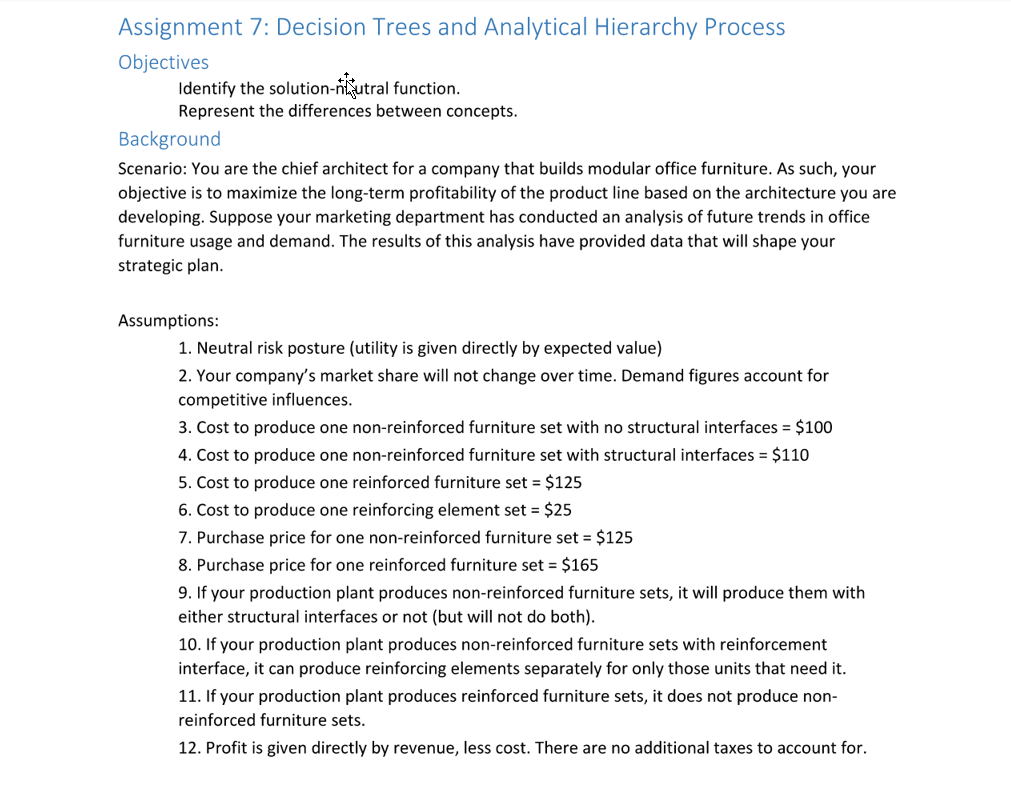
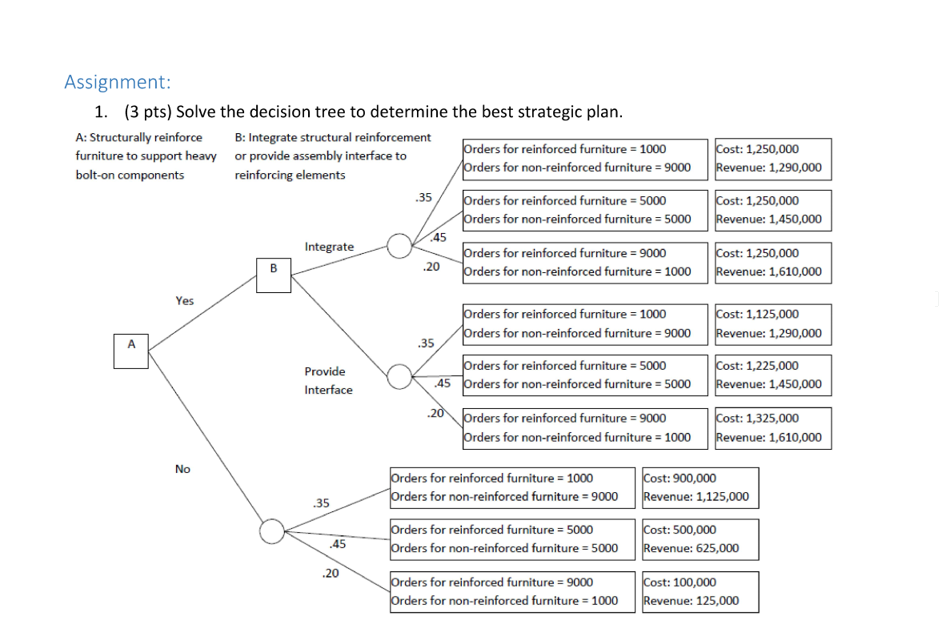
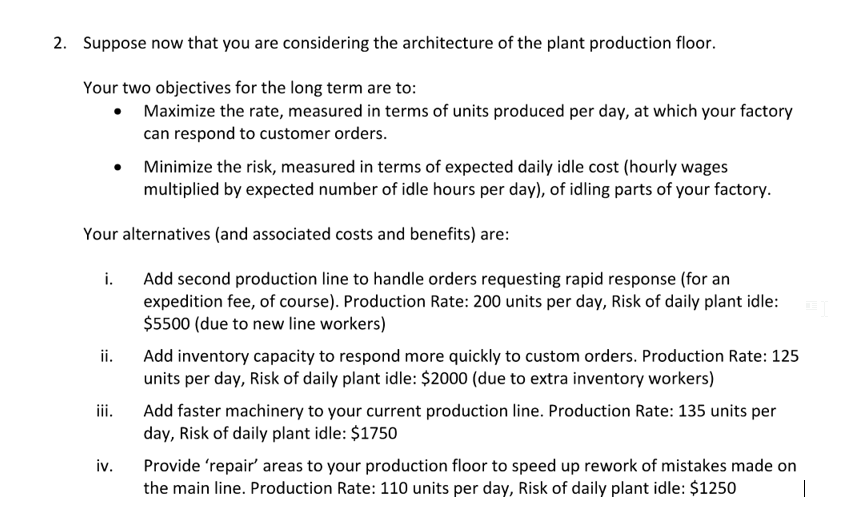
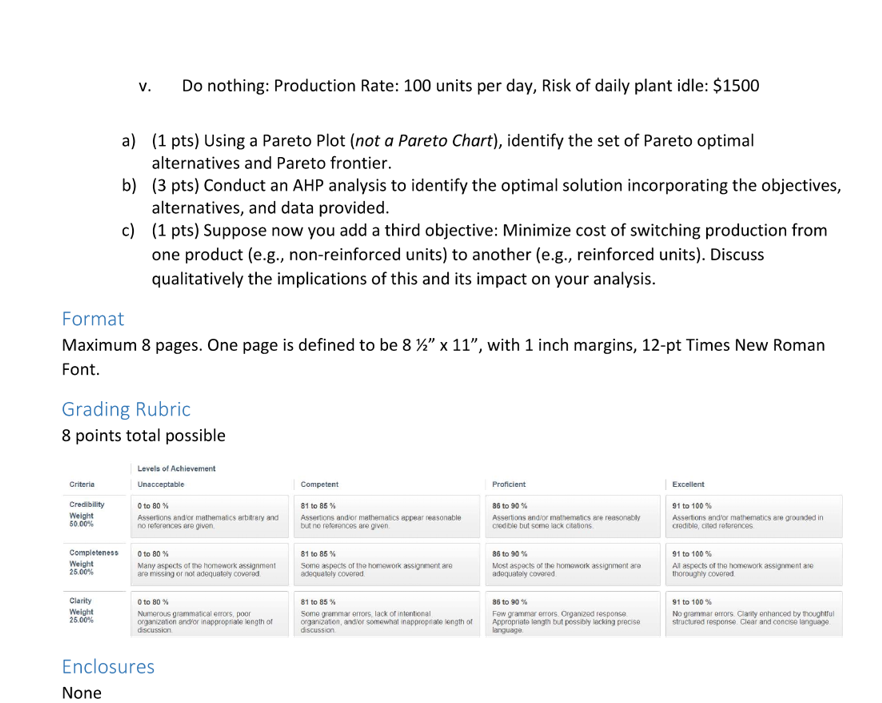
Assighment 7: Decision Trees and Analytical Hierarchy Process Objectives . Identify the solution-fijutral function. Represent the differences between concepts. Background Scenario: You are the chief architect for a company that builds modular office furniture. As such, your objective is to maximize the long-term profitability of the product line based on the architecture you are developing. Suppose your marketing department has conducted an analysis of future trends in office furniture usage and demand. The results of this analysis have provided data that will shape your strategic plan. Assumptions: 1. Neutral risk posture (utility is given directly by expected value) 2. Your company's market share will not change over time. Demand figures account for competitive influences. . Cost to produce one non-reinforced furniture set with no structural interfaces = $100 . Cost to produce one non-reinforced furniture set with structural interfaces = $110 . Cost to produce one reinforced furniture set = $125 . Cost to produce one reinforcing element set = $25 . Purchase price for one non-reinforced furniture set = $125 . Purchase price for one reinforced furniture set = $165 W 00 ~ & un & w . If your production plant produces non-reinforced furniture sets, it will produce them with either structural interfaces or not (but will not do both). 10. If your production plant produces non-reinforced furniture sets with reinforcement interface, it can produce reinforcing elements separately for only those units that need it. 11. If your production plant produces reinforced furniture sets, it does not produce non- reinforced furniture sets. 12. Profit is given directly by revenue, less cost. There are no additional taxes to account for. Assignment: 1. (3 pts) Solve the decision tree to determine the best strategic plan. A: Structurally reinforce B: Integrate structural reinforcement furniture to support heavy or provide assembly interface to Orders for reinforced furniture = 1000 Cost: 1,250,000 bolt-on components reinforcing elements Orders for non-reinforced furniture = 9000 Revenue: 1,290,000 .35 Orders for reinforced furniture = 5000 Cost: 1,250,000 Orders for non-reinforced furniture = 5000 Revenue: 1,450,000 45 Integrate Orders for reinforced furniture = 9000 Cost: 1,250,000 B .20 Orders for non-reinforced furniture = 1000 Revenue: 1,610,000 Yes Orders for reinforced furniture = 1000 Cost: 1,125,000 Orders for non-reinforced furniture = 9000 Revenue: 1,290,000 A .35 Provide Orders for reinforced furniture = 5000 Cost: 1,225,000 Interface .45 Orders for non-reinforced furniture = 5000 Revenue: 1,450,000 20 Orders for reinforced furniture = 9000 Cost: 1,325,000 Orders for non-reinforced furniture = 1000 Revenue: 1,610,000 No Orders for reinforced furniture = 1000 Cost: 900,000 .35 Orders for non-reinforced furniture = 9000 Revenue: 1,125,000 Orders for reinforced furniture = 5000 Cost: 500,000 .45 Orders for non-reinforced furniture = 5000 Revenue: 625,000 .20 Orders for reinforced furniture = 9000 Cost: 100,000 Orders for non-reinforced furniture = 1000 Revenue: 125,0002. Suppose now that you are considering the architecture of the plant production floor. Your two objectives for the long term are to: * Maximize the rate, measured in terms of units produced per day, at which your factory can respond to customer orders. * Minimize the risk, measured in terms of expected daily idle cost (hourly wages multiplied by expected number of idle hours per day), of idling parts of your factory. Your alternatives (and associated costs and benefits) are: i. Add second production line to handle orders requesting rapid response (for an expedition fee, of course). Production Rate: 200 units per day, Risk of daily plant idle: $5500 (due to new line workers) ii. Add inventory capacity to respond more quickly to custom orders. Production Rate: 125 units per day, Risk of daily plant idle: 52000 (due to extra inventory workers) ii. Add faster machinery to your current production line. Production Rate: 135 units per day, Risk of daily plant idle: $1750 iv. Provide 'repair' areas to your production floor to speed up rework of mistakes made on the main line. Production Rate: 110 units per day, Risk of daily plant idle: $1250 | v. Do nothing: Production Rate: 100 units per day, Risk of daily plant idle: $1500 a) (1 pts) Using a Pareto Plot (not a Pareto Chart), identify the set of Pareto optimal alternatives and Pareto frontier. b) (3 pts) Conduct an AHP analysis to identify the optimal solution incorporating the objectives, alternatives, and data provided. c) (1 pts) Suppose now you add a third objective: Minimize cost of switching production from one product (e.g., non-reinforced units) to another (e.g., reinforced units). Discuss qualitatively the implications of this and its impact on your analysis. Format Maximum 8 pages. One page is defined to be 8 12" x 11", with 1 inch margins, 12-pt Times New Roman Font. Grading Rubric 8 points total possible Levels of Achievement Criteria Unacceptable Competent Proficient Excellent Credibility 0 to 80 % 81 to 85 % 86 to 90 % 91 to 100 % Weigh Assertions and or mathematics arbitrary and Assertions and or mathematics appear reasonable Assertions andior mathematics are reasonably Assertions andfor mathematics are grounded in 50.00% no references are given. but no references are given. credible but some lack ofations credible, cited references Completeness 0 to 80 % 81 to 85 % 86 to $9 % 01 to 100 % Weight Many aspects of the homework assignment Some aspects of the homework assignment are Most aspects of the homework assignment are All aspects of the homework assignment ale 25.00% are misting or not adequately covered adequately covered adoquately covered thoroughly covered Clarity Q to 80 %% #1 to 85 % 86 to 90 % 91 to 100 % Weight Numerous grammatical errors, poor Some grammar errors lack of intentional Few grammar errors. Organized response No grammar errors. Clarity enhanced by thoughtful 26.00% organization andor inappropriate length of organization, andl'or somewhat inappropriate length of Appropriate length but possibly locking precise structured response. Clear and concise language decussion discussion larguage Enclosures None
Step by Step Solution
There are 3 Steps involved in it
1 Expert Approved Answer
Step: 1 Unlock
Question Has Been Solved by an Expert!
Get step-by-step solutions from verified subject matter experts
Step: 2 Unlock
Step: 3 Unlock
Students Have Also Explored These Related Law Questions!









 Study Help