Question: Assignment #1 (5%) - Let us develop an Elevator Pitch An elevator pitch is an overview of who you are, what you do and how
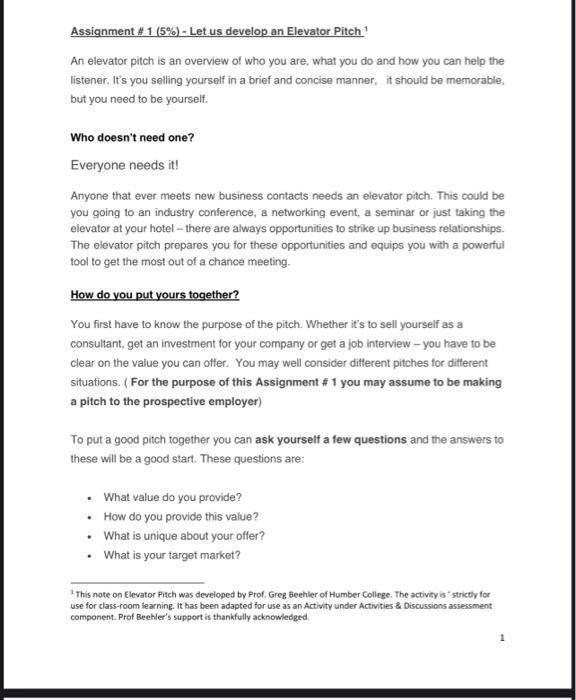
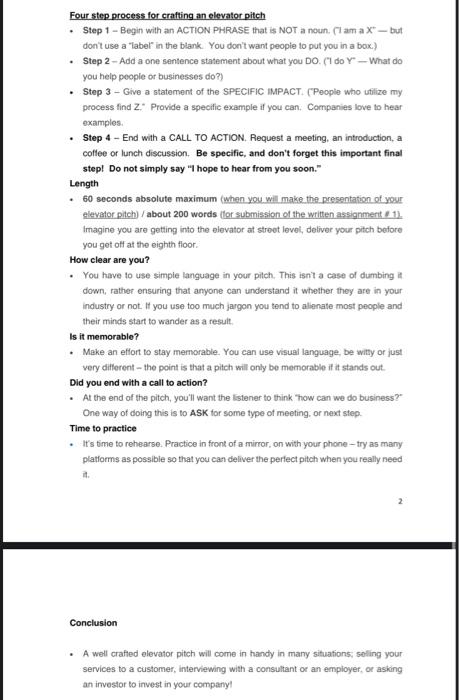
Assignment #1 (5%) - Let us develop an Elevator Pitch An elevator pitch is an overview of who you are, what you do and how you can help the listener. It's you selling yourself in a brief and concise manner, it should be memorable, but you need to be yourself. Who doesn't need one? Everyone needs it! Anyone that ever meets new business contacts needs an elevator pitch. This could be you going to an industry conference, a networking event, a seminar or just taking the elevator at your hotel - there are always opportunities to strike up business relationships. The elevator pitch prepares you for these opportunities and equips you with a powerful tool to get the most out of a chance meeting. How do you put yours together? You first have to know the purpose of the pitch. Whether it's to sell yourself as a consultant, get an investment for your company or get a job interview - you have to be clear on the value you can offer. You may well consider different pitches for different situations. (For the purpose of this Assignment #1 you may assume to be making a pitch to the prospective employer) To put a good pitch together you can ask yourself a few questions and the answers to these will be a good start. These questions are: What value do you provide? How do you provide this value? What is unique about your offer? What is your target market? This note on Elevator Pitch was developed by Prof, Greg Beehler of Humber College. The activity is strictly for use for class-room learning. It has been adapted for use as an Activity under Activities & Discussions assessment component. Prof Beehler's support is thankfully acknowledged 1 Four step process for crafting an elevator pitch Step 1 - Begin with an ACTION PHRASE that is NOT a noun. (I am ax - but don't use a "labelin the blank You don't want people to put you in a box.) Step 2 - Add a one sentence statement about what you DO. (do r-What do you help people or businesses do?) Step 3 - Give a statement of the SPECIFIC IMPACT (People who utilize my process find Z. Provide a specific example if you can. Companies love to hear examples Step 4 - End with a CALL TO ACTION. Request a meeting, an introduction, a coffee or lunch discussion. Be specific, and don't forget this important final step! Do not simply say "I hope to hear from you soon." Length 60 seconds absolute maximum (when you will make the presentation of your elevator pitch/about 200 words for submission of the written assignment #1). Imagine you are getting into the elevator at stroot level, deliver your pitch before you get off at the eighth floor. How clear are you? You have to use simple language in your pitch. This isn't a case of dumbing down, rather ensuring that anyone can understand it whether they are in your industry or not. If you use too much jargon you tend to alienate most people and their minds start to wander as a result, Is it memorable? Make an effort to stay memorable. You can use visual language be witty or just very different - the point is that a pitch will only be memorable it it stands out. Did you end with a call to action? . At the end of the pitch, you'll want the listener to think how can we do business? One way of doing this is to ASK for some type of meeting, or next step. Time to practice . It's time to rehearse. Practice in front of a mirror, on with your phone -- try as many platforms as possible so that you can deliver the perfect pitch when you really need 2 Conclusion A well crafted elevator pitch will come in handy in many situations, selling your services to a customer, interviewing with a consultant or an employer, or asking an investor to invest in your company









 Study Help