







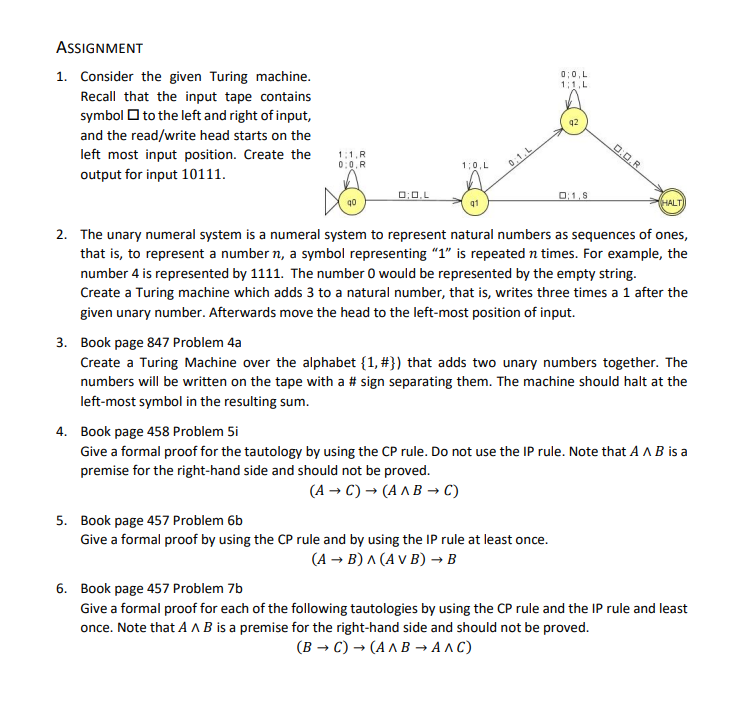
Question: ASSIGNMENT 1 . Consider the given Turing machine. Recall that the input tape contains symbol ( square ) to the left and
ASSIGNMENT
Consider the given Turing machine. Recall that the input tape contains symbol square to the left and right of input, and the readwrite head starts on the left most input position. Create the output for input
The unary numeral system is a numeral system to represent natural numbers as sequences of ones, that is to represent a number n a symbol representing is repeated n times. For example, the number is represented by The number would be represented by the empty string.
Create a Turing machine which adds to a natural number, that is writes three times a after the given unary number. Afterwards move the head to the leftmost position of input.
Book page Problem a
Create a Turing Machine over the alphabet # that adds two unary numbers together. The numbers will be written on the tape with a # sign separating them. The machine should halt at the leftmost symbol in the resulting sum.
Book page Problem i
Give a formal proof for the tautology by using the CP rule. Do not use the IP rule. Note that A wedge B is a premise for the righthand side and should not be proved.
A rightarrow CrightarrowA wedge B rightarrow C
Book page Problem b
Give a formal proof by using the CP rule and by using the IP rule at least once.
A rightarrow BwedgeA vee Brightarrow B
Book page Problem b
Give a formal proof for each of the following tautologies by using the CP rule and the IP rule and least once. Note that A wedge B is a premise for the righthand side and should not be proved.
B rightarrow CrightarrowA wedge B rightarrow A wedge C
Step by Step Solution
There are 3 Steps involved in it
1 Expert Approved Answer
Step: 1 Unlock

Question Has Been Solved by an Expert!
Get step-by-step solutions from verified subject matter experts
Step: 2 Unlock
Step: 3 Unlock
 Study Help