





Question: Assignment 1: Introduction To Discrete Event Simulation Questions Please read notes at end of assignment. Question 1: Verification and validation are important topics in Discrete
Assignment 1: Introduction To Discrete Event
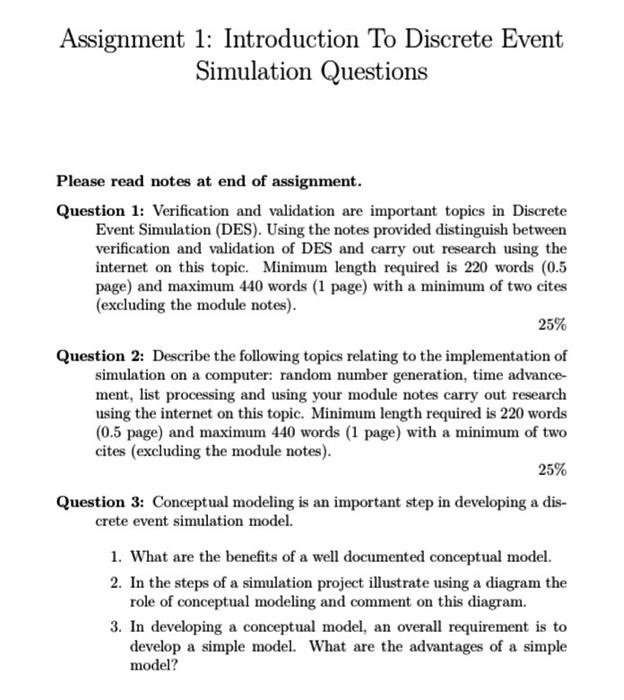
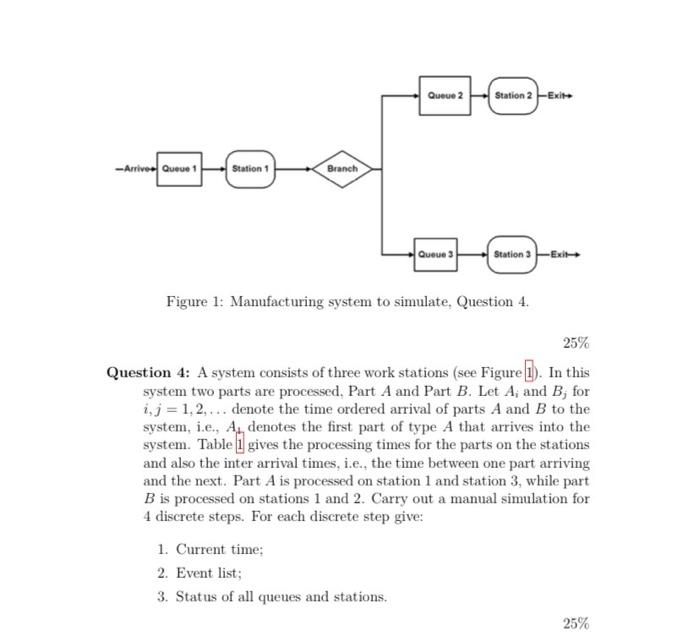
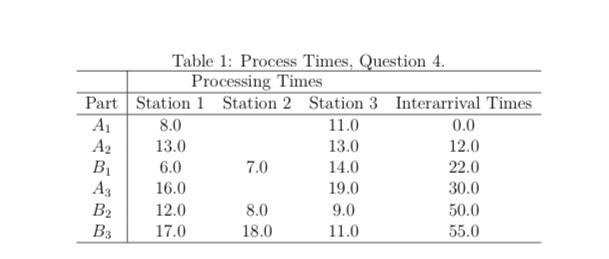
Assignment 1: Introduction To Discrete Event Simulation Questions Please read notes at end of assignment. Question 1: Verification and validation are important topics in Discrete Event Simulation (DES). Using the notes provided distinguish between verification and validation of DES and carry out research using the internet on this topic. Minimum length required is 220 words (0.5 page) and maximum 440 words ( 1 page) with a minimum of two cites (excluding the module notes). 25% Question 2: Describe the following topics relating to the implementation of simulation on a computer: random number generation, time advancement, list processing and using your module notes carry out research using the internet on this topic. Minimum length required is 220 words (0.5 page) and maximum 440 words ( 1 page) with a minimum of two cites (excluding the module notes). 25% Question 3: Conceptual modeling is an important step in developing a discrete event simulation model. 1. What are the benefits of a well documented conceptual model. 2. In the steps of a simulation project illustrate using a diagram the role of conceptual modeling and comment on this diagram. 3. In developing a conceptual model, an overall requirement is to develop a simple model. What are the advantages of a simple model? 25% Question 4: A system consists of three work stations (see Figure 1). In this system two parts are processed, Part A and Part B. Let Ai and Bj for i,j=1,2, denote the time ordered arrival of parts A and B to the system, i.e., A1 denotes the first part of type A that arrives into the system. Table 1 gives the processing times for the parts on the stations and also the inter arrival times, i.e., the time between one part arriving and the next. Part A is processed on station 1 and station 3 , while part B is processed on stations 1 and 2 . Carry out a manual simulation for 4 discrete steps. For each discrete step give: 1. Current time; 2. Event list; 3. Status of all queues and stations. Table 1: Process Times, Question 4. \begin{tabular}{c|cccc} \hline & \multicolumn{3}{|c}{ Processing Times } \\ \hline Part & Station 1 & Station 2 & Station 3 & Interarrival Times \\ \hlineA1 & 8.0 & & 11.0 & 0.0 \\ A2 & 13.0 & & 13.0 & 12.0 \\ B1 & 6.0 & 7.0 & 14.0 & 22.0 \\ A3 & 16.0 & & 19.0 & 30.0 \\ B2 & 12.0 & 8.0 & 9.0 & 50.0 \\ B3 & 17.0 & 18.0 & 11.0 & 55.0 \\ \hline \end{tabular}
Step by Step Solution

There are 3 Steps involved in it

1 Expert Approved Answer
Step: 1 Unlock blur-text-image

Question Has Been Solved by an Expert!

Get step-by-step solutions from verified subject matter experts

Step: 2 Unlock
Step: 3 Unlock

Students Have Also Explored These Related General Management Questions!