







Question: Assignment # 1: Predictive Approach and Agile Approach 1. Read JWD Consulting project management intranet site project Case Study. 2. Study the Case from the
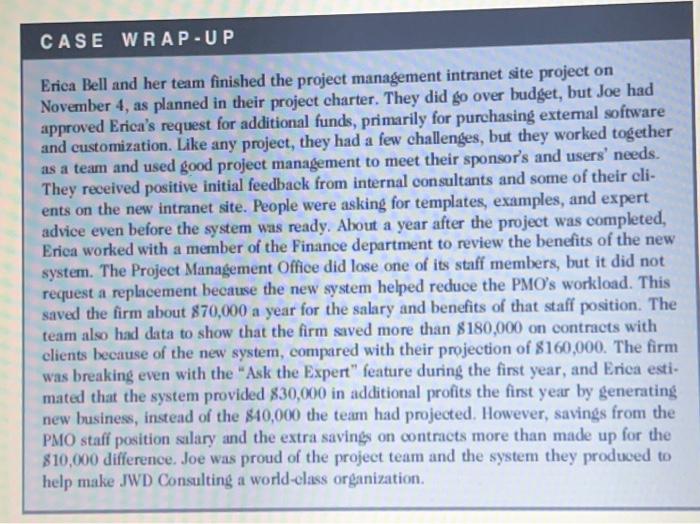
Erica Bell is in charge of the Project Management Office (PMO) for her consulting firm, JWD Consulting, which has grown to include more than 200 full-time consultants and even more part-time consultants. (JWD stands for Job Well Done.) JWD Consulting provides a variety of consulting services to assist organizations in selecting and managing IT projects. The firm focuses on finding and managing high-payoff projects and developing strong metrics to measure project performance and benefits to the organization after the project is implemented. The firm's emphasis on metries and working collaboratively with its customers gives it an edge over many competitors. Joe Fleming, the CEO, wants his company to continue to grow and become a world-class consulting organization. Because the core of the business is helping other organizations with project management, he felt it was crucial for JWD Consulting to have an exemplary process for managing its own projects. He asked Erica to work with her team and other consultants in the firm to develop several intranet site applications that would allow them to share their project management knowledge. He also thought that the firm should make some of the information available to the firm's clients. For example, the firm could provide project management templates, tools, articles, links to other sites, and an "Ask the Expert" feature to help build relationships with current and future clients. Because. JWD Consulting emphasizes the importance of high-payoff projects, Joe also wanted to see a business ease for this project before proceeding. \# 2. Case Analysis: An organization may initiate IT projects for several reasons, but the most important reason is to support business objectives. Providing a good return on investment at a reasonable level of risk is also important, especially in tough economic times. As mentioned in the chapter's opening case, JWD Consulting wants to follow an exemplary process for managing its projects because its core business is helping other organizations manage projects. Developing an intranet to share its project management knowledge could help. JWD Consulting reduce internal costs by working more effectively, and by allowing existing and potential customers to access some of the firm's information. JWD Consulting could also inerease revenues by bringing in more business. Therefore, the firm will use these metries-reducing internal costs and increasing revenues - to measure its performanee on this project. \# 3. Study the Agile Approach to each of the process groups in managing JWD Consulting intranet site project. An Agile Approach is often used for projects in which the business team cannot clearly express the scope early on the product life cycle, but the team does want to provide a potentially shippable product earlier rather than later. An Agile product team typically uses several iterations or deliveries of software instead of waiting until the end of the project to provide one product. Implementing Agile (Scrum), a team uses specific roles, artifacts, and ceremonies: - Product owner: The person responsible for the business value of the project and for deciding what work to do and in what order, as documented in the product backlog. In this case, Joe Fleming is the product owner. He is the CEO of JWD Consulting and the person who suggested the project. - ScrumMaster: The person who ensures that the team is productive, facilitates the daily Scrum, enables close cooperation across all roles and functions, and removes barriers that prevent the team from being effective. SorumMasters have authority over the process but not the people on the team. They must be comfortable surrendering control to the product owner and team. Some experts suggest that traditional project managers do not make great SorumMasters. In this ease, Erica Bell will take on the challenge and serve as the SerumMaster. - Serum team or development team: A cross-functional team of five to nine people who organize themselves and the work to produce the desired results for each sprint. A sprint normally lasts two to four weeks, during which specifie work must be completed and made ready for review. Large projects might require teams of teams. In this case, Michael Chen, Jessic Faue, Kevin Dodge, Cindy Dawson, Kim Phuong, and Page Miller are - Serum team or development team: A cross-functional team of five to nine people who organize themselves and the work to produce the desired results for each sprint. A sprint normally lasts two to four weeks, during which specifie work must be completed and made ready for review. Large projects might require teams of teams. In this case, Michael Chen, Jessie Faue, Kevin Dodge, Cindy Dawson, Kim Phuong, and Page Miller are development team members. Their positions are listed in the project charter shown earlier in Table 3-6. Kim and Page are client representatives who do not work for JWD Consulting, but they are key team members, especially for developing the parts of the intranet that external clients would use. Project Pre-Initiation and Initiation The main differences between pre-initiation in this case and the first case would be determining roles and deciding what functionality will be delivered as part of each release, how many sprints will be required to complete a release, and how many releases of software to Project Pre-Initiation and Initiation The main differences between pre-initiation in this case and the first case would be determining roles and deciding what functionality will be delivered as part of each release, how many sprints will be required to complete a release, and how many releases of software to deliver, similar to dividing the project into several smaller projects. A project charter, stakeholder register, stakeholder management strategy, and kick-off meeting would still be created as part of initiation, just as they were in the first version of this case. Using the Serum roles, however, Joe Fleming would be the product owner, Erica Bell the SerumMaster, and the other people listed in the project charter would be team members. Joe met with Erica to discuss what functionality will be delivered in each release, how many sprints will compose each release, how many software releases are required, and the approach required to complete the project. They decided that they still needed to survey potential users to colleet requirements for the new software and determine a way to measure the value of the intranet site after it was implemented. They estimated that this work would take about two months. They thought that only a few tasks associated with the survey and benefits measurement could be included in the software being developed. For example, two new software features might collect user enhancement requests and collect project benefits information. Joe and Erica would work together to create a survey that specifically asks potential users of the new intranet site which features would provide the most value. For example, instead of listing general ideas, they would list specific features Planning Instead of ereating a team contract, WBS, Gantt chart, and list of prioritized risks for the whole project, the team would follow the Scrum method. A preliminary scope statement for the entire project can still be a useful tool for planning; the team knows that more details will be added and changes will be made. Because Serum implies that team members work as a self-directed group, coached by the SerumMaster, a team contract should not be necessary. High-level descriptions of the work to be completed would be identified in the product and sprint backlogs. A Gantt chart for the entire project could still be created, as shown in Figure 3-6. Notice that the process groups do not follow a simple linear pattern. Several process groups are repeated for cach sprint, resulting in several iterations of a uscful software product, as shown by the milestones. Reeall that in the first version of this case, there was only one release or delivery of software near the end of the project, on Ootober 17. In this case, two additional deliveries of sof tware are scheduled on August 3 and September 11. Some teams create a release road map, as deseribed later in this section, for each software delivery. Because Erica and some of the project team would be inexperienced in using Serum, they would have to work out several challenges. For example, communications are very different because the project team meets every morning, physioally or virtually. There would also be communications issues with users of the new intranet site, who might be confused by getting three iterations of the product instead of just one. See Chapters 10 and 13, Project Communications Management and Project Stakeholder Management, for additional information. Monitoring and Controlling A burndown chart is an important artifact used to graphically display progress on each sprint (sce Figure 3-7). If the first sprint for the JWD Consulting intranet projeet is scheduled to last four weeks and produce five items or user stories listed in the sprint backlog. the bumdown ehart illustrates progress for that time period. Each user story should bo broken down into speeific tasks, and the team should estimate how long it will take to complete each task for each user story. A task should fit within a day, and the work a team member elaims in the daily Serum or stand-up meeting should fit within a day. Each day, the team should again estimate the number of hours remaining in each task. Some tasks might be added and some might be dropped as the scope becomes clearer. It does not matter how many hours are spent; what matters is how many hours of work remain to complete the user stories for that sprint. completed during the sprint. In this case, Joe would review the five features created during the first sprint. After the sprint demonstration review, he would update the product backlog based on the latest information and business needs, and the next sprint cycle would begin. Closing - What went well during the last sprint that we should continue doing? - What could we do differently to improve the product or process? The sprint retrospective meeting is usually led by the ScrumMaster, who documents a list of action items for implementation. Those items may be added to the product backlog if the product owner agrees with them. For example, after the first sprint for the JWD project management intranet site project, the team might suggest that the site be mobile enabled. This new requirement could be added to the product backlog and selected as an item for the next sprint. Recall that an agile approach weleomes new requirements as long as they focus on business value. Erica Bell and her team finished the project management intranet site project on November 4 , as planned in their project charter. They did go over budget, but Joe had approved Erica's request for additional funds, primarily for purchasing extemal software and customization. Like any project, they had a few challenges, but they worked together as a team and used good project management to meet their sponsor's and users' needs. They received positive initial feedback from internal consultants and some of their clients on the new intranet site. People were asking for templates, examples, and expert advice even before the system was ready. About a year after the project was completed, Erica worked with a member of the Finance department to review the benefits of the new system. The Project Management Office did lose one of its staff members, but it did not request a replacement because the new system helped reduce the PMO's workload. This saved the firm about $70,000 a year for the salary and benefits of that staff position. The team also had data to show that the firm saved more than 8180,000 on contracts with clients because of the new system, compared with their projection of $160,000. The firm was breaking even with the "Ask the Expert" feature during the first year, and Erica estimated that the system provided $30,000 in additional profits the first year by generating new business, instead of the $40,000 the team had projected. However, savings from the PMO staff position salary and the extra savings on contracts more than made up for the $10,000 difference. Joe was proud of the project team and the system they produced to help make JWD Consulting a world-elass organization
Step by Step Solution
There are 3 Steps involved in it

Get step-by-step solutions from verified subject matter experts
 Study Help