







Question: ASSIGNMENT #1 The purpose of this assignment is to solidify your understanding on the applications of the time value of money. The scores of this
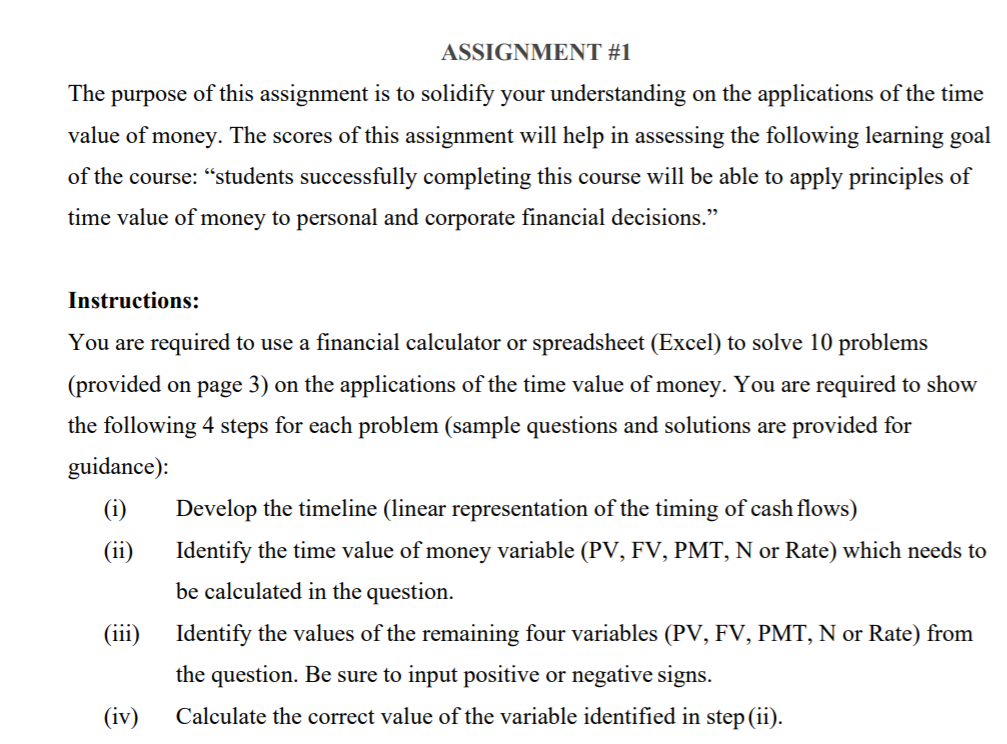
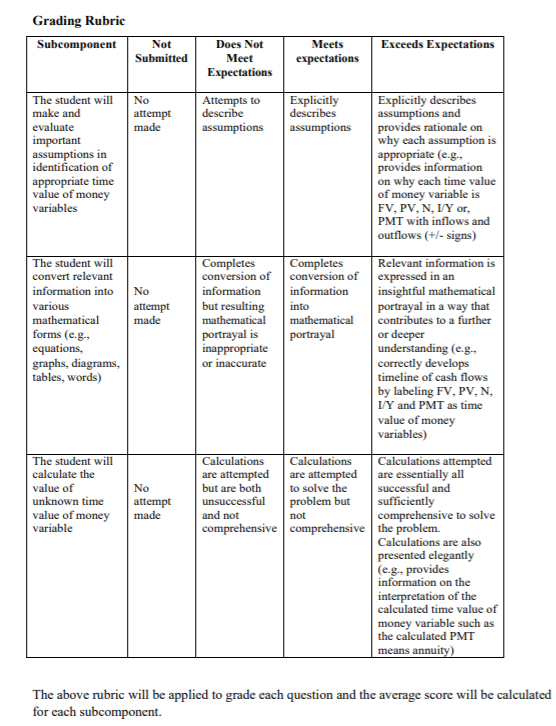
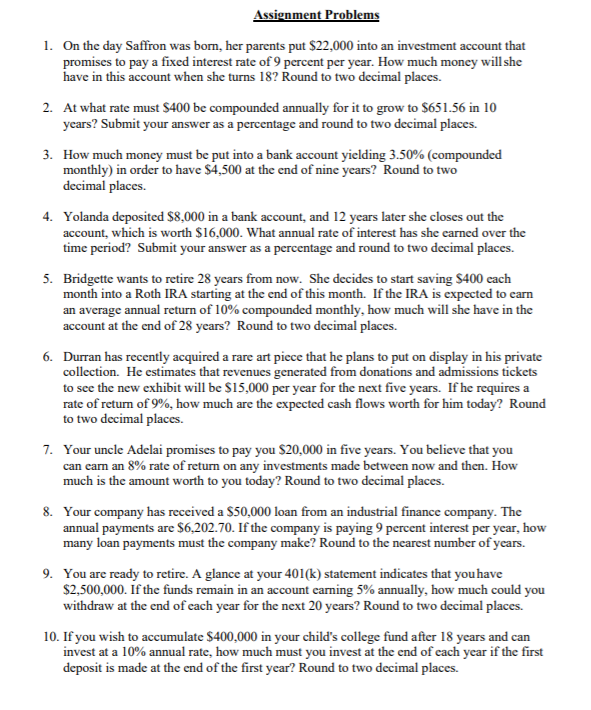
ASSIGNMENT #1 The purpose of this assignment is to solidify your understanding on the applications of the time value of money. The scores of this assignment will help in assessing the following learning goal of the course: students successfully completing this course will be able to apply principles of time value of money to personal and corporate financial decisions. Instructions: You are required to use a financial calculator or spreadsheet (Excel) to solve 10 problems (provided on page 3) on the applications of the time value of money. You are required to show the following 4 steps for each problem (sample questions and solutions are provided for guidance) (i) Develop the timeline (linear representation of the timing of cash flows) (ii) Identify the time value of money variable (PV, FV, PMT, N or Rate) which needs to be calculated in the question. (iii) Identify the values of the remaining four variables (PV, FV, PMT, N or Rate) from the question. Be sure to input positive or negative signs. Calculate the correct value of the variable identified in step (ii). (iv) Grading Rubric Subcomponent Not Submitted Does Not Meet Expectations Meets expectations Exceeds Expectations No attempt made The student will make and evaluate important assumptions in identification of appropriate time value of money variables The student will convert relevant information into various mathematical forms (e.g. equations, graphs, diagrams, tables, words) No attempt made Attempts to Explicitly Explicitly describes describe describes assumptions and assumptions assumptions provides rationale on why each assumption is appropriate (e.g. provides information on why each time value of money variable is FV, PV, N, I/Y or, PMT with inflows and outflows (+/- signs) Completes Completes Relevant information is conversion of conversion of expressed in an information information insightful mathematical but resulting into portrayal in a way that mathematical mathematical contributes to a further portrayal is portrayal or deeper inappropriate understanding (e.g., or inaccurate correctly develops timeline of cash flows by labeling FV, PV, N, I/Y and PMT as time value of money variables) Calculations Calculations Calculations attempted are attempted are attempted are essentially all but are both to solve the successful and unsuccessful problem but sufficiently and not not comprehensive to solve comprehensive comprehensive the problem. Calculations are also presented elegantly (e.g., provides information on the interpretation of the calculated time value of money variable such as the calculated PMT means annuity) The student will calculate the value of unknown time value of money variable No attempt made The above rubric will be applied to grade each question and the average score will be calculated for each subcomponent. Assignment Problems 1. On the day Saffron was born, her parents put $22,000 into an investment account that promises to pay a fixed interest rate of 9 percent per year. How much money will she have in this account when she turns 18? Round to two decimal places. 2. At what rate must $400 be compounded annually for it to grow to $651.56 in 10 years? Submit your answer as a percentage and round to two decimal places. 3. How much money must be put into a bank account yielding 3.50% (compounded monthly) in order to have $4,500 at the end of nine years? Round to two decimal places. 4. Yolanda deposited $8,000 in a bank account, and 12 years later she closes out the account, which is worth $16,000. What annual rate of interest has she earned over the time period? Submit your answer as a percentage and round to two decimal places. 5. Bridgette wants to retire 28 years from now. She decides to start saving S400 each month into a Roth IRA starting at the end of this month. If the IRA is expected to earn an average annual return of 10% compounded monthly, how much will she have in the account at the end of 28 years? Round to two decimal places. 6. Durran has recently acquired a rare art piece that he plans to put on display in his private collection. He estimates that revenues generated from donations and admissions tickets to see the new exhibit will be $15,000 per year for the next five years. If he requires a rate of return of 9%, how much are the expected cash flows worth for him today? Round to two decimal places. 7. Your uncle Adelai promises to pay you $20,000 in five years. You believe that you can eam an 8% rate of return on any investments made between now and then. How much is the amount worth to you today? Round to two decimal places. 8. Your company has received a $50,000 loan from an industrial finance company. The annual payments are $6,202.70. If the company is paying 9 percent interest per year, how many loan payments must the company make? Round to the nearest number of years. 9. You are ready to retire. A glance at your 401(k) statement indicates that you have $2,500,000. If the funds remain in an account earning 5% annually, how much could you withdraw at the end of each year for the next 20 years? Round to two decimal places. 10. If you wish to accumulate $400,000 in your child's college fund after 18 years and can invest at a 10% annual rate, how much must you invest at the end of each year if the first deposit is made at the end of the first year? Round to two decimal places. ASSIGNMENT #1 The purpose of this assignment is to solidify your understanding on the applications of the time value of money. The scores of this assignment will help in assessing the following learning goal of the course: students successfully completing this course will be able to apply principles of time value of money to personal and corporate financial decisions. Instructions: You are required to use a financial calculator or spreadsheet (Excel) to solve 10 problems (provided on page 3) on the applications of the time value of money. You are required to show the following 4 steps for each problem (sample questions and solutions are provided for guidance) (i) Develop the timeline (linear representation of the timing of cash flows) (ii) Identify the time value of money variable (PV, FV, PMT, N or Rate) which needs to be calculated in the question. (iii) Identify the values of the remaining four variables (PV, FV, PMT, N or Rate) from the question. Be sure to input positive or negative signs. Calculate the correct value of the variable identified in step (ii). (iv) Grading Rubric Subcomponent Not Submitted Does Not Meet Expectations Meets expectations Exceeds Expectations No attempt made The student will make and evaluate important assumptions in identification of appropriate time value of money variables The student will convert relevant information into various mathematical forms (e.g. equations, graphs, diagrams, tables, words) No attempt made Attempts to Explicitly Explicitly describes describe describes assumptions and assumptions assumptions provides rationale on why each assumption is appropriate (e.g. provides information on why each time value of money variable is FV, PV, N, I/Y or, PMT with inflows and outflows (+/- signs) Completes Completes Relevant information is conversion of conversion of expressed in an information information insightful mathematical but resulting into portrayal in a way that mathematical mathematical contributes to a further portrayal is portrayal or deeper inappropriate understanding (e.g., or inaccurate correctly develops timeline of cash flows by labeling FV, PV, N, I/Y and PMT as time value of money variables) Calculations Calculations Calculations attempted are attempted are attempted are essentially all but are both to solve the successful and unsuccessful problem but sufficiently and not not comprehensive to solve comprehensive comprehensive the problem. Calculations are also presented elegantly (e.g., provides information on the interpretation of the calculated time value of money variable such as the calculated PMT means annuity) The student will calculate the value of unknown time value of money variable No attempt made The above rubric will be applied to grade each question and the average score will be calculated for each subcomponent. Assignment Problems 1. On the day Saffron was born, her parents put $22,000 into an investment account that promises to pay a fixed interest rate of 9 percent per year. How much money will she have in this account when she turns 18? Round to two decimal places. 2. At what rate must $400 be compounded annually for it to grow to $651.56 in 10 years? Submit your answer as a percentage and round to two decimal places. 3. How much money must be put into a bank account yielding 3.50% (compounded monthly) in order to have $4,500 at the end of nine years? Round to two decimal places. 4. Yolanda deposited $8,000 in a bank account, and 12 years later she closes out the account, which is worth $16,000. What annual rate of interest has she earned over the time period? Submit your answer as a percentage and round to two decimal places. 5. Bridgette wants to retire 28 years from now. She decides to start saving S400 each month into a Roth IRA starting at the end of this month. If the IRA is expected to earn an average annual return of 10% compounded monthly, how much will she have in the account at the end of 28 years? Round to two decimal places. 6. Durran has recently acquired a rare art piece that he plans to put on display in his private collection. He estimates that revenues generated from donations and admissions tickets to see the new exhibit will be $15,000 per year for the next five years. If he requires a rate of return of 9%, how much are the expected cash flows worth for him today? Round to two decimal places. 7. Your uncle Adelai promises to pay you $20,000 in five years. You believe that you can eam an 8% rate of return on any investments made between now and then. How much is the amount worth to you today? Round to two decimal places. 8. Your company has received a $50,000 loan from an industrial finance company. The annual payments are $6,202.70. If the company is paying 9 percent interest per year, how many loan payments must the company make? Round to the nearest number of years. 9. You are ready to retire. A glance at your 401(k) statement indicates that you have $2,500,000. If the funds remain in an account earning 5% annually, how much could you withdraw at the end of each year for the next 20 years? Round to two decimal places. 10. If you wish to accumulate $400,000 in your child's college fund after 18 years and can invest at a 10% annual rate, how much must you invest at the end of each year if the first deposit is made at the end of the first year? Round to two decimal places
Step by Step Solution
There are 3 Steps involved in it

Get step-by-step solutions from verified subject matter experts
 Study Help